
Tilloclytus geminatus
(Haldeman, 1847)
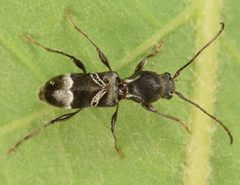
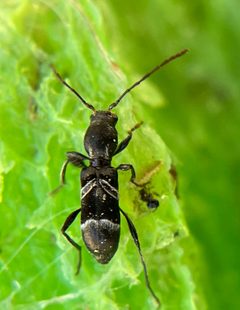
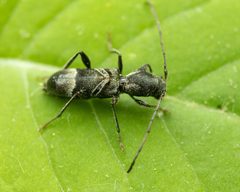
Tilloclytus geminatus is a small longhorn beetle (Cerambycidae) described by Haldeman in 1847. exhibit effective Batesian mimicry, with oblique markings creating the illusion of a constricted "waist" and transverse markings resembling the sheen of a shiny . The has been reared from various deciduous hardwoods and has been recorded sporadically across the eastern United States. It is considered infrequently encountered, likely due in part to being overlooked because of its ant-like appearance.
Pronunciation
How to pronounce Tilloclytus geminatus: /tɪlˈɒklɪtəs ˌdʒɛmɪˈnɑːtəs/
These audio files are automatically generated. While they are not always 100% accurate, they are a good starting point.
Identification
Distinguished from other -mimicking cerambycids in its size range by its more convex body profile compared to the flatter Molorchus and Euderces. Tilloclytus geminatus appears 'too big and convex in profile to be Molorchus' when observed carefully. Unlike Molorchus bimaculatus and Euderces , which are frequently found on flowers, T. geminatus has rarely been associated with flowers as .
Images
Appearance
Small , less than 10 mm in length. Body convex in profile. Color pattern includes oblique markings that create the illusion of a constricted waist, and transverse markings that resemble the sheen of a shiny . Overall appearance strongly resembles ants of similar size when viewed in profile.
Habitat
Associated with deciduous hardwood forests. have been found on flowering dogwood (Cornus florida) blossoms, though this appears to be an uncommon observation. Larval is within hardwood .
Distribution
Northeastern North America, with sporadic records across the eastern United States. Documented from Missouri (Howell County, southern Missouri), with additional records from across eastern U.S. Canadian records present (Ontario).
Seasonality
active in early spring; observed in early May in Missouri. Specific period not well documented.
Host Associations
- Cornus florida - visitationsingle observation on flowering dogwood blossoms in early May; possibly indicative of attraction to flowers
- Crataegus sp. - visitationreported on hawthorn flowers by Rice et al. 1985
- Pinus virginiana - larval reported by Perry 1975, but likely represents 'overflow' not typical of normal host preferences
- Various deciduous hardwoods - larval reared from multiple unrecorded hardwood collected across southern Missouri
Behavior
Ecological Role
Larval wood-borer in deciduous hardwoods. pollination potential via flower visitation, though this appears to be uncommon compared to other -mimicking cerambycids.
Human Relevance
No significant documented economic or agricultural impact. Of interest to entomologists and coleopterists due to its effective mimicry and infrequent encounter rate.
Similar Taxa
- Molorchus bimaculatusBoth are small -mimicking cerambycids found on flowers in early spring; Molorchus is flatter in profile and more commonly encountered on flowers
- Euderces spp.Similar -mimicking appearance and flower-visiting habits; Euderces are more frequently associated with flowers than T. geminatus
- Cyrtophorus verrucosusRelated -mimicking cerambycid in same ; has been collected on flowers of roughleaf dogwood and flowering dogwood
More Details
Taxonomic history
Described by Haldeman in 1847. First Missouri record published after 1994 checklist of Missouri cerambycids.
Collection challenges
The ' effective mimicry contributes to its infrequent encounter rate; observers may dismiss specimens as true ants without close examination.