
Tilloclytus
Bates, 1885
Species Guides
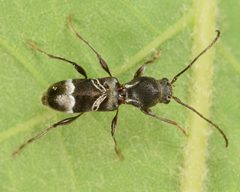
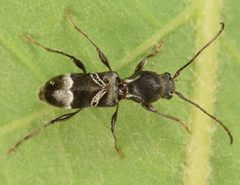
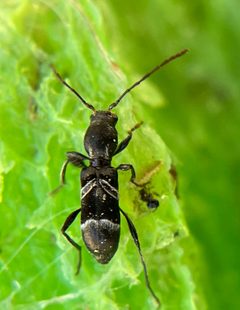
1Tilloclytus is a of longhorned beetles (Cerambycidae) established by Bates in 1885, currently comprising 14 recognized distributed across North America, the Caribbean, and northern South America. The genus is notable for containing -mimicking species, most notably Tilloclytus geminatus, which exhibits of small ants through body shape, coloration, and . are typically small (<10 mm), with some species occasionally found on flowers though they appear less frequently associated with floral visitation than related ant-mimicking genera such as Molorchus and Euderces.
Pronunciation
How to pronounce Tilloclytus: /tɪˈlɒklaɪtəs/
These audio files are automatically generated. While they are not always 100% accurate, they are a good starting point.
Identification
in this are distinguished from other -mimicking cerambycids by their convex body profile and specific elytral markings. Tilloclytus geminatus, the best-known species, possesses oblique markings that create the illusion of a constricted "waist" and transverse markings resembling the shiny of ants. Unlike the related genera Molorchus and Euderces, Tilloclytus species have a more convex body profile when viewed laterally. The genus can be separated from Cyrtophorus by the structure of the pronotum and elytral pattern, and from Cyrtinus by larger body size and different antennal proportions.
Images
Habitat
Deciduous hardwood forests, with larvae developing in living or dead hardwood trees. Tilloclytus geminatus has been reared from various deciduous hardwoods including oak and dogwood; a single record from Pinus virginiana likely represents an atypical "overflow" rather than normal preference.
Distribution
North America, Caribbean, and northern South America. Tilloclytus geminatus occurs sporadically across the eastern United States. Other are distributed in the Caribbean (Cuba, Hispaniola) and Central America.
Seasonality
active in spring, with Tilloclytus geminatus recorded from early May in Missouri.
Host Associations
- Cornus florida - visitationsingle observation of on flowering dogwood blossoms; weak evidence for true floral attraction
- Crataegus sp. - visitationreported by Rice et al. (1985)
- deciduous hardwoods - larval larvae develop in living or dead hardwood trees; specific include oak and other deciduous
- Pinus virginiana - larval atypical record, likely represents overflow rather than normal preference
Behavior
exhibit effective mimicry that may cause them to be overlooked by collectors. Tilloclytus geminatus has been observed running rapidly on vegetation. Unlike related ant-mimicking Molorchus and Euderces, this has not been frequently associated with flowers as adults, with only two documented flower records.
Similar Taxa
- Molorchussimilar -mimicking appearance and small size, but Molorchus are more commonly found on flowers and have a less convex body profile
- Eudercessimilar -mimicking appearance and , but Euderces are more frequently associated with flowers and have different elytral markings
- Cyrtophorus-mimicking cerambycid with similar size range, but differs in pronotal structure and has been documented on Cornus with greater regularity
- Cyrtinus-mimicking cerambycid, but notably smaller with different antennal proportions