
Cyrtinus pygmaeus
(Haldeman, 1847)
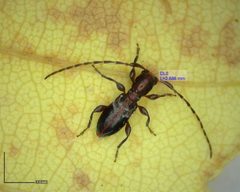
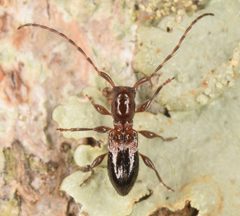
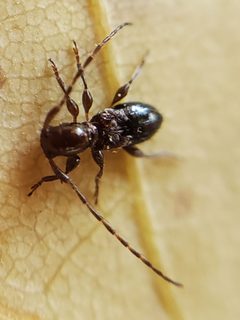
Cyrtinus pygmaeus is an exceptionally small of longhorned beetle in the Lamiinae. At only 2–3 millimeters in length, it is the smallest member of the Cerambycidae in North America. The species exhibits remarkable mimicry, with bearing two prominent humps near their bases and bands of white creating the illusion of a narrow-waisted ant. It has been reared from dead branches of various hardwood trees including river birch, chinquapin oak, willow oak, and black oak. Despite being described in 1847 and considered widespread across eastern North America, it remains infrequently encountered in the field due to its diminutive size and effective mimicry.
Pronunciation
How to pronounce Cyrtinus pygmaeus: //sɪrˈtaɪnəs pɪɡˈmiːəs//
These audio files are automatically generated. While they are not always 100% accurate, they are a good starting point.
Identification
The combination of extremely small size (2–3 mm), -like appearance with two prominent elytral humps, and bands of white creating a " waist" illusion distinguishes this from all other North American cerambycids. It is most readily confused with actual ants, particularly Lasius americanus, with which it frequently associates. Unlike other ant-mimicking cerambycids in related tribes (such as Euderces or Tilloclytus), C. pygmaeus belongs to the Lamiinae rather than Cerambycinae, though this distinction requires close examination. The slow, clumsy movement—slower even than the ants it mimics—contrasts with the rapid, frenetic running typical of most other ant-mimicking longhorned beetles.
Images
Appearance
measure only 2–3 millimeters in length, making this the smallest in the Cerambycidae. The body is compact with bearing two prominent humps near their bases, contributing to the -like silhouette. Bands of white on the bases of the elytra create the visual effect of a constricted " waist" characteristic of ants. The overall coloration and body form effectively mimic small ants such as Lasius americanus. The are relatively short for a cerambycid. The 's small size and ant-like appearance make it exceptionally difficult to detect visually in the field.
Habitat
Associated with dead twigs and branches of hardwood trees. are found on dead wood among colonies of small ants. The has been reared from dead branches of river birch, chinquapin oak, willow oak, and black oak in forested .
Distribution
Recorded from the United States, with distribution across eastern North America. Specific records include Missouri (Stoddard County), with the considered widespread across the eastern United States based on rearing records from multiple states.
Seasonality
has been observed from rearing cans during the emergence period, suggesting activity during warmer months. Specific seasonal patterns are poorly documented due to the ' cryptic nature and infrequent field encounters.
Host Associations
- Betula nigra - larval river birch
- Quercus muhlenbergii - larval chinquapin oak
- Quercus phellos - larval willow oak
- Quercus velutina - larval black oak
- Quercus marilandica - associated blackjack oak; forest where found
- Quercus falcata - associated southern red oak; forest where found
Life Cycle
Larvae develop within dead branches of hardwood trees. have been reared from collected dead branches, emerging in captivity. The likely overwinters as larvae or adults within dead wood, though specific details are undocumented.
Behavior
exhibit exceptionally effective mimicry in both appearance and movement. Unlike most ant-mimicking cerambycids, which run rapidly and frenetically like typical longhorned beetles, C. pygmaeus moves slowly and clumsily—slower even than the ants it mimics. This sluggish movement contributes to its camouflage among ant colonies. Adults have been observed crawling on human skin after beating vegetation, suggesting they readily drop from branches when disturbed. They do not exhibit the rapid response typical of many cerambycids.
Ecological Role
Larvae function as decomposers of dead hardwood branches, contributing to nutrient cycling in forest . The ' mimicry represents a case of , where a harmless species gains protection from by resembling unpalatable or aggressive ants.
Human Relevance
Of minimal direct economic importance due to its small size and association with already dead wood rather than living trees. Occasionally encountered by entomologists and collectors, where it is recognized as a noteworthy find due to its extreme small size and effective mimicry. Has been used as an example in discussions of mimicry and macrophotography techniques.
Similar Taxa
- EudercesOther -mimicking cerambycids that are small and ant-like, but belong to Cerambycinae rather than Lamiinae, and typically exhibit more rapid movement and different elytral structure.
- Tilloclytus geminatusAnother -mimicking cerambycid with similar overall appearance, but larger (approximately 10 mm), with different pattern of markings creating ant-like illusion, and belonging to tribe Anaglyptini in Cerambycinae.
- Lasius americanusThe most commonly mimicked by C. pygmaeus; are frequently found among colonies of this ant and are nearly identical in size and general appearance.
More Details
Taxonomic placement
The belongs to the tribe Cyrtinini within the Lamiinae. This is one of the few -mimicking cerambycid lineages in Lamiinae rather than Cerambycinae.
Detection difficulty
Despite being described in 1847 and considered widespread, the is rarely encountered in the field. Most records come from rearing rather than direct observation. The author MacRae noted that he had encountered the species only three times in the wild over many years of collecting, each time as a single specimen that landed on his arm after beating branches.
Movement characteristics
The slow, clumsy movement of this contrasts sharply with other -mimicking cerambycids, which typically retain the rapid, frenetic running characteristic of the . This sluggish movement may enhance its mimicry of certain ant species or reduce detection by that cue on movement.