
Lasius americanus
Emery, 1893
Woodland Fuzzy Ant
Lasius americanus, commonly known as the woodland fuzzy , is a small ant in the Formicinae. are characterized by dusty brown coloration with lighter semi-translucent legs and a distinctive lack of erect setae on the . The species was historically confused with the Eurasian Lasius alienus and was only recognized as a distinct North American species in 2018. It inhabits temperate forests and woodlands, typically found under rotting wood or in trees.
Pronunciation
How to pronounce Lasius americanus: /ˈlæsi.əs əˈmɛrɪˌkeɪnəs/
These audio files are automatically generated. While they are not always 100% accurate, they are a good starting point.
Identification
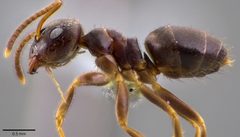
Distinguished from similar Lasius by the combination of: dusty brown coloration (not black), absence of erect setae on , and very sparse setae on propodeum and hind leg bases. Previously confused with Lasius alienus, but now recognized as a distinct species based on morphological and likely genetic differences. The semi-translucent legs and overall 'fuzzy' appearance help separate it from darker Lasius species like L. niger.
Images
Appearance
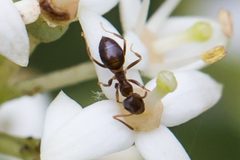
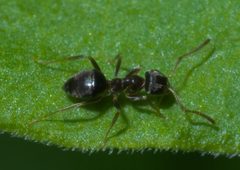
are dusty brown in color with lighter semi-translucent legs. lack erect setae (stiff hair-like structures). The propodeum and back legs have very few erect setae near their base. The overall body has a somewhat fuzzy or velvety appearance.
Habitat
Temperate forests and woodlands. Most commonly found under rotting wood or in trees.
Distribution
North America, predominantly in southern Canada and the eastern United States.
Ecological Role
Serves as a for -mimicking beetles. The longhorned beetle Cyrtinus pygmaeus, North America's smallest cerambycid, occurs among colonies of Lasius americanus and other small ants, where the 's slow, clumsy movement and ant-like appearance provide effective mimicry.
Similar Taxa
- Lasius alienusHistorically confused with L. americanus; Eurasian now considered distinct. The 2018 taxonomic revision separated the North American as L. americanus.
- Lasius nigerFormerly included L. americanus as a variety (L. niger var. americanus); L. niger is typically darker black in coloration rather than dusty brown.
- Cyrtinus pygmaeusNot an but a mimic; occurs in association with L. americanus colonies where its ant-mimicry is most effective due to the small size of both .
Misconceptions
The was long misidentified as Lasius alienus, a Eurasian species, until 2018 when it was formally recognized as a distinct North American species. Earlier taxonomic treatments placed it as a variety of Lasius niger.
More Details
Taxonomic History
First described by Emery in 1893 as Lasius niger var. americanus. Later treated as part of Lasius alienus, but recognized as a distinct in 2018 based on morphological differences. The name Lasius americanus has been reinstated as the valid name for this North American species.
Mimicry Associations
The -mimicking longhorned beetle Cyrtinus pygmaeus (2-3 mm) is found among Lasius americanus colonies. The 's slow, clumsy movement matches that of these small ants, making it one of the most effective ant mimics in North America. The beetle has been recorded from various hardwood trees including river birch, chinquapin oak, willow oak, and black oak.
Sources and further reading
- BugGuide
- Wikipedia
- GBIF taxonomy match
- iNaturalist taxon
- NCBI Taxonomy
- Catalogue of Life
- The Ants and Butterflies of Gates Canyon: Quite the Ecosystem | Bug Squad
- North America’s itsiest bitsiest longhorned beetle | Beetles In The Bush
- Formicidae | Beetles In The Bush | Page 2
- From the Bug of the Week mailbag, termites or ants? Eastern subterranean termites, Reticulitermes flavipes, or Citronella ants, Lasius sp. — Bug of the Week
- Curious isolation: new butterfly species discovered | Blog
- Alternative host-searching strategy in Ghilaromma orientalis