
Euderces bicinctus
(Linsley, 1935)
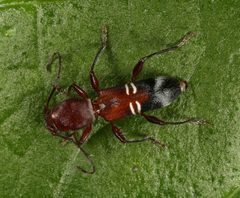
Euderces bicinctus is a of -mimicking longhorned beetle in the Cerambycidae, described by Linsley in 1935. Like other members of the Euderces, it exhibits of small ants, an common among the Tillomorphini tribe. The species is distributed in North and Middle America. Specific details regarding its and remain poorly documented in published literature.
Pronunciation
How to pronounce Euderces bicinctus: //juˈdɜːrsiːz baɪˈsɪŋktəs//
These audio files are automatically generated. While they are not always 100% accurate, they are a good starting point.
Identification
Euderces bicinctus can be distinguished from other Euderces by the specific pattern implied by its species epithet "bicinctus" (two-banded), referring to markings on the . Within the , species identification typically requires examination of antennal proportions, elytral patterns, and body proportions. As with other Euderces, the possesses a compact, -like body form with a relatively small and enlarged pronotum that creates the illusion of an ant's head when viewed from above.
Images
Distribution
Recorded from North America and Middle America, including Mexico (MX) and the United States (US). Specific locality records are sparse.
Ecological Role
As a member of the Tillomorphini tribe, E. bicinctus likely participates in -mimicry complexes, potentially gaining protection from through resemblance to unpalatable or aggressive ant . The larval stage presumably develops as a wood-borer in dead hardwood branches, based on documented habits of .
Similar Taxa
- Euderces piniSimilar -mimicking and flower-visiting ; distinguished by associations and geographic range
- Euderces reicheiOverlaps in distribution and -mimicking appearance; requires careful examination of elytral markings and antennal structure to differentiate
- Cyrtophorus verrucosusAnother -mimicking cerambycid with convergent body form; belongs to different tribe (Clytini) and typically has more prominent elytral
Sources and further reading
- BugGuide
- Wikipedia
- GBIF taxonomy match
- iNaturalist taxon
- Catalogue of Life
- Flower ants? Check again! | Beetles In The Bush
- Bug Eric: That's Not an Ant?!
- The “silky-bellied humpbacked” ant | Beetles In The Bush
- roadkill | Blog
- North America’s itsiest bitsiest longhorned beetle | Beetles In The Bush
- Beetle Collecting 101: How to pin a beetle | Beetles In The Bush