
Euderces reichei
LeConte, 1873
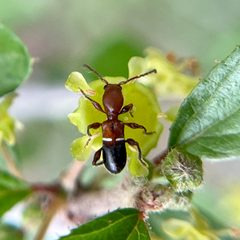
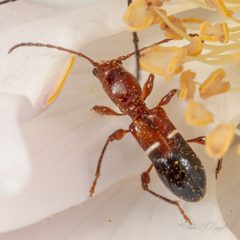
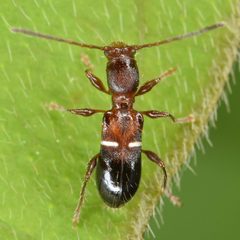
Euderces reichei is a of -mimicking longhorned beetle in the Cerambycidae, described by John Lawrence LeConte in 1873. are small, typically under 10 mm in length, and exhibit of ants through their compact body form, constricted waist-like appearance, and coloration. The species has been recorded across the eastern and central United States, with adults frequently encountered on flowers of flowering dogwood (Cornus florida) during spring.
Pronunciation
How to pronounce Euderces reichei: //juːˈdɜːrsiːz ˈraɪkaɪ//
These audio files are automatically generated. While they are not always 100% accurate, they are a good starting point.
Identification
Euderces reichei can be distinguished from other -mimicking cerambycids by its small size (under 10 mm), compact and convex body profile, and characteristic elytral markings that create the illusion of a constricted waist and shiny . It differs from the similar Molorchus by its more robust, convex body form—Molorchus tend to be flatter in profile. Tilloclytus geminatus, another ant-mimic in the same region, has a less convex profile and different elytral patterning. Euderces reichei has more pronounced oblique markings compared to Cyrtophorus verrucosus, which tends to have more irregular, verrucose (warty) sculpturing on the .
Images
Habitat
are associated with deciduous hardwood forests and woodlands, particularly areas where flowering dogwood (Cornus florida) occurs. The has been recorded in dry post oak woodlands and xeric dolomite prairie remnants (glades) in Missouri. Larval include various deciduous hardwoods, though specific host records for this species are limited.
Distribution
Eastern and central United States. Documented from Missouri, with records from the Ozark Trail region in Howell County and southwestern Missouri. GBIF records indicate presence in Mexico and the United States.
Seasonality
are active during spring, with peak activity coinciding with flowering dogwood bloom in early to mid-May. One record from June 6 in Texas suggests activity may extend into early summer in southern portions of the range.
Host Associations
- Cornus florida - feeding/ site frequently found on flowers
- deciduous hardwoods - larval Larval development in wood, specific poorly documented
Life Cycle
Larvae develop in wood of deciduous hardwoods. emerge in spring and are associated with flowers, particularly dogwood blossoms.
Behavior
exhibit -mimicry as a defensive , moving in ways that enhance their resemblance to ants. They are frequently found on flowers of flowering dogwood, suggesting adults may feed on pollen or nectar. The ant-like appearance likely provides protection from that avoid ants.
Similar Taxa
- Molorchus bimaculatusSimilar size and -mimicry; distinguished by flatter body profile and different elytral pattern
- Tilloclytus geminatusAnother -mimic in same region; less convex body, different markings, less frequently associated with flowers
- Cyrtophorus verrucosus-mimic with more irregular, warty elytral sculpturing; also found on dogwood flowers
More Details
Ant mimicry
Euderces reichei represents a clear example of , where a harmless (the ) adopts the appearance of a harmful or unpalatable species (ants) to deter . The mimicry includes body shape, coloration with dark and light patterning creating the illusion of a constricted petiole ("waist"), and .
Taxonomic history
Described by John Lawrence LeConte in 1873, a prolific American entomologist who described numerous North American . The species epithet 'reichei' likely honors a colleague or collector, though the specific etymology is not documented in available sources.