
Neoclytus acuminatus
(Fabricius, 1775)
Red-headed Ash Borer, Red-necked Ash Borer
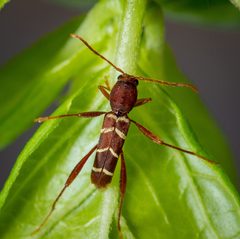
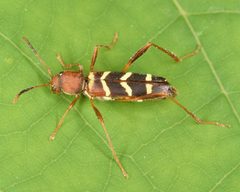
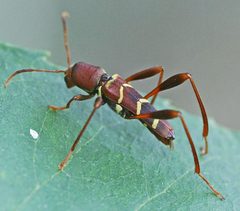
Neoclytus acuminatus, commonly known as the red-headed ash borer, is a North American longhorn beetle in the Cerambycidae. measure 12–16 mm in length and exhibit striking -mimic coloration with reddish-brown bodies marked by four contrasting yellow bands. The develops in dead or dying hardwood trees, particularly ash, hickory, and oak, where larvae feed on sapwood. Multiple may occur annually in warmer regions. Adults emerge in early spring and are frequently attracted to ethanol-based baits. The species has expanded beyond its native range through human-mediated transport of wood materials and is now established in parts of Europe.
Pronunciation
How to pronounce Neoclytus acuminatus: /ne.oʊˈklaɪtəs əˌkjuːmɪˈneɪtəs/
These audio files are automatically generated. While they are not always 100% accurate, they are a good starting point.
Identification
Distinguished from similar Neoclytus by the specific pattern of four yellow transverse bands on the and reddish-brown . The -mimic appearance separates it from non-mimetic cerambycids. Males can be identified by their distinctive "pushup stance" —fully extending front legs to elevate head and during release. May be confused with other banded cerambycids such as Neoclytus scutellatus or Neoclytus caprea, but banding pattern and associations differ. Distinguished from actual wasps by hardened forewings (elytra) meeting in a straight line down the back and long, thread-like without elbowed segments.
Images
Habitat
Develops in dead, dying, or stressed hardwood trees and woody vegetation. Found in forests, woodlots, and urban areas where trees occur. frequently encountered on freshly cut logs, stumps, and dying trees. Has been recorded from ash, hickory, oak, and other hardwoods, as well as shrubs and woody vines. In Europe, established in urban and semi-urban environments with imported wood materials.
Distribution
Native to North America, occurring across the eastern and central United States and southern Canada. Range extends from the Atlantic coast west to the Rocky Mountains and into Idaho. Established as an in Europe, with records from at least 21 countries including Romania (since 2006) and other western Palearctic regions. Also recorded from Neotropical . Continuous northward and eastward expansion in the Palearctic attributed to climate change and movement of infested materials.
Seasonality
period varies geographically: February to November in the southeastern United States, May to August in the northeastern United States and Canada. Multiple per year possible in southern regions (up to three), typically single generation in northern areas. Adults emerge in early spring from pupae. Firewood brought indoors during late winter or early spring may yield emergent adults inside homes.
Diet
Larvae feed on sapwood of dead, dying, or stressed hardwood trees. do not feed on wood; specific adult diet not documented in available sources.
Host Associations
- Fraxinus - larval Primary ; references ash
- Carya - larval Hickory frequently utilized
- Quercus - larval Oak commonly used
- Robinia pseudoacacia - larval Black locust; serious pest of planted windbreaks and farm woodlots
- woody vines and shrubs - larval Recorded from various woody vegetation beyond primary tree
Life Cycle
deposited into bark fissures of trees. Larvae bore through bark into sapwood, feeding on nutritious tissue. Larval development occurs through spring, summer, and fall. occurs in chambers beneath bark. probably occurs in pupal stage. Development typically completed in one year, with emerging the following spring. Multiple possible in warmer climates.
Behavior
Males exhibit a distinctive "pushup stance"—periodically stopping to fully extend front legs, elevating and above the substrate. This posture coincides with release of , elevating to increase dissemination rates. never displayed by females. are fast-moving and readily take when disturbed. Males guard mates during and after copulation to ensure paternity. Females oviposit into bark fissures while males remain mounted. Adults attracted to ethanol and ethanol/red wine baits, commonly captured in traps.
Ecological Role
Primary decomposer of dead and dying hardwood timber in natural forest , accelerating nutrient cycling and creating space for new growth. Contributes to healthy forest dynamics by hastening decomposition of non-living . In urban and agricultural settings, acts as a pest of stressed, newly planted, or nursery stock trees. Larval feeding may disrupt sap flow and weaken trunks of young trees, increasing susceptibility to wind damage. Serves as prey for woodpeckers and other .
Human Relevance
Considered a secondary pest that attacks stressed, dying, or recently dead trees rather than healthy forest timber. Primary economic impact is damage to felled trees intended for hardwood lumber or firewood. Frequently introduced into homes via stored firewood, where may emerge but cause no structural damage. Occasional pest of nursery stock and newly planted landscape trees. Not a primary of tree . Management through proper storage and drying of firewood; no chemical control typically warranted for natural .
Similar Taxa
- Neoclytus scutellatusSimilar size, coloration, and banding pattern; distinguished by specific elytral markings and often collected in same
- Neoclytus capreaBanded ash borer with similar -mimic appearance and associations; differs in banding pattern details
- Neoclytus mucronatusSimilar members with overlapping ranges; morphological differences in pronotal and elytral features
Misconceptions
Frequently mistaken for or bees due to wasp-mimic coloration and fast, erratic . The "red-headed ash borer" is somewhat misleading as the is and develops in many hardwoods beyond ash, including hickory, oak, and black locust. emerging in homes from stored firewood are sometimes misidentified as structural pests, though they do not reinfest milled lumber or cause damage to buildings.
More Details
Pheromone biology
Males produce an released during a stereotyped "pushup stance" that elevates the body and increases pheromone dissemination. This provides a reliable visual indicator for laboratory pheromone collection and behavioral study.
Global expansion
The has demonstrated significant Holarctic expansion in recent decades, with establishment in Europe documented since at least 2006. Spread attributed to commercial trade in wood materials, climate change, and anthropogenic transport.
Bait trap attraction
Research indicates ethanol/red wine mixtures are more attractive than ethanol alone, suggesting additional volatile compounds in wine enhance capture rates for this and related cerambycid .
Sources and further reading
- BugGuide
- Wikipedia
- GBIF taxonomy match
- iNaturalist taxon
- NCBI Taxonomy
- Catalogue of Life
- Bug Eric: Wasp Wednesday: Not Wasp IX
- Ascalaphidae | Beetles In The Bush
- August | 2022 | Beetles In The Bush
- entomology | Beetles In The Bush | Page 5
- Recycling ash: Banded Ash Borer, Neoclytus caprea — Bug of the Week
- Calling Behavior of the Cerambycid Beetle Neoclytus acuminatus acuminatus (F.)
- New records of the alien longhorn beetle Neoclytus acuminatus (Coleoptera: Cerambycidae) in Romania
- Red-headed ash borer Neoclytus acuminatus acuminatus (Fabricius) (Coleoptera: Cerambycidae): the global distribution, current spreading and the seasonal activity depending on its different habitats