
Podoschistus vittifrons
(Cresson, 1868)
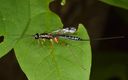
Podoschistus vittifrons is the sole North American representative of its , a member of the ichneumonid Poemeniinae. It is an ectoparasitoid that targets wood-boring larvae, using its elongated ovipositor to deposit through solid wood. The has undergone repeated taxonomic revision, previously assigned to the genera Xorides and Neoxorides. Despite its large size and distinctive appearance, it is rarely encountered in the field.
Pronunciation
How to pronounce Podoschistus vittifrons: /ˌpoʊ.doʊˈskɪs.təs ˌvɪ.tɪˈfrɒnz/
These audio files are automatically generated. While they are not always 100% accurate, they are a good starting point.
Identification
Large, slender ichneumon with an exceptionally long, needle-like ovipositor. Previously confused with Rhyssa due to similar size, body shape, and tree-trunk foraging . Distinguished from Rhyssa by subtle morphological features discernible to ; definitive identification requires examination by an authority on ichneumonid . The specific epithet vittifrons refers to banded or striped frontal markings, though this trait is not elaborated in available sources.
Images
Habitat
Forest with standing timber, particularly areas supporting wood-boring beetles. Also recorded from remnant woodlands in fragmented landscapes surrounded by farmland and suburban development.
Distribution
North America. Documented from Massachusetts (South Deerfield, Mount Sugarloaf area) and Canada (George L, CA; Pembina Provincial Park, CA).
Diet
Larva is ectoparasitic on wood-boring . Recorded : Dicerca divaricata (Buprestidae) and Graphisurus fasciatus (Cerambycidae). diet unknown.
Host Associations
- Dicerca divaricata - Buprestidae; larval
- Graphisurus fasciatus - Cerambycidae; larval
Life Cycle
Female locates tunneling in tree boles and inserts her ovipositor through wood to deposit an on the larva. The larva hatches and slowly consumes the beetle grub.
Behavior
Females climb on tree trunks, apparently detecting concealed larvae through the wood. This leads to confusion with similar-looking tree-foraging ichneumonids.
Ecological Role
agent of wood-boring beetles; -level impact unknown due to rarity.
Human Relevance
Potential value in forestry for natural suppression of wood-boring pests. Taxonomic confusion with related has required expert intervention for correct identification.
Similar Taxa
- RhyssaSimilar large size, slender build, elongated ovipositor, and of climbing tree trunks to locate . Distinguished by morphological details requiring examination.
- XoridesFormerly placed in this ; now separated based on revised classification (Poemeniinae vs. Xoridinae).
- NeoxoridesFormerly placed in this ; taxonomic revision transferred to Podoschistus.
More Details
Taxonomic history
Classification has changed repeatedly and will likely continue to be modified. Formerly placed in Xorides and Neoxorides before assignment to Podoschistus.
Rarity
Not commonly encountered despite its large size; 85 iNaturalist observations suggest it is underreported rather than genuinely rare, or genuinely scarce in accessible .