
Dicerca divaricata
(Say, 1823)
Flat-headed Hardwood Borer
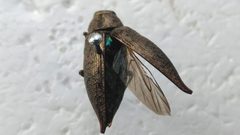
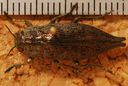
Dicerca divaricata is a medium-sized jewel beetle ( Buprestidae) native to eastern North America. are black in color and measure 15–22 mm in length. The is a wood-boring whose larvae develop in the wood of various hardwood trees, particularly maples (Acer), American elm (Ulmus americana), and redbud (Cercis). Adults are active in late spring, with activity recorded in May and June. The species serves as a for the Podoschistus vittifrons.
Pronunciation
How to pronounce Dicerca divaricata: /dɪˈsɛr.kə dɪˌvær.ɪˈkeɪ.tə/
These audio files are automatically generated. While they are not always 100% accurate, they are a good starting point.
Identification
Distinguished from other Dicerca by association with specific plants (maples, elm, redbud) and geographic distribution. Similar species D. obscura is associated primarily with persimmon and staghorn sumac; D. lurida is associated primarily with hickories (Carya). of D. divaricata are active in May–June, overlapping with some but host plant association provides the most reliable distinguishing character. The all-black coloration may separate it from more metallic or brassy congeners, though this requires verification.
Images
Habitat
Deciduous forests and woodlands containing tree . Larval is the wood of living or recently dead hardwood trees. are found on trunks of host trees.
Distribution
Eastern North America. Recorded from West Virginia and throughout the Nearctic region. Distribution corresponds to the range of its primary trees, particularly sugar maple (Acer saccharum), red maple (Acer rubrum), American elm (Ulmus americana), and redbud (Cercis) .
Seasonality
active in late spring; period recorded as May and June. Specific timing may vary with latitude and local climate conditions.
Diet
Larvae bore into and feed on the wood of hardwood trees, specifically Acer saccharum, Acer rubrum, Ulmus americana, and Cercis . feeding habits not documented.
Host Associations
- Acer saccharum - larval sugar maple
- Acer rubrum - larval red maple
- Ulmus americana - larval American elm
- Cercis - larval redbud
Life Cycle
Wood-boring with larval development in hardwood trees. Larvae tunnel through wood, likely requiring multiple years to complete development based on patterns observed in . emerge in spring and are active for a limited period. Specific details on -laying , larval instars, and not documented.
Behavior
are cryptic, resting on bark of trees where their coloration renders them difficult to detect. Adults fly during daytime in late spring. Larvae bore into wood of host trees.
Ecological Role
Primary decomposer of hardwood tree wood, contributing to nutrient cycling in forest . Serves as for , specifically the ichneumonid Podoschistus vittifrons, which is ectoparasitic on D. divaricata larvae.
Human Relevance
Considered a pest of hardwood trees due to larval wood-boring activity. May affect timber quality in managed forests or ornamental plantings of maple, elm, and redbud. Not a major economic pest relative to other wood-boring beetles.
Similar Taxa
- Dicerca obscuraSimilar size and appearance, but primarily associated with persimmon (Diospyros virginiana) and staghorn sumac (Rhus typhina) rather than maple/elm/redbud; distribution extends further west into Oklahoma
- Dicerca luridaSimilar cryptic habits and appearance, but primarily associated with hickories (Carya ) and more widely distributed across eastern North America; active year-round including winter hibernation
More Details
Parasitoid relationships
Documented as a for the ichneumonid Podoschistus vittifrons, which locates larvae boring in wood and inserts its ovipositor through the bark to parasitize them