
Dicerca
Eschscholtz, 1829
Species Guides
22- Dicerca asperata
- Dicerca callosa
- Dicerca caudata(Tailed Jewel Borer)
- Dicerca crassicollis
- Dicerca divaricata(Flat-headed Hardwood Borer)
- Dicerca dumolini
- Dicerca hesperoborealis
- Dicerca hornii
- Dicerca juncea
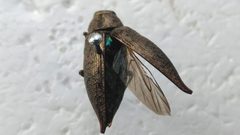
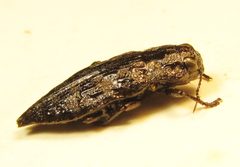
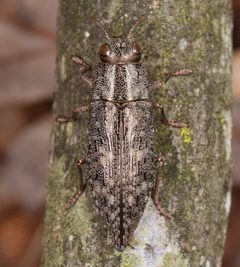
Dicerca is a of jewel beetles ( Buprestidae) containing that are among the larger and more conspicuous members of the family when viewed as pinned specimens, yet are remarkably cryptic in their natural . Species in this genus are wood-boring beetles associated with dead or dying hardwood trees, with documented associations including persimmon (Diospyros virginiana), hickories (Carya spp.), pecan (Carya illinoinensis), and staghorn sumac (Rhus typhina). are active year-round, including winter hibernation under loose bark, and exhibit brilliant metallic coloration with strong surface sculpturing that provides effective camouflage against tree bark. The genus is widespread across eastern North America, with some species extending into western regions, and includes several commonly encountered yet easily overlooked species due to their cryptic habits.
Pronunciation
How to pronounce Dicerca: /dɪˈsɜːrkə/
These audio files are automatically generated. While they are not always 100% accurate, they are a good starting point.
Identification
Dicerca can be distinguished from other buprestid by their relatively large size among jewel beetles, combined with brilliant metallic coloration ranging from brassy gold to bronze and tones. The surface sculpturing is strongly developed, with or punctate textures that contribute to their cryptic appearance on bark. When alive, they are difficult to detect due to coloration that matches dead wood and bark; when dead and removed from substrate, they appear gaudy and conspicuous. Similar genera in Buprestidae may share metallic coloration but typically lack the combination of large size, strong surface sculpturing, and specific tree associations characteristic of Dicerca.
Images
Habitat
Associated with dead or dying hardwood trees, particularly in woodlands and forest edges. Specific documented include: mixed-grass prairie woodlands with persimmon trees; wind-thrown or cut hickory trees and branches with hard, strong wood; and dead branches of living pecan trees. occur on trunks and branches of trees, often sitting on bark surfaces. Larvae develop in galleries within dead wood of host branches and trunks.
Distribution
Eastern North America, with -specific ranges. Dicerca obscura occurs across the eastern U.S. but is absent from much of New England, the Appalachian Mountains, the Allegheny Plateau, and the upper Midwest, with western records extending to northwestern Oklahoma. Dicerca lurida is widespread across eastern North America and is perhaps the commonest species of the . Dicerca furcata has been recorded in Romania. Dicerca moesta occurs in West Siberia, Russia, including Tyumenskaya Oblast. GBIF records indicate presence in Norway, Sweden, and Vermont, USA.
Seasonality
are active throughout the year, including winter. occur as adults even during winter, hibernating under loose bark. Activity resumes during first warm days of spring, when adults search for freshly killed trees for mating and oviposition. Year-round occurrence distinguishes this from most jewel beetles, which typically have limited adult activity periods in late spring and early summer.
Diet
Larvae are wood-borers that feed within galleries in dead wood of trees. have been observed on host tree bark but specific adult feeding habits are not documented in available sources.
Host Associations
- Diospyros virginiana (persimmon) - primary most commonly associated for D. obscura; beetles reared from dead persimmon trees
- Carya alba (mockernut hickory) - D. lurida found on wind-thrown trees; hickories appear to be preferred
- Carya glabra (pignut hickory) - D. lurida reared from dead wood
- Carya laciniosa (shellbark hickory) - D. lurida reared from dead wood
- Carya illinoinensis (pecan) - D. asperata larvae overwinter in dead branches of living pecan trees
- Salix exigua (sandbar willow) - D. lurida reared from this
- Rhus typhina (staghorn sumac) - D. obscura reared from this per Knull (1920)
Life Cycle
Larvae develop in galleries within dead wood of tree branches and trunks. Larvae of D. asperata have been documented in galleries within dead portions of otherwise living branches. are long-lived and can be found year-round, hibernating under loose bark during winter. Adults colonize freshly killed or wind-thrown host trees rapidly for mating and -laying. accumulation in galleries indicates larval activity.
Behavior
exhibit remarkable cryptic , sitting motionless on bark surfaces where their metallic coloration and surface sculpturing render them nearly invisible against the substrate. Even experienced observers frequently overlook individuals sitting in plain sight. Adults rapidly colonize newly available dead or dying material. Hibernation occurs under loose bark during winter months. The beetles are not known to be active fliers during observation periods; they appear to rely on and remaining motionless for avoidance.
Ecological Role
Wood-boring beetles that contribute to decomposition of dead hardwood branches and trunks. Larval tunneling in dead wood facilitates nutrient cycling and creates for other organisms. Rapid of freshly killed trees suggests a role in early stages of wood decomposition in hardwood . Contribution to branch mortality in living trees with dead branches has been documented in pecan.
Human Relevance
Collected by entomologists and enthusiasts; specimens are prized for their attractive metallic appearance in collections. Not known to be agricultural pests, though association with pecan trees (Carya illinoinensis) suggests potential minor economic relevance in orchard contexts. No significant timber pest status documented. Serve as examples of and evolutionary in educational contexts.
Similar Taxa
- Other Buprestidae generaMany jewel beetles share metallic coloration, but Dicerca is distinguished by larger size, strong surface sculpturing, year-round activity, and specific hardwood associations combined with bark-matching
- D. alniSimilar in appearance to D. furcata; the two require careful comparison for identification, as noted in Romanian records
More Details
Taxonomic authority
established by Eschscholtz in 1829. Nelson (1975) provided a major revision of the genus in North America.
Crypsis paradox
Dicerca exemplify a striking paradox: as pinned specimens in collections they appear brilliantly colored and conspicuous, yet in life on their trees they are extraordinarily difficult to detect due to coloration and sculpturing that matches bark substrates. This has been noted for multiple species including D. obscura and D. lurida.
Sources and further reading
- BugGuide
- Wikipedia
- GBIF taxonomy match
- iNaturalist taxon
- NCBI Taxonomy
- Catalogue of Life
- The Marvelously Cryptic Dicerca lurida | Beetles In The Bush
- The “obscure” Dicerca | Beetles In The Bush
- Critical revision of the presence of Dicerca furcata (Coleoptera: Buprestidae) in Romania
- New distribution data for Dicerca moesta (Fabricius, 1792) (Coleoptera, Buprestidae) in West Siberia, Russia
- A Newly Discovered Overwintering Habitat ofDicerca Asperata(Laporte and Gory, 1837) (Coleoptera: Buprestidae: Chrysochroinae: Dicercini)