
Acmaeodera
Eschscholtz, 1829
Species Guides
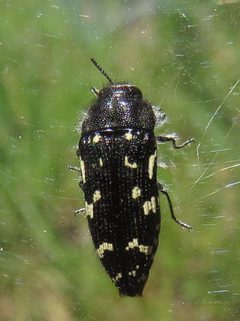
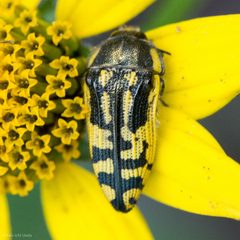
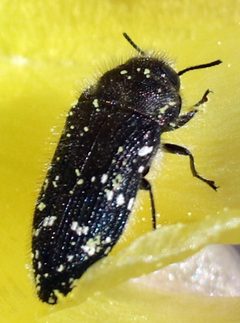
132Acmaeodera is a large of jewel beetles ( Buprestidae) with over 150 in North America, reaching greatest diversity in the desert southwest and Mexico. are metallic, often with distinctive color patterns, and are frequently observed visiting flowers to feed on pollen. The genus is distinguished by unique : are along the midline and remain closed during flight, functioning as a protective shield over the while only the hindwings provide propulsion. This trait, combined with abdominal banding in many species, creates a -like appearance in flight and has led to recognition of several species as hymenopteran mimics. Larvae are wood-borers in twigs and branches of various woody plants.
Pronunciation
How to pronounce Acmaeodera: /ˌæk.mi.oʊˈdɪə.rə/
These audio files are automatically generated. While they are not always 100% accurate, they are a good starting point.
Identification
Acmaeodera are distinguished from other Buprestidae by their that do not separate during . Most species are small to medium-sized (5–11 mm), with metallic coloration ranging from bronze, , green, to blue. Many species exhibit yellow or cream-colored maculations on the elytra, often arranged in spots or bands. The pronotum is typically coarsely punctate. Species-level identification is notoriously difficult due to the lack of modern revisions; many species resemble each other closely and require comparison with determined specimens or consultation.
Images
Habitat
are commonly found in open including grasslands, glades, desert scrub, and montane meadows where their plants and flower resources occur. Larval habitat consists of dead or dying woody branches and twigs of various hardwood trees and shrubs.
Distribution
North America from Canada (Alberta) through the United States, with greatest diversity in the southwestern U.S. (Arizona, New Mexico, Texas, California) and Mexico including Baja California. Some extend into Central America.
Seasonality
Most North American are active during spring and early summer (April–July). Activity in the southwestern U.S. and Mexico extends into late summer, coinciding with the monsoonal season beginning in July. A few species, such as A. macra, exhibit unusual fall activity (September–October) in Oklahoma and Texas.
Diet
feed on pollen from a wide variety of flowers, particularly Asteraceae (composites) including Heterotheca, Gutierrezia, Helianthus, and many others. They have also been observed feeding on flower petals. Larvae are wood-borers, feeding on dead or dying twigs and small branches of hardwood trees and shrubs.
Host Associations
- Asteraceae - pollen/nectar sourcePrimary visited for feeding; includes Heterotheca, Gutierrezia, Helianthus, Hymenothrix, Isocoma, Ericameria, and many other
- Rosaceae - Larval Cercocarpus spp. (mountain mahogany) confirmed for multiple including A. rubrocuprea, A. mariposa, A. nelsoni, and others
- Fabaceae - Larval Acacia spp. and Prosopis spp. recorded for some
- Fagaceae - Larval Quercus spp. (oak) recorded for some
- Cactaceae - Opuntia blossoms recorded for A. carlota
- Rhamnaceae - Larval Ceanothus recorded for some
- Ulmaceae - Larval Ulmus (elm) recorded for A. tubulus
- Juglandaceae - Larval Carya (hickory) and Juglans (walnut) recorded for A. tubulus
- Betulaceae - Larval Celtis (hackberry) and Ostrya (hophornbeam) recorded for A. tubulus
- Salicaceae - Larval Salix (willow) recorded for A. tubulus
- Rosaceae - Larval Crataegus (hawthorn) recorded for A. tubulus
- Fabaceae - Larval Gleditsia (honey locust) and Robinia (black locust) recorded for various
Life Cycle
Complete with , larva, pupa, and stages. Larvae are elongate, legless wood-borers that tunnel in dead or dying twigs and small branches. Development time varies by and climate; adults typically emerge in spring or early summer. Some southwestern species show extended or bimodal patterns associated with monsoon seasons.
Behavior
are and frequently observed visiting flowers, where they feed on pollen and may accumulate significant pollen loads on their hairy bodies. When disturbed, adults typically dodge to the backside of branches or fly away rapidly. is distinctive: remain and shield-like while hindwings alone provide propulsion, creating a -like silhouette. Several are considered hymenopteran mimics due to this flight appearance combined with abdominal banding. Adults are occasionally found at lights at night.
Ecological Role
function as through pollen consumption and transport. Larvae contribute to nutrient cycling as decomposers of dead woody material. The serves as prey for various including sphecid (Cerceris californica recorded preying on A. maculifera).
Human Relevance
Highly favored by insect collectors due to attractive metallic coloration and diversity. Several are considered uncommon or rare in collections. The is taxonomically challenging, with ongoing need for revision. Some species have been used in studies of mimicry and evolution.
Similar Taxa
- ChrysobothrisBoth are flower-visiting Buprestidae, but Chrysobothris have that separate during and typically lack the elytra shield characteristic of Acmaeodera
- AnthaxiaSimilar small metallic Buprestidae that visit flowers, but Anthaxia have separated in and different body proportions
- AgrilusBoth are wood-boring Buprestidae, but Agrilus are typically more elongate, have separated , and are less commonly observed on flowers
- CastiarinaAustralian ecological equivalent with similar flower-visiting , but geographically separated and not closely related
Sources and further reading
- BugGuide
- Wikipedia
- GBIF taxonomy match
- iNaturalist taxon
- NCBI Taxonomy
- Catalogue of Life
- An uncommon fall-active Acmaeodera | Beetles In The Bush
- Introducing Acmaeodera chuckbellamyi | Beetles In The Bush
- Acmaeodera carlota in northern Arizona | Beetles In The Bush
- Springtime Acmaeodera | Beetles In The Bush
- Winter Botany Quiz #6 – answers and a checklist | Beetles In The Bush
- Halictidae | Beetles In The Bush
- Mexican Acmaeodera Eschscholtz, 1829: A new species and checklist, with miscellaneous taxonomic and biological notes on other North American Buprestidae (Coleoptera)
- Acmaeodera immaculata Horn in Alberta, Canada, with notes about geographic distribution of related species (Coleoptera: Buprestidae)
- Distributional and Biological Notes on North and Central American Species of Acmaeodera (Coleoptera: Buprestidae)