
Polycestinae
Lacordaire, 1857
jewel beetles
Tribe Guides
8- Acmaeoderini
- Beerellus
- Haplostethini(metallic wood-boring beetles)
- Paratyndaris
- Polycesta(jewel beetles)
- Ptosima(Redbud Borers)
- Strigoptera(jewel beetles)
- Thrincopygini
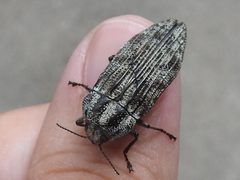
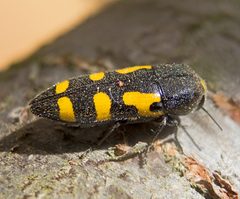
Polycestinae is a of metallic wood-boring beetles ( Buprestidae) characterized by diverse body forms ranging from robust to elongate. The subfamily contains approximately 15 recognized tribes including Acmaeoderini, Haplostethini, Polycestini, and Tyndarini. Members exhibit varied ecological associations, with larvae of many developing in dead or dying wood of diverse plants while are often found on foliage or flowers. The subfamily has a global distribution with particular diversity in arid and semi-arid regions.

Pronunciation
How to pronounce Polycestinae: /ˌpɒlɪˈsɛstɪniː/
These audio files are automatically generated. While they are not always 100% accurate, they are a good starting point.
Identification
Polycestinae can be distinguished from other buprestid by a combination of characters including: with distinct process; mesosternum with or without carina; metasternum with or without median ; and varied antennal structure. The tribe Acmaeoderini is characterized by short, serrate and often spotted or patterned . Tyndarini typically exhibit compact, robust bodies with short elytra. Haplostethini often show reduced wing venation. Definitive identification to subfamily level requires examination of internal skeletal structures and genitalia.
Images
Habitat
Members occupy diverse including forests, woodlands, savannas, and arid scrublands. Larval development occurs predominantly in dead or dying branches and trunks of woody plants. Many are associated with stressed or recently killed material rather than long-decayed wood. Some tribes, particularly Acmaeoderini, include species adapted to herbaceous host plants in more open habitats.
Distribution
Global distribution with centers of diversity in the Palearctic region, southwestern North America, and the Neotropics. The tribe Acmaeoderini is particularly diverse in the Palearctic and southwestern Nearctic. Tyndarini show strong representation in the southwestern United States and Mexico extending into Central America. Haplostethini occur across North America with some restricted to western regions.
Seasonality
activity periods vary by tribe and region. Spring and early summer activity predominates for most temperate . Some southwestern species exhibit bimodal patterns corresponding to spring and late summer rainfall. Fall-active species occur in the southcentral United States. Activity is generally correlated with plant and local moisture conditions.
Diet
Larvae are , feeding on cambium and sapwood of plants. Diet breadth ranges from highly to narrowly specialized. Larvae of Acmaeoderini feed predominantly on Fabaceae, Fagaceae, Rosaceae, Apiaceae, Anacardiaceae, Moraceae, and Asteraceae; some utilize conifers. of many species are anthophilous, feeding on pollen and nectar without strict floral specificity.
Life Cycle
Complete with , larval, pupal, and stages. Eggs are deposited on bark of plants. Larvae tunnel through cambium and outer sapwood, creating galleries packed with . Development typically spans one to two years depending on and conditions. occurs in chambers constructed in wood or at the wood-bark interface. Adults emerge through D-shaped or circular exit holes.
Behavior
are and often observed basking on plant foliage or flowers. Many are strong fliers and readily take when disturbed. Adults of some species are cryptic and difficult to detect visually on branches, requiring beating of foliage to collect. Larval includes creation of -packed galleries and packing of tunnels behind feeding progress.
Ecological Role
Larvae contribute to wood decomposition and nutrient cycling in forest and woodland . As primary colonizers of stressed or recently dead wood, they facilitate subsequent by other saproxylic organisms. Some serve as prey for . may contribute to pollination of flowers.
Human Relevance
Several are occasional pests of landscape trees and ornamental plantings, particularly when trees are stressed by suboptimal growing conditions. Agrilus difficilis and related species can cause significant damage to honey locust in urban settings. The group is of considerable interest to coleopterists due to taxonomic diversity and collection challenges. Some species are traded among collectors.
Similar Taxa
- AgrilinaeSimilar larval wood-boring habit and ; distinguished by prosternal process structure, wing venation, and larval gallery characteristics
- ChrysochroinaeOverlapping coloration and body form; distinguished by mesosternal structure and antennal insertion details
- BuprestinaeSimilar metallic coloration and general habitus; distinguished by prosternal and mesosternal , and typically more elongate body form
Sources and further reading
- BugGuide
- Wikipedia
- iNaturalist taxon
- NCBI Taxonomy
- Buprestidae | Beetles In The Bush | Page 9
- Buprestidae type specimens at Fundación Miguel Lillo, Argentina | Beetles In The Bush
- Let’s make a deal! | Beetles In The Bush
- Beetle Collecting 101: How to rear wood-boring beetles | Beetles In The Bush
- jewel beetles | Beetles In The Bush | Page 8
- A revision of the genus Paratyndaris Fisher, 1919 (Coleoptera: Buprestidae: Polycestinae)
- New data on the taxonomy and distribution of subfamily Polycestinae (Coleoptera: Buprestidae) in Bulgaria
- Synopsis of the Host Plants of the Palaearctic Jewel Beetles of the Tribe Acmaeoderini (Coleoptera, Buprestidae: Polycestinae)