
Buprestinae
Leach, 1815
jewel beetles, metallic wood-boring beetles
Tribe Guides
7- Actenodini
- Anthaxiini
- Buprestini(metallic wood-boring beetles)
- Chrysobothrini(metallic wood-boring beetles)
- Melanophilini
- Spectralia
- Xenorhipidini
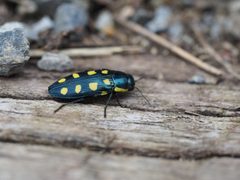
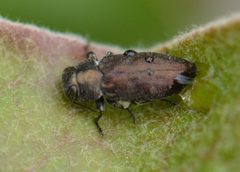
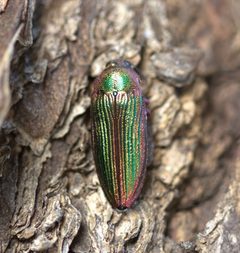
Buprestinae is a of jewel beetles ( Buprestidae) comprising approximately 1,500+ worldwide. The subfamily contains five recognized tribes: Anthaxiini, Buprestini, Chrysobothrini, Melanophilini, and Xenorhipidini. Members are characterized by their brilliant metallic coloration and sculptured bodies. are primarily phytophagous, with many species visiting flowers for nectar and pollen. Larvae are predominantly wood-borers, though some exhibit leaf-mining habits in tropical regions. Several species are significant forestry pests or .
Pronunciation
How to pronounce Buprestinae: //bjuˈprɛstɪniː//
These audio files are automatically generated. While they are not always 100% accurate, they are a good starting point.
Identification
Buprestinae can be distinguished from other buprestid by the combination of: typically not prolonged into a large conical process (unlike Stigmoderini in some classifications); antennal serrations beginning at antennomere 4 or 5; and tarsal claws with distinct basal . Within the subfamily, tribal distinctions rely on antennal structure, prosternal shape, and elytral sculpturing patterns. Chrysobothrini possess distinctly serrate with 11 segments; Anthaxiini have short, weakly serrate antennae; Buprestini exhibit strongly serrate to pectinate antennae in males; Melanophilini and Xenorhipidini show intermediate forms.
Images
Habitat
Terrestrial worldwide, with highest diversity in temperate and subtropical regions for wood-boring , and moist tropical regions for leaf-mining species. frequent flowers, bark surfaces, and foliage of plants. Larval habitats include living and dead wood, bark, and leaf tissue.
Distribution
Worldwide distribution across all biogeographic regions. Highest in the Nearctic (37% of described ), Palearctic (22%), and Neotropical (19%) regions. Documented from North America, Europe, Asia, Africa, Australia, and Central and South America. Specific records include Bulgaria, China (Yunnan, Hebei, Sichuan provinces), Peru, and Papua New Guinea.
Seasonality
activity varies by latitude and . Temperate species typically active from late spring through summer (May–August in North America). Some species associated with spring wildflowers (e.g., flowering dogwood in April–May). periods documented for specific species include September for some western North American .
Diet
are phytophagous, feeding on pollen, nectar, and floral tissues. Documented feeding on petals of winecup (Callirhoe involucrata), flowers of Eriogonum, and various composite flowers. Larvae are predominantly , tunneling in bark and wood of living or dead trees; some are leaf-miners in tropical regions.
Host Associations
- Paliurus spina-christi - plantfor Chrysobothris leonhardi in Bulgaria
- Callirhoe involucrata - food source and suspected larval for Agrilus muticus; feed on petals and mate in flowers
- Eriogonum - food source and confirmed larval for Agrilus blandus
- Hibiscus - larval for Agrilus concinnus, breeding in base of living plants
- Sphaeralcea - association, larval unconfirmedfor Agrilus malvastri
- Malvaceae - plant with multiple associationsincludes Callirhoe, Hibiscus, and Sphaeralcea as for several Agrilus
- Acacia angustissima - flower visitationfor Hiperantha interrogationis
- Chilopsis linearis - flower visitationfor Hiperantha interrogationis nominotypical
- Muntingia calabura - food source consume petals, observed in Ecuador
- burned wood - larval Phaenops yin larvae found under bark
- Pinus - larval for Chalcophora virginiensis and other pine-associated
- Populus deltoides - associationdead and dying cottonwood trunks harbor buprestid fauna
- Cornus florida - flower visitationattracts various buprestid and cerambycid beetles
- Coreopsis lanceolata - flower visitationfavored pollen and nectar source for Acmaeodera
- gray rabbitbrush (Ericameria nauseosa) - flower visitation and associationfor Crossidius coralinus
Life Cycle
Holometabolous development with , larval, pupal, and stages. Larvae are the primary feeding and growth stage. Wood-boring larvae typically have extended development periods (1–3+ years), tunneling in phloem, cambium, and xylem. Leaf-mining in tropics may have shorter larval periods. occurs in wood or soil. Adults are relatively short-lived, focused on and .
Behavior
Many are strong, direct fliers. Some exhibit flower-constancy, repeatedly visiting the same plant species. Antennal grasping during mating has been observed in related . Cryptic coloration provides camouflage on bark surfaces; some species exhibit -mimicry. Adults of some (Acmaeodera, Anthaxia, Agrilaxia) routinely visit flowers, while others are rarely observed on flowers. in Acmaeodera involves holding together during flight, resembling small bees.
Ecological Role
Larvae contribute to wood decomposition and nutrient cycling in forest . Some are primary colonizers of stressed, dying, or burned trees. Several species are significant forestry pests (e.g., Agrilus planipennis, emerald ash borer; A. mali; Lamprodila festiva; Melanophila acuminata) or that cause substantial economic and ecological damage. serve as for some plant species through flower visitation.
Human Relevance
Significant economic impact through damage to timber, fruit trees, and ornamental plantings. Emerald ash borer (Agrilus planipennis) is a major pest in North America. are popular among insect collectors due to brilliant metallic coloration. Some species used in jewelry manufacture historically. Research subjects for studies on -finding , chemical , and .
Similar Taxa
- ChrysochroinaeAnother large of Buprestidae; distinguished by different antennal structure and larval habits, though some tribes formerly placed in Chrysochroinae (e.g., Chalcophorini) now included there based on molecular
- Agrilinae containing many similar wood-boring ; distinguished by more cylindrical body form, shorter , and different larval gallery patterns
- PolycestinaeSmaller with some flower-visiting like Acmaeodera; distinguished by body shape and antennal structure
More Details
Tribal classification
The contains five tribes: Anthaxiini, Buprestini, Chrysobothrini, Melanophilini, and Xenorhipidini. Recent phylogenetic studies based on mitochondrial support Chrysobothris as sister to Phaenops, with Buprestis sister to (Melanophila + (Chrysobothris + Phaenops)).
Mitochondrial genome characteristics
Complete mitogenomes of Buprestinae range from 15,789–16,051 , with high A+T content (73.42–79.29%) and positive AT-skew. Gene arrangement is typical of coleopteran insects.
Collection and study challenges
Many are difficult to collect due to cryptic habits, short periods, and specific associations. Some species known only from single specimens or limited series. Winter collecting activities often focus on curating specimens and planning field seasons.
Sources and further reading
- BugGuide
- Wikipedia
- iNaturalist taxon
- NCBI Taxonomy
- Super Crop Challenge #11 | Beetles In The Bush
- Coleoptera | Beetles In The Bush | Page 10
- Christmas in January | Beetles In The Bush
- Review of Calodema and Metaxymorpha | Beetles In The Bush
- Let’s make a deal! | Beetles In The Bush
- New data on the distribution and host plants of subfamily Buprestinae (Coleoptera: Buprestidae) in Bulgaria
- Lasionota (Nelsonozodes) piurae Moore & Diéguez, 2019 (Coleoptera: Buprestidae: Buprestinae: Stigmoderini): description of the male, ecology and distribution in Peru
- Four Mitochondrial Genomes of Buprestinae (Coleoptera: Buprestidae) and Phylogenetic Analyses.
- A study of Anthaxia subgen. Thailandia Bílý, 1990 from China (Coleoptera, Buprestidae, Buprestinae).