
Agrilinae
Tribe Guides
4- Agrilini
- Aphanisticus(metallic wood-boring beetles)
- Eupristocerus
- Tracheini
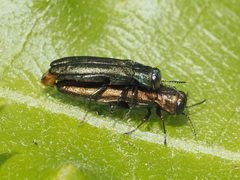
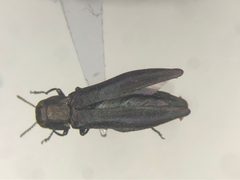
Agrilinae is a of metallic wood-boring beetles ( Buprestidae) characterized by larvae that develop in plant stems, twigs, and branches. The subfamily contains the hyperdiverse Agrilus, which with nearly 4,000 described is among the largest genera in the animal kingdom. Most Agrilinae are secondary pests of broadleaf forests, developing in recently dead wood, though some species attack living trees of economic importance. are typically small, often under 8 mm, and lack the vivid metallic colors common in other Buprestidae subfamilies. The subfamily has a distribution with greatest diversity in tropical and warm temperate regions.

Pronunciation
How to pronounce Agrilinae: /ˌæɡrɪˈlaɪniː/
These audio files are automatically generated. While they are not always 100% accurate, they are a good starting point.
Identification
Agrilinae can be distinguished from other Buprestidae by the following combination of characters: usually serrate or pectinate (not ), typically broad and flat, and larvae that are stem and branch borers rather than leaf miners or root feeders. The Agrilus, which constitutes the majority of , is characterized by small size (typically 4–8 mm), cylindrical body form, and often subdued coloration compared to the brilliant metallic hues of Chrysochroinae or Buprestinae. The related genus Paragrilus differs from Agrilus by having antennae that can be received in grooves along the sides of the pronotum. Species identification within Agrilinae genera often requires examination of male genitalia due to morphological similarity.
Images
Habitat
Agrilinae are primarily associated with woody plants in forested and woodland . Larvae develop in twigs, branches, and stems of deciduous trees and shrubs. Most species utilize recently dead or dying wood, though some attack living . The shows strong association with broadleaf angiosperms; no species are known to be associated with coniferous plants. Host plants span multiple including Fagaceae (oaks), Betulaceae (birches), Oleaceae (ashes), Malvaceae (hibiscus), and Viscaceae/Santalaceae (mistletoes).
Distribution
distribution with highest diversity in tropical and warm temperate regions of the New World, Palearctic, Afrotropical, and Oriental regions. The Agrilus occurs worldwide. North American fauna includes numerous across the United States and Mexico, with some species extending into Canada. The is notably absent from forests due to lack of conifer associations.
Seasonality
activity periods vary by and latitude. In temperate regions, most species are active during late spring and summer months (May–August). Species associated with specific plants such as Hibiscus may have more restricted periods tied to host . Some species are attracted to lights at night.
Diet
Larvae feed on phloem and outer xylem tissues of plant stems, twigs, and branches. of most feed on foliage of their larval host plants. Some species in the Paragrilus have been observed visiting extrafloral .
Host Associations
- Quercus - larval multiple Agrilus and Coraebus
- Fagus - larval Agrilus including A. bilineatus
- Betula - larval Agrilus anxius (bronze birch borer)
- Fraxinus - larval Agrilus planipennis (emerald ash borer)
- Hibiscus - larval Agrilus concinnus, Paragrilus tenuis
- Diospyros virginiana - larval Agrilus fuscipennis
- Phoradendron - larval Agrilus turnbowi, A. andersoni, A. howdenorum
- Sida - larval four Paragrilus of P. rugatulus group
Life Cycle
Complete with , larva, pupa, and stages. Eggs are deposited on or near plants. Larvae bore into stems, twigs, or branches and feed on phloem and outer xylem, creating galleries. Development typically requires one to two years depending on and climate. occurs within the gallery. Adults emerge through exit holes in the host plant. Species developing in dead wood can be reared by collecting infested material and allowing adults to emerge.
Behavior
of most Agrilinae are and found on foliage of plants. They are generally wary and quick to take when disturbed. Some species are attracted to ultraviolet light. Flight is characterized by short, intermittent flight bouts; most individuals are poor dispersers with limited sustained flight capability, though a small proportion of individuals in some species can achieve long-distance . The walnut twig beetle (Pityophthorus juglandis), though in a different , has been studied using flight mills alongside Agrilinae species.
Ecological Role
Agrilinae function primarily as secondary decomposers in forest , hastening the breakdown of dead and dying woody material. that attack living trees can become primary pests, particularly when trees are stressed by drought, , or other factors. The contributes to nutrient cycling in broadleaf forests. Some species serve as indicators of forest health due to their association with stressed or declining trees.
Human Relevance
Several Agrilinae are significant forest and ornamental pests. Agrilus planipennis (emerald ash borer) is a major pest in North America, causing extensive mortality of ash trees. Agrilus anxius (bronze birch borer) and A. bilineatus (two-lined chestnut borer) cause damage to ornamental and forest trees. These pests have economic impacts on timber, nursery, and urban forestry industries. The is also of interest to entomologists and collectors due to the hyperdiversity of Agrilus and the taxonomic challenges it presents.
Similar Taxa
- BuprestinaeAnother of Buprestidae; typically larger with more vivid metallic coloration and ; larvae often leaf miners rather than stem borers
- Chrysochroinae containing many of the most brilliantly colored jewel beetles; often larger with more flattened body form; includes many spectacular in such as Chrysochroa and Catoxantha
- PolycestinaeSmaller of Buprestidae; often with distinctive sculpturing or setal patterns; larvae typically develop in dead wood but with different morphological characteristics
More Details
Taxonomic complexity
The Agrilus presents extraordinary taxonomic challenges due to its enormous and morphological similarity among . Species limits are often difficult to define, and many species can only be reliably distinguished by examination of male genitalia. This has resulted in a 'taxonomic quagmire' with many species poorly characterized.
Research significance
Agrilinae have been subjects of mill studies to assess capabilities, which are critical for understanding invasion and managing pest species. Studies show generally poor flight capacity in most individuals, with long-distance dispersal dependent on rare individuals with exceptional flight performance.
Sources and further reading
- BugGuide
- Wikipedia
- iNaturalist taxon
- NCBI Taxonomy
- One-shot Wednesday: The “other” hibiscus jewel beetle | Beetles In The Bush
- Pelecinidae | Beetles In The Bush
- Two new species of Agrilus from Mexico | Beetles In The Bush
- Agrilus fuscipennis on Persimmon | Beetles In The Bush
- Super Crop Challenge #11 | Beetles In The Bush
- The Pan-Pacific Entomologist 88(2)—Penrose Memorial issue | Beetles In The Bush
- A review of North and Central American Paragrilus Saunders, 1871 (Coleoptera: Buprestidae: Agrilinae)
- A revision of the genus Synechocera deyrolle (Coleoptera : Buprestidae : Agrilinae)
- New taxa, distribution and biological records of Afrotropical Coraebini Bedel, 1921 (Coleoptera: Buprestidae: Agrilinae)
- Review of Ukrainian Species of the Genus Meliboeus (Coleoptera, Buprestidae, Agrilinae)
- A revision of the Phillippine Coroebine genus Obenbergerula Strand (Coleoptera : Buprestidae : Agrilinae)
- Intra- and interspecific variations in flight performance of oak-associated Agrilinae (Coleoptera: Buprestidae) using computerised flight mills
- Revision of the coroebine genus Coraebosoma Obenberger (Coleoptera: Buprestidae: Agrilinae)
- First biological report on the genus Cantonius (Buprestidae, Agrilinae, Aphanisticini), with descriptions of two new species from China.