
Buprestis laeviventris
(LeConte, 1857)
metallic wood-boring beetle, jewel beetle
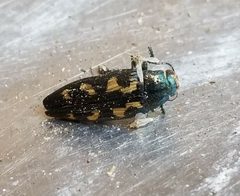
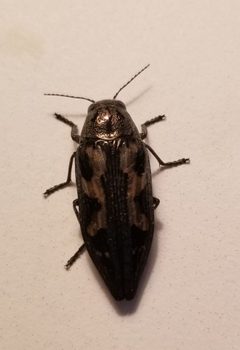
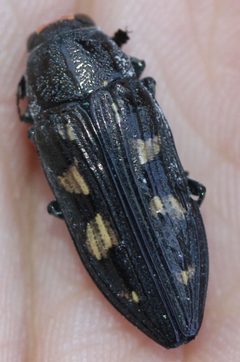
Buprestis laeviventris is a of metallic wood-boring beetle in the Buprestidae. It is native to North America and has been recorded from western Canada through the western United States. are attracted to recently dead or dying coniferous trees, particularly pines. The species exhibits elytral color variation and has been the subject of recent youth science research projects examining morphological diversity across different pine species.
Pronunciation
How to pronounce Buprestis laeviventris: //bjuˈprɛstɪs ˌlaɪvɪˈvɛntrɪs//
These audio files are automatically generated. While they are not always 100% accurate, they are a good starting point.
Identification
Members of the Buprestis are recognized by their moderately large size, brilliant metallic coloration, and cylindrical body form. Buprestis laeviventris can be distinguished from by examination of elytral and coloration patterns. Specific diagnostic characters require comparison with related such as B. consularis. The species shows intraspecific variation in elytral coloration and pattern, with some individuals appearing more green and others more coppery-brown.
Images
Habitat
Coniferous forest , particularly areas with Pinus . are found on trunks and branches of recently dead or dying pine trees. The species occurs in montane and foothill woodlands across its range.
Distribution
Nearctic region. Recorded from North America including western Canada (British Columbia) and the western United States. Distribution spans from the Pacific Northwest through the Rocky Mountain region and into the southwestern United States.
Seasonality
activity period appears to extend from late spring through summer, with peak activity likely in June and July based on collection records.
Diet
Larvae are wood-borers in dead or dying coniferous trees, particularly Pinus . have been observed on pine trunks and may feed on foliage or bark tissues; specific adult feeding habits are not well documented.
Host Associations
- Pinus contorta - larval lodgepole pine
- Pinus jeffreyi - larval Jeffrey pine
- Pinus edulis - larval Colorado pinyon pine - specimen beaten from dead branches in New Mexico
Life Cycle
Complete with , larval, pupal, and stages. Larvae develop as wood-borers in dead or dying pine trees. Adults emerge and are attracted to recently dead material. Detailed information is limited.
Behavior
are and found running on trunks and branches of trees. They are relatively sluggish compared to some other Buprestidae (e.g., Chrysobothris), making them easier to capture. Adults are attracted to recently dead or dying pines and may aggregate on suitable host material.
Ecological Role
As a primary wood-boring , larvae contribute to decomposition of dead coniferous wood and nutrient cycling in forest . The is part of the early successional of insects colonizing recently dead trees.
Human Relevance
Of interest to entomologists and collectors due to its attractive metallic coloration. Has been used in youth science education programs to teach diversity and morphological variation. Not considered an economic pest.
Similar Taxa
- Buprestis consularisSimilar size, coloration, and preferences; both occur on dead pines in western North America. B. consularis may be distinguished by subtle differences in elytral and color pattern. The two have been confused in the field.
- Buprestis striataSimilar subgeneric placement (Cypriacis) and association with conifers. B. striata has more strongly ribbed with alternate intervals depressed and heavily punctate.
- Buprestis salisburyensisSimilar size and metallic coloration, but B. salisburyensis has distinctive red elytral margins and larger punctures, placing it in subgenus Stereosa rather than Cypriacis.
Sources and further reading
- BugGuide
- Wikipedia
- GBIF taxonomy match
- iNaturalist taxon
- NCBI Taxonomy
- Catalogue of Life
- Cole and Connor: Two Teen Entomologists Cultivating Curiosities | Bug Squad
- Pentatomidae | Beetles In The Bush
- The Buprestis tree | Beetles In The Bush
- A Buprestis hat-trick! | Beetles In The Bush
- The invasion that wasn’t | Beetles In The Bush