
Buprestis salisburyensis
Herbst, 1801
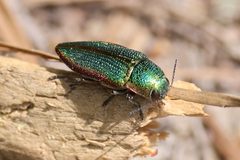
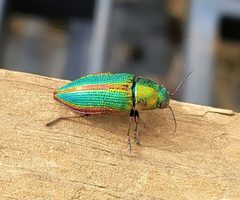
Buprestis salisburyensis is a metallic wood-boring beetle in the Buprestidae, subgenus Stereosa. The is characterized by brilliant metallic blue-green coloration with bright red margins on the . It is associated with pine in eastern North America and has been collected from Virginia pine (Pinus virginiana) in Tennessee.
Pronunciation
How to pronounce Buprestis salisburyensis: //bjuːˈprɛstɪs ˌsælzbəˈrɪɛn.sɪs//
These audio files are automatically generated. While they are not always 100% accurate, they are a good starting point.
Identification
Distinguished from other Buprestis by the combination of: (1) large elytral punctures characteristic of subgenus Stereosa; (2) brilliant metallic blue-green coloration with bright red elytral margins; and (3) association with pine . Most similar to other Stereosa members but color pattern is distinctive. Less skittish and slower to take than Chrysobothris species.
Images
Appearance
Medium to large jewel beetle with brilliant metallic blue-green coloration. have bright red margins along the edges. Large punctures on the elytra distinguish it as a member of subgenus Stereosa. The striking coloration may serve a cryptic function among pine needles.
Habitat
Pine woodlands, particularly areas with Virginia pine (Pinus virginiana). have been found on tree trunks and on rocks at tree bases. Larvae likely develop in pine wood. Associated with blufftop pine forests in at least one known locality.
Distribution
Eastern North America. Documented from Tennessee (South Cumberland State Park, Grundy County) and Ontario, Canada. Distribution appears to be more restricted than many .
Seasonality
active in late May. Specific period duration unknown due to limited collection records.
Host Associations
- Pinus virginiana - larval_hostVirginia pine; found on trunks and at base of trees, larvae likely develop in wood
Behavior
are relatively calm and disinclined to flee compared to other buprestids. Have been observed sitting on tree trunks and rocks at tree bases. Adults of related Stereosa members have been beaten from needles of young, healthy pines, suggesting similar may occur in this .
Ecological Role
Wood-boring likely contributing to nutrient cycling in pine . Larval tunneling in dead or dying pine wood creates for other organisms.
Human Relevance
Of interest to coleopterists and collectors due to striking appearance and relative rarity. No known economic significance.
Similar Taxa
- Buprestis striataBoth occur on Virginia pine in same ; distinguished by B. striata's ribbed with alternate depressed, heavily punctate intervals (subgenus Cypriacis) versus B. salisburyensis's large punctures (subgenus Stereosa) and different coloration
- Buprestis confluentaBoth are brilliantly colored, relatively rare Buprestis ; distinguished by B. confluenta's emerald green with dense yellow flecks on and association with cottonwood rather than pine
More Details
Taxonomic History
Placed in subgenus Stereosa based on elytral punctation. First described by Herbst in 1801.
Collection Notes
Specimens have been collected by beating vegetation and by visual searching on tree trunks. At South Cumberland State Park, Tennessee, found sympatrically with B. striata and Chrysobothris orono on Virginia pine.