
Buprestis striata
Fabricius, 1775
Striated Jewel Beetle
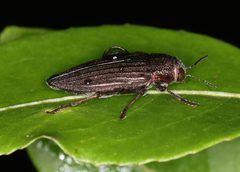
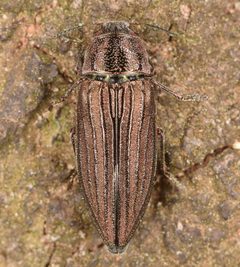
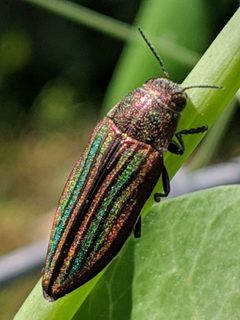
Buprestis striata is a of metallic wood-boring beetle in the Buprestidae, commonly known as the Striated Jewel . It is found in the Caribbean and North America. The species belongs to the subgenus Cypriacis, recognizable by its strongly ribbed with alternate intervals depressed and heavily punctate. It has been documented from Virginia pine (Pinus virginiana) in Tennessee, where it occurs on bluff tops alongside other rare buprestid species.
Pronunciation
How to pronounce Buprestis striata: //bjuːˈprɛstɪs ˈstraɪətə//
These audio files are automatically generated. While they are not always 100% accurate, they are a good starting point.
Identification
Recognizable as a member of the subgenus Cypriacis by the with alternate intervals depressed and heavily punctate, giving the a strongly ribbed appearance. Distinguished from other North American Buprestis by this distinctive elytral . Few other species in this subgenus occur in eastern North America.
Images
Habitat
Associated with pine trees, specifically documented from Virginia pine (Pinus virginiana) on bluff tops. The has been found on living trees with sparse crowns and sun-exposed trunks, as well as in areas with dead standing timber.
Distribution
Caribbean and North America. Documented from Tennessee (South Cumberland State Park), with broader distribution records including the Caribbean region and North American Nearctic zone. GBIF records indicate presence in New Brunswick, Canada, and broader Nearctic/Neotropic/Palearctic regions.
Seasonality
have been observed in late May in Tennessee. Specific seasonal activity period not well documented but appears to be spring to early summer based on limited collection records.
Host Associations
- Pinus virginiana - breedingDocumented from Virginia pine on bluff tops in Tennessee. Found on living trees with sun-exposed trunks.
Behavior
have been observed sitting on tree trunks. in the Buprestis are generally not very skittish or quick to take compared to other buprestid genera such as Chrysobothris, making them relatively easy to capture.
Ecological Role
Wood-boring whose larvae likely develop in pine wood. As with other buprestids, contributes to nutrient cycling in forest through decomposition of dead and dying wood.
Human Relevance
Of interest to coleopterists and collectors due to its relative rarity and distinctive appearance. Documented occurrence in Tennessee represented a noteworthy find for regional buprestid surveys.
Similar Taxa
- Buprestis salisburyensisBoth occur in the same (Virginia pine on bluff tops in Tennessee) and were found on the same tree. B. salisburyensis belongs to subgenus Stereosa and has large punctures on rather than the ribbed appearance of B. striata.
- Buprestis confluentaAnother member of Buprestis with striking appearance, but B. confluenta has brilliant green coloration with dense yellow flecks on and is associated with cottonwood (Populus deltoides) rather than pine.
- Other Buprestis (Cypriacis) speciesOther members of subgenus Cypriacis share the ribbed elytral appearance, but most occur in northern and western North America rather than the eastern U.S.
More Details
Subgenus placement
Buprestis striata belongs to the subgenus Cypriacis, one of several subgenera within Buprestis. This subgenus is characterized by the distinctive elytral with depressed, punctate intervals creating a ribbed appearance.
Co-occurrence with rare species
In Tennessee, B. striata has been found co-occurring with other rare buprestids including Buprestis salisburyensis and Chrysobothris orono, all associated with Virginia pine on bluff tops. This concentration of rare makes the site particularly significant for buprestid diversity.