
Dicerca lurida
(Fabricius, 1775)
Hickory Jewel Beetle
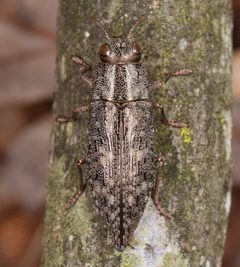
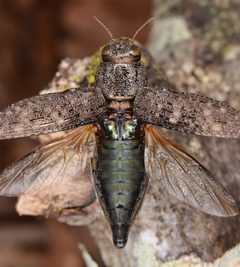
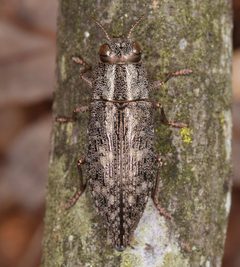
Dicerca lurida is a jewel beetle in the Buprestidae, commonly known as the Hickory Jewel Beetle. measure 12–20 mm and display cryptic coloration that renders them nearly invisible against tree bark despite their metallic luster when viewed as pinned specimens. The is strongly associated with hickory trees (Carya spp.) and is one of the most common jewel beetles in eastern North America. Unlike most jewel beetles with restricted seasonal activity, D. lurida occurs year-round as adults, including winter hibernation under loose bark.
Pronunciation
How to pronounce Dicerca lurida: /dɪˈsɜːrkə ˈlʊrɪdə/
These audio files are automatically generated. While they are not always 100% accurate, they are a good starting point.
Identification
Distinguished from other Dicerca by its relatively large size, widespread distribution, and strong association with hickory . The cryptic, bark-matching coloration contrasts with the more conspicuously metallic appearance of many other jewel beetles when alive. The species can be separated from similar Chrysobothris species by its more elongate body form and the structure of the pronotum and . Microscopic examination may be required for definitive identification of some specimens. The combination of large size, dull metallic luster, and occurrence on recently dead hickory distinguishes it from most sympatric buprestids.
Images
Habitat
Deciduous forests and woodlands where hickory trees (Carya spp.) occur. are found on trunks and branches of recently dead or dying hickory trees, including wind-thrown trees and cut logs. The colonizes wood while still hard and strong, not preferring advanced decay. Hibernation occurs under loose bark of standing or fallen trees.
Distribution
Widespread across eastern North America. Recorded from Ontario and Québec in Canada, and throughout the eastern and central United States. The is described as perhaps the commonest member of the Dicerca in North America.
Seasonality
occur throughout the year, unlike most jewel beetles with restricted seasonal periods. Peak flight activity occurs from April to May. Adults resume activity from winter hibernation during the first warm days of spring. Sunning on tree trunks and logs has been observed during the active period.
Diet
Larvae are wood-borers that feed within the trunks and branches of hickory trees (Carya spp.), including mockernut hickory (Carya alba), pignut hickory (Carya glabra), and shellbark hickory (Carya laciniosa). do not feed on wood; their diet is not explicitly documented but adult buprestids typically feed on foliage or do not feed substantially.
Host Associations
- Carya alba - larval mockernut hickory
- Carya glabra - larval pignut hickory
- Carya laciniosa - larval shellbark hickory
- Salix exigua - larval sandbar willow; less preferred
Life Cycle
The requires at least three years. Larvae develop within the wood of trees, boring through trunks and branches. occurs within the wood, and emerge to seek fresh host material. Adults overwinter under loose bark, resuming activity in spring to locate newly dead trees for mating and oviposition.
Behavior
are remarkably cryptic and difficult to detect when stationary on bark due to their camouflage coloration. They are wary and capable of rapid escape when disturbed. Adults have been observed sunning on tree trunks and logs during the flight period. The rapidly colonizes fresh wind-thrown or cut hickory wood.
Ecological Role
As a wood-boring , larvae contribute to the decomposition of dead and dying hickory trees, recycling nutrients in forest . The serves as prey for specialized including the crabronid Cerceris fumipennis, which provisions its nests with paralyzed buprestid beetles. may also serve as agents for phoretic pseudoscorpions and other arthropods found under bark.
Human Relevance
The has been used as a model organism for studying buprestid and associations. Its predictable occurrence on freshly dead hickory makes it a reliable target for collectors and researchers studying wood-boring . No significant economic impact as a pest has been documented; it primarily utilizes already dead or dying trees rather than attacking healthy timber.
Similar Taxa
- Chrysobothris spp.Similar size and (dead wood), but distinguished by body shape, pronotal structure, and typically more brilliant metallic coloration
- Other Dicerca speciesD. lurida is the most widespread and common in the in eastern North America; other species may be distinguished by preferences, geographic range, and subtle morphological differences requiring microscopic examination
More Details
Cryptic coloration
Despite appearing brilliantly metallic when pinned and viewed under direct light, living D. lurida are nearly invisible against bark due to surface sculpturing that diffuses light and creates a matte, bark-matching appearance. This explains why such an abundant and widespread remains seldom seen by casual observers.