
Cerceris fumipennis
Say, 1837
Smoky-winged Beetle Bandit Wasp
Cerceris fumipennis is a solitary, ground-nesting and the only buprestid-hunting member of Crabronidae in eastern North America. Females construct subterranean nests in hard-packed sandy soil and provision them exclusively with paralyzed jewel beetles (Buprestidae). The wasp has become a valuable biosurveillance tool for detecting the emerald ash borer (Agrilus planipennis), as it efficiently locates and captures these beetles from distances up to 2 km from its nest. Citizen science programs known as "WaspWatchers" monitor wasp colonies to survey for pest beetles.
Pronunciation
How to pronounce Cerceris fumipennis: /sɛrˈkɛrɪs fjuːmɪˈpɛnɪs/
These audio files are automatically generated. While they are not always 100% accurate, they are a good starting point.
Identification
Distinguished from other Cerceris by its exclusive association with buprestid beetles at nest entrances—other species prey on different insects (e.g., C. bicornis takes weevils). Distinguished from similar burrow-makers by nest architecture: perfectly circular entrance with symmetrical fine-textured diggings, versus angled entrances with asymmetric diggings for Bembix sand wasps, or D-shaped entrances with beveled rims for tiger larvae. carrying prey fly slower and more directly with a "thick-thoraxed" profile due to beetles held upside down beneath the .
Images
Appearance
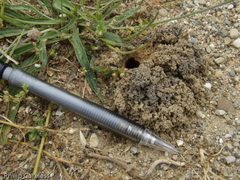
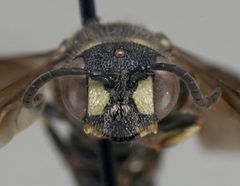
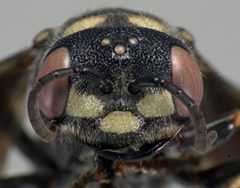
Large , approximately the size of a common yellow jacket. Body predominantly black with limited yellow markings. Wings are dark smoky blue-black. A single broad, creamy yellow band across the is conspicuous. Females have three creamy yellow patches between the ; males have two yellow triangular patches abutting the eyes. Nest entrance is a pencil-sized circular hole with a symmetrical mound of fine-textured diggings.
Habitat
Open areas of hard-packed sandy soil in sunny locations, often surrounded by woody suitable for buprestid prey. Frequently nests in human-disturbed sites including baseball diamonds, infrequently used roads and parking areas, roadsides, footpaths, and soil around campfire pits. Colonies may contain 5 to 500 loosely aggregated individual nests.
Distribution
Continental United States east of the Rocky Mountains, from Texas and Florida north to Maine, Wyoming, and into Canada. More than twenty colonies of varying size documented in Canada. Not present in western North America.
Seasonality
season varies by latitude. In Ontario, begins the last week of June and continues until early September. In North Carolina, active from late May through early July. Drought conditions may postpone emergence or shorten flight season. spend approximately 10 months in during , larval, and pupal stages.
Diet
Specialized of jewel beetles (Coleoptera: Buprestidae). Documented prey includes at least 51 across 11 , with Agrilus and Dicerca most commonly collected. Occasionally takes non-buprestid prey including leaf beetles (Neochlamisus spp.) and weevils, though buprestids comprise the vast majority of provisions.
Host Associations
- Agrilus planipennis - preyemerald ash borer; key target for biosurveillance
- Agrilus crataegi - preydocumented in British Columbia
- Agrilus granulatus populi - preydocumented in British Columbia
- Agrilus quadriguttatus - preysmall prey, multiple individuals per
- Agrilus obsoletoguttatus - preysmallest prey , up to 13 per
- Acmaeodera idahoensis - preydocumented in British Columbia
- Actenodes acornis - preyfrequently collected in Missouri
- Anthaxia (Haplanthaxia) caseyi caseyi - preysmallest documented prey at 4.2 mm; British Columbia
- Buprestis rufipes - preylarge prey, typically one per
- Chrysobothris laricis - preydocumented in British Columbia
- Chrysobothris leechi - preylargest documented prey at 12.0 mm; British Columbia
- Chrysobothris sexsignata - preydocumented in Missouri
- Dicerca lurida - preyfrequently collected in Missouri
- Dicerca obscura - preydocumented in Missouri
- Phaenops drummondi - preydocumented in British Columbia
- Phaenops gentilis - preydocumented in British Columbia
- Phaenops intrusa - preydocumented in British Columbia
- Poecilonota cyanipes - preyfrequently collected in Missouri
- Poecilonota thureura - preynew state record from Louisiana
- Spectralia gracilipes - preydocumented in Missouri
Life Cycle
Females construct single subterranean nests containing 5–12 (up to 24), each 7–20 cm below grade. Each cell is provisioned with paralyzed buprestid beetles—larger singly, smaller species in multiples (up to 13 for Agrilus obsoletoguttatus). A single hotdog-shaped is laid on the 's mesosternum. Cells are sealed with 3–6 cm of soil backfill. Development spans approximately 10 months in cells (egg, larval, and pupal stages). typically emerge the following season.
Behavior
Solitary but aggregate-nesting; females maintain individual nests in close proximity forming informal colonies. Hunting females attack prey by alighting on beetles, climbing over them, and grasping the with before inserting the stinger into the coxal joint to inject paralytic venom. Prey may be stung again at the nest entrance if paralysis is incomplete. Foraging range estimated at maximum 2 km, with average distance of 750 m from nest. drop prey when threatened and do not retrieve it, instead seeking new prey. Prey beetles are paralyzed but kept alive to prevent spoilage until larval feeding begins.
Ecological Role
regulating of jewel beetles, including wood-boring involved in nutrient cycling and decomposition. Serves as an efficient biosurveillance agent for detecting and cryptic buprestid pests, particularly emerald ash borer. May contribute to local buprestid diversity surveys in urban and forested .
Human Relevance
Primary value lies in biosurveillance for emerald ash borer (Agrilus planipennis), an pest killing North American ash trees. Detection capabilities exceed traditional survey methods ( traps, visual surveys). Citizen science program "WaspWatchers" trains volunteers to monitor colonies and collect prey beetles. Methods include "hunting" (netting returning with prey) and "gathering" (collecting beetles dropped at nest entrances). Transportable colonies enable mobile survey systems. Has facilitated detection of EAB in new areas and discovery of new state records for native buprestids. Does not sting humans even when handled.
Similar Taxa
- Cerceris bicornisSimilar nest architecture but preys on weevils rather than buprestids; slightly larger burrow entrances and faster, more powerful
- Bembix americanaSand wasp with similar burrows but angled entrance, asymmetric diggings, and preference for sandier substrates; no buprestid prey at entrance
- Cicindelidia punctulataTiger larval burrows are straight but smaller (~5 mm), D-shaped with beveled rim; lack diggings or have them washed away
More Details
Foraging Range and Survey Effectiveness
GIS-based analysis of prey composition indicates highest correlation between conifer-feeding ratios and land cover at 1,000–1,500 m from nests, establishing effective survey range significantly greater than -baited traps (30 m average). This enables efficient coverage of large areas for pest detection.
Prey Size and Provisioning Strategy
Positive relationship between size and prey size documented. Females adjust provisioning strategy by number rather than : single large beetles (Buprestis, Dicerca) versus multiple small beetles (Agrilus spp.) to ensure adequate larval nutrition.
Prey Location Mechanism
Unknown; suspected use of buprestid or plant volatiles rather than visual search, given in locating cryptic prey and repeated returns to same source trees.
Sources and further reading
- BugGuide
- Wikipedia
- GBIF taxonomy match
- iNaturalist taxon
- NCBI Taxonomy
- Catalogue of Life
- Working with Cerceris fumipennis—Part 2 | Beetles In The Bush
- Working with Cerceris fumipennis—Part 1 | Beetles In The Bush
- Hymenoptera | Beetles In The Bush | Page 6
- Wasp, Geographic Data Improve Surveillance for Emerald Ash Borer
- Predatory Wasps and Citizen Scientists are Taking on the Emerald Ash Borer
- ID Challenge #19 | Beetles In The Bush
- The nest provisioning behavior of the waspCerceris fumipennis
- Colony distribution and prey diversity of Cerceris fumipennis (Hymenoptera, Crabronidae) in British Columbia
- Colony distribution and prey diversity of Cerceris fumipennis (Hymenoptera, Crabronidae) in British Columbia
- Ball Diamonds as Habitat for Nests of Cerceris fumipennis (Hymenoptera: Crabronidae): Comparisons among Three States
- Factors Associated With Diversity and Distribution of Buprestid Prey Captured by ForagingCerceris fumipennis(Hymenoptera: Crabronidae)
- Biology, Prey, and Levels of Prey Paralyzation byCerceris fumipennisSay (Hymenoptera: Crabronidae) in New Hampshire
- Temporal and spatial dynamics of the emerald ash borer invasion in Connecticut as shown by the native digging wasp Cerceris fumipennis (Hymenoptera: Crabronidae).