
Cercerini
Lepeletier, 1845
Weevil Wasps and Allies
Genus Guides
2- Cerceris(Typical Weevil Wasps and Allies)
- Eucerceris(weevil wasps)
Cercerini is a tribe of solitary within the Philanthinae of the Crabronidae. Members are commonly known as "weevil wasps" due to their specialized on weevils (Curculionidae). The tribe contains approximately 900 across several , with Cerceris being the largest and most widely distributed. These wasps are characterized by their stout bodies, strong adapted for handling hard-bodied prey, and distinctive nesting involving burrows in soil or pre-existing cavities.
Pronunciation
How to pronounce Cercerini: //kɛrˈkɛriˌnaɪ//
These audio files are automatically generated. While they are not always 100% accurate, they are a good starting point.
Identification
Cercerini is distinguished from other Philanthinae tribes by the combination of: mandibular structure with a distinct prepical tooth on the inner margin; forewing with two submarginal (rarely one); and specialized on Coleoptera (weevils). Differs from Philanthini ( wolves) by prey type and less elongated body form. Differs from Aphilanthopsini by wing venation and abdominal shape. -level identification requires examination of clypeal structure, pronotal shape, and male genitalia.
Images
Appearance
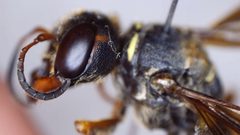
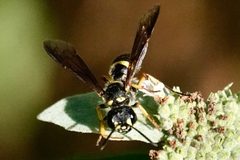
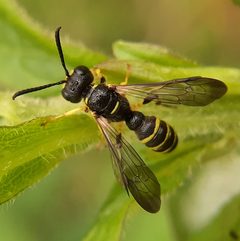
Medium to large with robust, somewhat flattened bodies. broad with large, powerful . relatively short, slightly clubbed in some . compact; propodeum often with distinct . , with tergites showing variable color patterns—commonly black with yellow, red, or white markings. Legs stout, forelegs sometimes modified for prey manipulation. Wings with reduced venation compared to other crabronids; forewing with one or two submarginal .
Habitat
Diverse open including sandy soils, clay banks, coastal dunes, grasslands, and forest edges. Many favor loose or sandy substrates suitable for nest excavation. Some utilize pre-existing cavities in wood, hollow stems, or abandoned burrows of other insects. Often found in areas with abundant flowering plants for nectar and nearby of weevil prey.
Distribution
Worldwide distribution with greatest diversity in temperate and subtropical regions. Particularly -rich in the Holarctic, Mediterranean basin, and southern Africa. Absent from oceanic islands and Antarctica. North American fauna especially well-studied, with numerous species in arid western regions.
Seasonality
activity primarily during warm months; temperate active from late spring through summer (May–August in Northern Hemisphere). Some tropical species with extended or year-round activity. Peak times often midday to afternoon. Males typically emerge and active earlier than females.
Diet
feed on nectar from flowers; females provision nests exclusively with paralyzed adult weevils (Curculionidae), with some showing prey specificity to particular weevil or .
Life Cycle
Solitary nesting. Female excavates burrow or modifies pre-existing cavity, constructs individual , and provisions each with multiple paralyzed weevils. Single laid on first weevil in each cell. Larva feeds progressively on provided prey, pupates within cell, and overwinters as or pupa. Typically in temperate regions; some tropical may produce multiple . Males do not participate in nest construction or provisioning.
Behavior
Females hunt weevils on vegetation, capturing prey with and stinging to induce paralysis. Prey transported in or by dragging to nest. Some practice "" with additional prey after hatching. Nests often aggregated in suitable substrate, though individuals maintain separate burrows. Males patrol nesting areas and vegetation for females; some territorial reported. Defensive stinging rare; sting used primarily for prey subjugation.
Ecological Role
Significant of weevil , potentially providing of some agricultural pest . contribute to pollination through nectar feeding. Serve as prey for various nest including cuckoo wasps (Chrysididae) and satellite flies (Miltogramminae).
Human Relevance
Generally beneficial due to on weevils, some of which are agricultural or forestry pests. Occasionally considered nuisance when nesting in high densities in sandy areas used for recreation. Sting mild to humans; not aggressive. Some studied for potential in of weevil pests.
Similar Taxa
- PhilanthiniAlso in Philanthinae but prey on bees rather than weevils, have more elongated bodies, and different mandibular structure
- AphilanthopsiniPrey on ants; differ in wing venation, more cylindrical , and nesting in pre-existing cavities rather than excavated burrows
- Other CrabronidaeMost other crabronid tribes prey on different groups (spiders, flies, caterpillars) and lack the robust mandibular and body form of Cercerini
More Details
Nesting Biology
Nesting habits vary considerably among . Cerceris typically excavate simple burrows in soil with 1–10 . Some Philanthinus species utilize pre-existing cavities. Nest architecture correlates with soil type: sandy substrates favor simple burrows, while harder soils associated with use of existing cavities.
Prey Specificity
Prey records indicate varying degrees of specialization. Some Cerceris are capturing diverse weevils, while others show strong preference for particular (e.g., Cerceris fumipennis primarily preys on Curculio and Conotrachelus). This specificity has conservation implications and potential for targeted .
Taxonomic History
Historically treated as Cerceridae or as part of Sphecidae. Current placement in Crabronidae reflects phylogenetic analyses showing Philanthinae as within crabronid , distinct from sphecids (thread-waisted wasps).