
Buprestis rufipes
Olivier, 1790
red-legged buprestis, red-legged buprestis beetle, redbellied buprestis
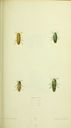
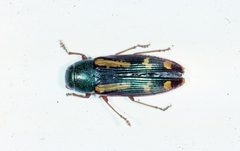
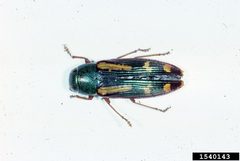
Buprestis rufipes is a striking metallic wood-boring beetle native to the eastern and southern United States. measure 18–25 mm and display brilliant metallic green coloration with distinctive golden-yellow bands across the , with reddish legs and underparts that give the its name. The has been reared from dead or dying hardwood trunks, particularly maple, beech, oak, elm, and blackgum. Despite its visual prominence, the species remains poorly studied, with no recorded larval plants and limited ecological data.
Pronunciation
How to pronounce Buprestis rufipes: /bjuˈprɛstɪs ˈruːfɪˌpɛs/
These audio files are automatically generated. While they are not always 100% accurate, they are a good starting point.
Identification
are distinguished by their large size (18–25 mm), brilliant metallic green , pronotum, and with contrasting golden-yellow transverse bands. The legs and portions of the underparts are distinctly reddish, a feature reflected in the specific epithet rufipes. The elytral punctation and banding pattern separate it from similar eastern Buprestis .
Images
Habitat
Associated with dead or dying hardwood trees in early stages of decay, with bark partly sloughed and outer wood layer slightly softened. have been observed on standing dead timber and cut wood sections.
Distribution
Native to southern and eastern United States in North America. Records span from the Atlantic seaboard westward through the Mississippi River valley.
Seasonality
activity has been documented from late May through early July, with peak numbers declining by mid-summer.
Behavior
are and visually alert, making them difficult to approach for photography. When confined, they remain active and restless. The has been successfully reared from trunk sections maintained in captivity.
Ecological Role
inhabit dead or dying hardwood, suggesting a role in colonizing and breaking down decaying wood. The serves as prey for the specialized hunting Cerceris fumipennis, which provisions its nests with paralyzed buprestid beetles.
Human Relevance
Occasionally encountered by landowners and naturalists due to its size and brilliant coloration. Specimens have been submitted alive to entomologists for identification. The was featured in a 2013 Entomological Society of America World of Insects Calendar submission.
Similar Taxa
- Buprestis gibbsiiSimilar metallic green coloration with yellow markings, but B. gibbsii occurs in the Pacific Northwest rather than eastern North America and lacks the reddish legs of B. rufipes.
- Chrysobothris speciesLarvae of B. rufipes resemble Chrysobothris larvae but are larger and less flattened; are readily distinguished by size and color pattern.
Sources and further reading
- BugGuide
- Wikipedia
- GBIF taxonomy match
- iNaturalist taxon
- Catalogue of Life
- Cicindelidae | Beetles In The Bush | Page 7
- 2013 ESA World of Insects Calendar Selection | Beetles In The Bush
- Working with Cerceris fumipennis—Part 2 | Beetles In The Bush
- Special Delivery | Beetles In The Bush
- January | 2011 | Beetles In The Bush | Page 3
- Super Crop Challenge #11 | Beetles In The Bush