
Chrysobothris sexsignata
(Say, 1839)
Six-marked Jewel Beetle
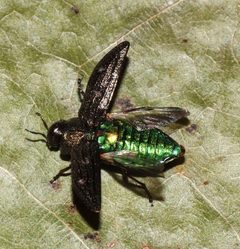
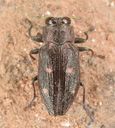
Chrysobothris sexsignata is a metallic wood-boring beetle in the Buprestidae, commonly known as the Six-marked Jewel . It is found in North America, with confirmed records from Canada (New Brunswick, Nova Scotia, Ontario, Prince Edward Island) and the United States. The is one of several Chrysobothris species that serve as prey for the crabronid Cerceris fumipennis.
Pronunciation
How to pronounce Chrysobothris sexsignata: /ˌkrɪs.oʊˈbɒθ.rɪs ˌsɛk.sɪɡˈneɪ.tə/
These audio files are automatically generated. While they are not always 100% accurate, they are a good starting point.
Identification
The specific epithet "sexsignata" (six-marked) likely refers to distinctive markings on the , though detailed diagnostic characters distinguishing this from are not provided in available sources. As a member of the Chrysobothris femorata species-group, it shares the general body plan of medium-sized, somewhat flattened buprestids with metallic coloration typical of the .
Images
Distribution
North America. Confirmed records from Canada: New Brunswick, Nova Scotia, Ontario, Prince Edward Island. Also present in the United States, including Missouri where it has been collected from Cerceris fumipennis colonies.
Seasonality
activity in Missouri coincides with the main activity period for most buprestid beetles, from late May through late June.
Host Associations
- Cerceris fumipennis - preyCollected as prey by this crabronid that hunts jewel beetles to provision its nests.
Similar Taxa
- Chrysobothris femorata species-groupMembers of this group share similar body form and can be difficult to distinguish without examination of specific character suites including antennal structure, elytral foveae, pygidial impressions, and elytral .
More Details
Biosurveillance significance
Chrysobothris sexsignata has been documented among buprestid beetles collected through biosurveillance efforts using Cerceris fumipennis . This method has been employed to detect emerald ash borer (Agrilus planipennis) and survey buprestid diversity.
Sources and further reading
- BugGuide
- Wikipedia
- GBIF taxonomy match
- iNaturalist taxon
- NCBI Taxonomy
- Catalogue of Life
- Working with Cerceris fumipennis—Part 1 | Beetles In The Bush
- ID Challenge #19 | Beetles In The Bush
- Introducing Chrysobothris caddo | Beetles In The Bush
- The perfectly polyphagous Chrysobothris purpureovittata | Beetles In The Bush