
Bembix americana
Fabricius, 1793
American Sand Wasp
Species Guides
3- Bembix americana comata(Western Sand Wasp)
- Bembix americana hamata
- Bembix americana spinolae(Eastern Sand Wasp)
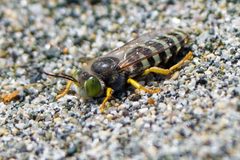
Bembix americana is a solitary digger wasp in the Crabronidae, widely distributed across the Americas from the Caribbean to North and South America. Females construct burrows in loose sand where they provision with paralyzed flies as food for their larvae. The exhibits notable parental care, with females progressively increasing prey deliveries as larvae grow. Seven are currently recognized, reflecting considerable geographic variation in and nesting .
Pronunciation
How to pronounce Bembix americana: //ˈbɛm.bɪks ə.ˌmɛ.rɪˈkɑː.nə//
These audio files are automatically generated. While they are not always 100% accurate, they are a good starting point.
Identification
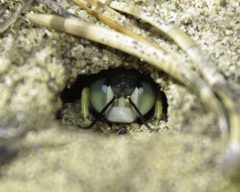
Distinguished from other sand wasps by its association with open sandy and the characteristic round burrow entrances with coarse, piled diggings (as opposed to the fanned diggings of tiger beetles). The has been observed to have a robust build typical of the Bembix, though specific diagnostic features separating it from are not documented in available sources.
Images
Habitat
Open, barren sand exposures including sand prairies, sand barrens, and vacant lots with deep, dry, loose sand. In Missouri, specifically associated with critically imperiled sand prairie remnants in the Southeast Lowlands.
Distribution
Caribbean Sea, Central America, North America, and South America. Recorded from the Caribbean, Middle America, and throughout continental North and South America.
Seasonality
Active during spring and fall in cooler regions; in Missouri sand prairies, observed during early autumn (late August to September) when cooler nights and crisp air prevail.
Diet
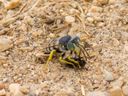
females provision nests exclusively with flies (Diptera), which they capture, sting to paralyze, and transport to burrows. As many as twenty flies may be provided for a single larva.
Life Cycle
Females dig burrows into loose sand; some construct multi-celled nests, though single-celled nests are more common. are laid on paralyzed prey within . Larvae are fed progressively: females provide greater numbers of prey as larvae grow, demonstrating active parental care.
Behavior
Females engage in , repeatedly leaving the nest to hunt flies and returning with prey. Burrow construction produces distinctive round entrances with coarse, piled diggings. are active on warm sandy surfaces and may follow observers for extended periods.
Ecological Role
of flies; contributes to regulation of dipteran in sandy . Its burrowing activity may influence soil structure in sand prairie .
Human Relevance
Subject of extensive behavioral research; one of the most thoroughly studied North American digger wasps. Provides opportunities for observation and photography in sandy . Seven recognized, indicating taxonomic interest.
Similar Taxa
- Tiger beetles (Cicindela spp.)Create similar burrows in sand, but produce fanned rather than piled diggings; burrow entrances more irregular in shape.
- Ammophila spp. (thread-waist wasps)Share sphecid-like and caterpillar-hunting , but have distinctive thread-waisted petiole and different prey type.
- Bembix sayi, Bembix texana in the same with similar and nesting habits; precise distinctions require expert examination.