
Bembix americana spinolae
Lepeletier, 1845
Eastern Sand Wasp
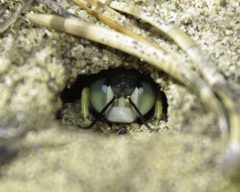
A sand wasp common on barren sand exposures where females dig burrows into loose sand. provision nests with paralyzed flies, with females providing progressively more prey as larvae grow. Formerly placed in Sphecidae, now classified in Crabronidae. The subspecies is part of a variable with intermediate characteristics between B. americana comata and B. americana spinolae in some .
Pronunciation
How to pronounce Bembix americana spinolae: /ˈbɛmbɪks əˌmɛrɪˈkeɪnə ˌspɪnoʊˈlaɪ/
These audio files are automatically generated. While they are not always 100% accurate, they are a good starting point.
Identification
Burrows distinguished from tiger burrows by rounder shape and coarser, piled rather than fanned diggings. As a Bembix , likely has stocky body form typical of the , though specific diagnostic features for this versus are not documented in available sources.
Images
Habitat
Barren sand exposures and deep, dry sand barrens; sandy prairie remnants. Requires loose, sandy substrate suitable for burrow excavation.
Distribution
North America; specifically documented from sand prairies in Missouri's Southeast Lowlands and Washington State. Caribbean, Middle America, and South America records present in GBIF but not verified in detailed sources.
Seasonality
Active in spring and fall; observed in early autumn (late August to September) in Missouri sand prairies when cooler temperatures limit activity of other sand-dwelling insects.
Diet
females provision nests with flies (Diptera), which they capture, sting to paralyze, and transport to burrows.
Life Cycle
Females construct underground burrows with one or more ; each cell receives a progressively greater number of paralyzed flies as the larva develops, with up to twenty flies reported for a single larva. Some show variation in cell number per nest, with multi-celled nests documented.
Behavior
Active parental care through : females return repeatedly to add more prey as larvae grow. Burrow excavation in loose sand produces characteristic coarse, piled diggings.
Ecological Role
of flies; contributes to sand prairie dynamics through and as a component of sand barren biodiversity.
Human Relevance
Subject of entomological study due to nesting and parental care strategies; presence indicates intact sand prairie .
Similar Taxa
- Cicindela formosa (big sand tiger beetle)Shares barren sand and burrows in sand; distinguished by burrows having fanned rather than piled diggings and more elongate shape
- Cicindela punctulata (punctured tiger beetle)Co-occurs on sand exposures; tiger burrows differ in shape and digging pattern
- Ammophila proceraAnother thread-waisted wasp found in similar prairie ; distinguished by bold silver thoracic markings and use of caterpillar prey rather than flies