
Agrilus obsoletoguttatus
Gory, 1841
Beech Borer
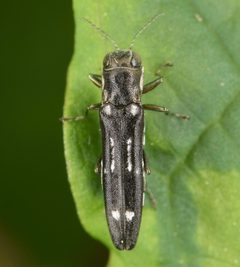
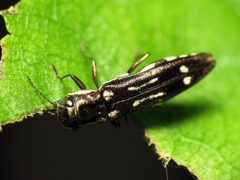
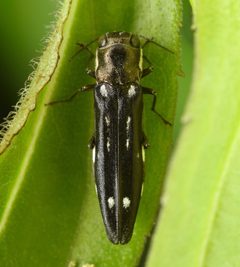
Agrilus obsoletoguttatus is a small metallic wood-boring beetle in the Buprestidae, native to North America. It is among the smallest jewel beetle utilized as prey by the predatory Cerceris fumipennis, which provisions its underground nests with paralyzed buprestid beetles. The species has been documented in nest caches containing up to 13 individuals, reflecting its small size relative to larger buprestid prey.
Pronunciation
How to pronounce Agrilus obsoletoguttatus: /ˈæɡrɪləs ˌɒbsəlɛtoʊˈɡʌtætəs/
These audio files are automatically generated. While they are not always 100% accurate, they are a good starting point.
Identification
Agrilus obsoletoguttatus can be distinguished from similar Agrilus by its small size—among the smallest of the Agrilus species documented as prey for Cerceris fumipennis in Missouri. The species exhibits the typical Agrilus body plan: elongate, somewhat flattened, with metallic coloration. Specific diagnostic features for field identification are not documented in available sources; precise identification requires examination of elytral punctation patterns and other subtle morphological characters.
Images
Habitat
Associated with wooded supporting its plants. As a buprestid , larvae develop in wood, likely in beech (Fagus) or related hardwoods given its . are active during late spring to early summer, coinciding with the peak activity period of its Cerceris fumipennis.
Distribution
North America. Documented from Missouri in the central United States, with records from New Brunswick and Ontario in Canada. The ' range extends across eastern and central North American forests.
Seasonality
activity occurs from late May through early July, with peak abundance in June. This timing aligns with the primary foraging period of Cerceris fumipennis, which provisions nests during this window. numbers decline rapidly in late June to early July, coinciding with seasonal decline in buprestid activity generally.
Host Associations
- Fagus - larval Inferred from 'Beech Borer'; specific documentation not located in sources
Life Cycle
Complete with , larval, pupal, and stages. Larvae are wood-borers, developing in tree phloem and sapwood. Adults emerge in late spring. Detailed parameters are not documented in available sources.
Behavior
are active during daylight hours and have been observed as prey of Cerceris fumipennis. When captured by , they are paralyzed and transported to underground nests. Wasps may provision nests with multiple individuals of this small —up to 13 documented in a single nest—to ensure adequate food for larval development.
Ecological Role
As a wood-boring , larvae contribute to nutrient cycling in forest through decomposition of woody material. serve as prey for , notably Cerceris fumipennis, forming a documented predator-prey relationship utilized in biosurveillance programs.
Human Relevance
Indirectly relevant through its role in supporting of Cerceris fumipennis, which is used as a biosurveillance tool for detecting buprestid pests such as the emerald ash borer (Agrilus planipennis). Collections of A. obsoletoguttatus from nests have contributed to biodiversity surveys and faunal documentation.
Similar Taxa
- Agrilus quadriguttatusSimilar size range and shared utilization by Cerceris fumipennis; both frequently co-occur in nest caches and require careful examination of elytral markings for separation
- Agrilus politusOverlapping and seasonality; distinguished by subtle differences in elytral punctation and coloration
- Agrilus pseudofallaxSimilar size and ; co-occurs in some nest collections
Sources and further reading
- BugGuide
- Wikipedia
- GBIF taxonomy match
- iNaturalist taxon
- NCBI Taxonomy
- Catalogue of Life
- ID Challenge #19 | Beetles In The Bush
- Wasp, Geographic Data Improve Surveillance for Emerald Ash Borer
- Working with Cerceris fumipennis—Part 2 | Beetles In The Bush
- Hymenoptera | Beetles In The Bush | Page 6
- Cicindelidae | Beetles In The Bush | Page 7
- immatures | Beetles In The Bush | Page 5