
Agrilus quadriguttatus
Gory, 1841
Four-spotted Agrilus
Species Guides
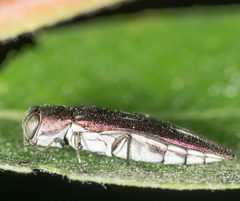
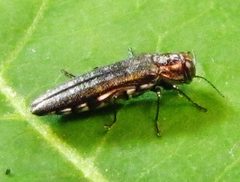
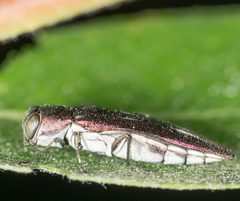
1Agrilus quadriguttatus is a metallic wood-boring beetle in the Buprestidae. The is native to North America and is among the smaller buprestid beetles utilized as prey by the hunting Cerceris fumipennis. Subspecific variation exists, with three recognized including the nominate form.
Pronunciation
How to pronounce Agrilus quadriguttatus: /ˈæɡrɪləs ˌkwɒdraɪˈɡʌtətəs/
These audio files are automatically generated. While they are not always 100% accurate, they are a good starting point.
Identification
Distinguished from similar Agrilus by subtle morphological characters not detailed in available sources. The specific epithet 'quadriguttatus' (four-spotted) suggests a diagnostic four-spotted pattern, though this requires verification. Among the smaller Agrilus species in North America.
Images
Appearance
Small metallic wood-boring beetle. Typical of the Agrilus with an elongate, somewhat flattened body form and metallic coloration. Specific color pattern details are not documented in available sources.
Habitat
Associated with woody vegetation. Documented from cottonwood (Populus deltoides) and black willow (Salix nigra) in Oklahoma. Likely associated with riparian or floodplain forests given plant preferences.
Distribution
Native to North America. Documented from Missouri and Oklahoma in the central United States. GBIF records indicate presence across multiple biogeographic realms, though these may represent data quality issues or introduced .
Seasonality
activity observed from late May through early July in Missouri, with peak abundance in June. Activity declines in late June to early July, coinciding with general buprestid seasonal patterns in the region.
Host Associations
- Populus deltoides - larval Cottonwood; collected from lower branches of declining trees
- Salix nigra - larval Black willow
Behavior
are active during daylight hours. Subject to by Cerceris fumipennis, which captures adults and provisions underground nests. Multiple individuals may be captured by a single due to small size.
Ecological Role
Larval development in woody plants contributes to nutrient cycling in dead and dying wood. Serves as prey for , notably Cerceris fumipennis .
Human Relevance
Utilized as a biosurveillance through collection from Cerceris fumipennis nests. This method allows detection of buprestid diversity including this without direct searching of plants.
Similar Taxa
- Agrilus obsoletoguttatusSimilar small size and ; both found in same Cerceris fumipennis nests and collected from same types. A. obsoletoguttatus described as 'among the smallest' while A. quadriguttatus is 'rather small'.
- Agrilus pseudofallaxFound in association in Cerceris fumipennis nests; similar size class
More Details
Subspecies
Three recognized: Agrilus quadriguttatus quadriguttatus Gory, 1841 (nominate form); Agrilus quadriguttatus fulminans Fisher, 1928; and Agrilus quadriguttatus niveiventris Horn, 1891. Geographic distributions and diagnostic characters of subspecies are not documented in available sources.
Predation by Cerceris fumipennis
Nests provisioned with A. quadriguttatus typically contain multiple individuals (up to seven documented) due to small prey size, in contrast to single large beetles of like Buprestis. may use -produced volatiles to locate trees, then return repeatedly to the same tree until beetle supply is exhausted.
Sources and further reading
- BugGuide
- Wikipedia
- GBIF taxonomy match
- iNaturalist taxon
- NCBI Taxonomy
- Catalogue of Life
- Working with Cerceris fumipennis—Part 2 | Beetles In The Bush
- Hymenoptera | Beetles In The Bush | Page 6
- Cicindelidae | Beetles In The Bush | Page 7
- immatures | Beetles In The Bush | Page 5
- iReport | Beetles In The Bush | Page 2