
Cicindelidia punctulata
(Olivier, 1790)
Punctured Tiger Beetle
Species Guides
2- Cicindelidia punctulata chihuahuae(Chihuahua Tiger Beetle)
- Cicindelidia punctulata punctulata(Sidewalk tiger beetle)
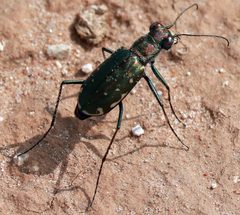
Cicindelidia punctulata, commonly known as the punctured tiger , is one of the most widespread tiger beetle in North America. The species exhibits notable geographic variation in coloration, with eastern typically showing dark brown coloration and western populations displaying greenish or bronze metallic hues. Two are recognized: the nominotypical C. p. punctulata in the east and C. p. chihuahuae in the west, with integrade populations occurring in intermediate zones. The species is exceptionally adaptable, occurring in diverse from upland sand and clay sites to wet bottomlands, lawns, agricultural fields, and even urban environments such as sidewalks and parking lots.
Pronunciation
How to pronounce Cicindelidia punctulata: //sɪˌsɪndəˈlɪdiə ˌpʌŋktjʊˈlætə//
These audio files are automatically generated. While they are not always 100% accurate, they are a good starting point.
Identification
Cicindelidia punctulata can be distinguished from similar by several key features. The bear a distinctive longitudinal row of punctures (the source of both its scientific and ). The elytra are subparallel, slightly wider posteriorly, with a generally shinier surface compared to the more opaque, rounded elytra of Cicindelidia nigrocoerulea. The basal antennomere bears a single seta (vs. two in C. nigrocoerulea). Western (C. p. chihuahuae) exhibit greenish or bronze metallic coloration, while eastern (C. p. punctulata) are typically dark brown. The body is relatively parallel-sided compared to more rounded .
Images
Habitat
Occurs in an exceptionally broad range of including dry upland sand and clay sites, wet bottomland sand sites, lawns, soybean fields, dirt roads, gravel parking lots, and cement sidewalks. Shows distinct preference for exposed clay and sandy substrates. Absent from wet bottomland clay sites where such habitat exists. In western regions, found in juniper chaparral, mesquite chaparral, dry grasslands, and alkaline flats.
Distribution
Transcontinental in North America, occurring from Canada through the United States to Mexico. Present throughout the eastern and central United States, extending westward through the Great Plains and into the southwestern United States. Absent from the Pacific Coast of North America. in the western United States represent the C. p. chihuahuae, while eastern populations are C. p. punctulata, with integrade zones in intermediate areas.
Seasonality
activity period spans April through November in temperate regions, with activity ceasing during winter months when temperatures routinely fall below freezing. Peak activity varies geographically; in New Mexico, active adults observed in September.
Life Cycle
Larval burrows have been observed in diverse substrates including sand, clay, and soil, though not documented in cement sidewalks despite presence there. This suggests greater selectivity during the larval stage compared to adults.
Behavior
are fast-running typical of tiger beetles. activity observed, with individuals found on exposed substrates at night. Has been observed scavenging at salmon oil baits. capability present but not extensively characterized.
Ecological Role
in terrestrial across diverse . Serves as prey for various vertebrate and predators.
Human Relevance
Frequently encountered by entomologists and naturalists due to its ubiquity and activity. Subject of taxonomic humor (proposed as "Cicindela ubiquita") due to its extreme commonness. occasionally observed in anthropogenic including sidewalks and parking lots, making it one of the most accessible tiger for public observation.
Similar Taxa
- Cicindelidia nigrocoeruleaSimilar size and general appearance; distinguished by two setae on basal antennomere (vs. one), subarcuate (rounded) that are more opaque, and coloration typically blue, green, or black rather than brown
- Cicindela formosaShares sand preferences and similar body shape; distinguished by different elytral maculation pattern and lack of longitudinal puncture row
- Cicindelidia obsoletaOverlaps in grassland ; distinguished by larger size, different elytral pattern, and lack of puncture row