
Neochlamisus
Karren, 1972
warty leaf beetles
Species Guides
9- Neochlamisus bebbianae(warty leaf beetle)
- Neochlamisus bimaculatus(warty leaf beetle)
- Neochlamisus chamaedaphnes
- Neochlamisus comptoniae(warty leaf beetle)
- Neochlamisus eubati(Blackberry Case-bearing Leaf Beetle)
- Neochlamisus gibbosus(warty leaf beetle)
- Neochlamisus platani(sycamore leaf beetle)
- Neochlamisus scabripennis(warty leaf beetle)
- Neochlamisus velutinus(warty leaf beetle)
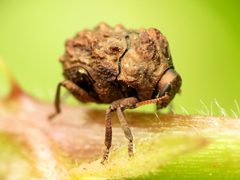
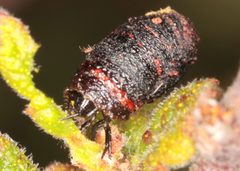
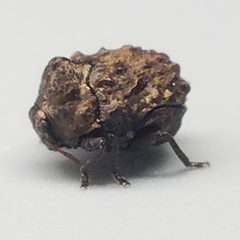
Neochlamisus is a of case-bearing leaf beetles in the tribe Fulcidacini, commonly known as warty leaf beetles. measure 3–4 mm and exhibit cryptic coloration resembling caterpillar . The genus comprises 17–18 restricted to North America, including Mexico. These beetles are notable for their elaborate fecal case construction by larvae and have become important model organisms for studying -associated speciation, particularly in N. bebbianae, which exhibits distinct host forms on different tree species.
Pronunciation
How to pronounce Neochlamisus: /ˌniːoʊˌklæˈmaɪsʊs/
These audio files are automatically generated. While they are not always 100% accurate, they are a good starting point.
Identification
Distinguished from other leaf beetles by the combination of small size (3–4 mm), warty irregular body surface, and cryptic -mimicking appearance. When disturbed, the complete retraction of appendages into body grooves is diagnostic. Larvae are identified by their portable fecal cases, which differ from the cases of related . -level identification often requires knowledge of plant association, as many species are morphologically similar but host-specific. N. bebbianae is exceptional in using multiple host genera; on different hosts are distinguished as separate host forms. N. platani can be recognized by its bright coppery coloration.
Images
Habitat
Terrestrial; associated with foliage of plants. and larvae occur on leaves and stems of woody plants. Larvae remain on the natal host plant throughout development.
Distribution
Restricted to North America, including the United States, Canada, and Mexico. All 17–18 accepted occur within this range.
Seasonality
are active in spring, when mating and oviposition occur. Larval development proceeds through spring and summer, with occurring after approximately twenty days in the sealed case. Adult timing varies by and latitude.
Diet
Folivorous. feed on leaves of plants. Larvae feed externally on host plant foliage while remaining enclosed within their portable fecal cases.
Host Associations
- Platanus occidentalis - of N. platani; bright coppery beetles associated with eastern sycamore
- Acer - Maple for N. bebbianae host forms
- Salix - Willow for N. bebbianae host forms
- Quercus imbricaria - Shingle oak for some Neochlamisus
- Multiple tree genera - N. bebbianae exceptional in using six tree across five plant ; most other are monophagous or oligophagous
Life Cycle
Females lay singly on leaves or stems of plants in spring, then form a fecal cap around each egg. Larvae hatch and remain on the natal host plant, adding to and enlarging their fecal cases regularly as they grow. Case enlargement is an elaborate, repeated process until the case is sealed to the substrate for . After approximately twenty days, the newly hardened cuts a circular cap from the case apex and emerges to feed and mate on the larval host plant.
Behavior
exhibit cryptic : when disturbed, they retract the and fold legs and into body grooves, becoming nearly indistinguishable from caterpillar . If disturbance is sufficient, they may release their grip and roll off the leaf. Larvae carry their portable fecal cases throughout development, an unusual behavior among leaf beetles. Case construction and enlargement is a complex, regularly repeated behavior.
Ecological Role
Herbivore; leaf-feeding beetle that contributes to nutrient cycling through herbivory. Serves as prey for including the Cerceris fumipennis (primarily a jewel beetle predator that occasionally takes Neochlamisus). to diverse guilds including 22 of hymenopteran parasitoids across seven .
Human Relevance
Important model organism for evolutionary research, particularly studies of -associated speciation, ecological speciation, and host race formation. N. bebbianae host forms are extensively studied for understanding how host plant shifts promote reproductive isolation and genetic divergence. Occasionally preyed upon by beneficial used in biosurveillance for beetles.
Similar Taxa
- ExemaAlso in tribe Fulcidacini with similar -mimicking appearance and fecal case-bearing larvae; Exema are smaller (2–3 mm vs. 3–4 mm in Neochlamisus) and typically associated with Asteraceae rather than woody plants
- ChlamisusFormer from which Neochlamisus were transferred; morphologically similar but now classified separately
- Other CamptosomataShare case-bearing larval habit but differ in case construction ( vs. portable) and
More Details
Evolutionary significance
Neochlamisus, particularly N. bebbianae, has become a premier model system for studying ecological speciation. forms associated with different tree exhibit host-plant-specific ecological differentiation, pre- and post-mating reproductive barriers, and genetic differentiation despite . Research has demonstrated ecologically dependent postmating isolation and isolation by , providing strong evidence for 's role in speciation.
Parasitoid communities
Comprehensive rearing studies have documented 22 of hymenopteran attacking Neochlamisus, including 17 newly documented species. Parasitoid guilds show both overlap and differentiation across , raising questions about whether parasitoids exhibit host-associated differentiation parallel to their beetle hosts.
Sources and further reading
- BugGuide
- Wikipedia
- GBIF taxonomy match
- iNaturalist taxon
- NCBI Taxonomy
- Working with Cerceris fumipennis—Epilogue | Beetles In The Bush
- Chrysomelidae | Beetles In The Bush | Page 4
- Chrysomelidae | Beetles In The Bush | Page 3
- IMMATURE STAGES OF CANADIAN NEOCHLAMISUS KARREN (COLEOPTERA: CHRYSOMELIDAE
- Biology and Morphology of Neochlamisus gibbosus (Fabricius, 1777) (Coleoptera: Chrysomelidae: Cryptocephalinae: Fulcidacini)
- Isolation by adaptation in Neochlamisus leaf beetles: host-related selection promotes neutral genomic divergence
- Ecologically dependent postmating isolation between sympatric host forms ofNeochlamisus bebbianaeleaf beetles
- Isolating a Role for Natural Selection in Speciation: Host Adaptation and Sexual Isolation in Neochlamisus bebbianae Leaf Beetles
- Postmating isolation and genetically variable host use in ecologically divergent host forms of Neochlamisus bebbianae leaf beetles
- ISOLATING A ROLE FOR NATURAL SELECTION IN SPECIATION: HOST ADAPTATION AND SEXUAL ISOLATION INNEOCHLAMISUS BEBBIANAELEAF BEETLES
- Does strong selection promote host specialisation and ecological speciation in insect herbivores? Evidence from Neochlamisus leaf beetles
- Aspects of the Natural History of Neochlamisus (Coleoptera: Chrysomelidae) II: Characterization of Parasitoid Guilds from Different Plant Hosts
- SELECTION AND GENOMIC DIFFERENTIATION DURING ECOLOGICAL SPECIATION: ISOLATING THE CONTRIBUTIONS OF HOST ASSOCIATION VIA A COMPARATIVE GENOME SCAN OF NEOCHLAMISUS BEBBIANAE LEAF BEETLES
- Aspects of the Natural History of <I>Neochlamisus</I> (Coleoptera: Chrysomelidae): Fecal Case-Associated Life History and Behavior, with a Method for Studying Insect Constructions