
Chlamisus
Rafinesque, 1815
Cloaked Warty Leaf Beetles
Species Guides
5- Chlamisus arizonensis
- Chlamisus foveolatus(warty leaf beetle)
- Chlamisus maculipes
- Chlamisus quadrilobatus
- Chlamisus texanus(warty leaf beetle)
Chlamisus is a of warty leaf beetles in the Chrysomelidae, commonly known as cloaked warty leaf beetles. The genus contains more than 90 described distributed primarily in the Neotropics, with some species extending into North America. Members of this genus exhibit case-bearing larval and -mimicry as , adaptations shared with related genera in the tribe Chlamisini.
Pronunciation
How to pronounce Chlamisus: //ˈklæmɪsəs//
These audio files are automatically generated. While they are not always 100% accurate, they are a good starting point.
Identification
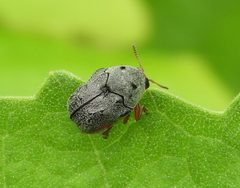
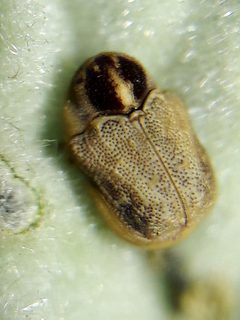
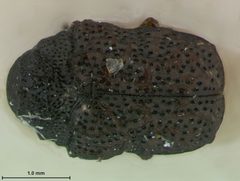
of Chlamisus are small beetles, typically 2-4 mm in length, with a compact, rounded body form. When disturbed, they retract their and appendages into grooves, rendering them nearly indistinguishable from caterpillar in size, shape, texture, and coloration. This frass-mimicry distinguishes them from most other leaf beetles. The can be separated from the similar genus Exema by subtle differences in body proportions and antennal structure, though definitive identification often requires examination of genitalia. Some exhibit variable coloration including metallic sheens that enhance frass resemblance.
Images
Habitat
occur in diverse including tropical savanna (cerrado), woodland edges, and agricultural settings. Chlamisus minax has been documented in cerrado vegetation of central Brazil. Chlamisus cribripennis occurs in blueberry fields in eastern North America.
Distribution
Neotropical distribution with greatest diversity in South and Central America. Documented from Colombia. Chlamisus minax studied in Uberlândia, Minas Gerais, Brazil. Chlamisus cribripennis recorded in Nova Scotia, Canada, representing a northward range extension.
Seasonality
of Chlamisus minax are present in the field during spring-summer, emerging in mid-October following spring rains. Pupae undergo from April through October.
Diet
Herbivorous. Chlamisus minax larvae feed on floral buds; feed on young leaves and stalks of floral buds. Chlamisus cribripennis feeds on blueberry (Vaccinium). Specific diet composition for most remains undocumented.
Host Associations
- Heteropterys pteropetala A. Juss. - Malpighiaceae; monophagous association documented for Chlamisus minax
- Vaccinium - Ericaceae; of Chlamisus cribripennis in Nova Scotia blueberry fields
Life Cycle
() cycle documented for Chlamisus minax. emerge mid-October. Larvae pass through six morpho-stages while constructing protective cases from mantle material, egg rests, and . occurs on the plant; pupae fall to ground and enter from April through October. Case-bearing is characteristic of the , with larvae enclosed in portable fecal cases.
Behavior
exhibit -like upon disturbance: the is retracted and legs and fold into precisely matched grooves, completing -mimicry. If disturbance is sufficient, beetles may roll off leaves to escape. Larvae are case-bearing, constructing protective cases from maternal fecal material and their own excrement. Copulation in Chlamisus minax has been observed at the stem base of young inflorescences during daylight in late October.
Ecological Role
Herbivore; phytophagous feeding on bark, leaves, and floral structures of plants. Chlamisus cribripennis has been identified as an economically important agricultural pest on blueberries in Canada.
Human Relevance
Chlamisus cribripennis is recognized as a pest of cultivated blueberries in Nova Scotia, Canada, requiring control measures. The otherwise has minimal documented economic impact, though related warty leaf beetles occasionally attract attention for their remarkable mimicry.
Similar Taxa
- ExemaShares -mimicry and case-bearing larval ; Exema are generally smaller (2-3 mm vs. 3-4 mm for Chlamisus/Neochlamisus) and differ in antennal and body proportions
- NeochlamisusClosely related in tribe Chlamisini with similar -mimicry and case-bearing larvae; are slightly larger and may show differences in pronotal structure
More Details
Case-bearing biology
Like other Cryptocephalinae, Chlamisus larvae are case-bearing. Females cover each with a fecal cap that serves as the foundation for the larval case, which the larva subsequently expands with its own excrement and . This has been documented in detail for Chlamisus minax.
Research significance
The 2005 study of Chlamisus minax represented the first field investigation of Brazilian Chlamisinae , establishing baseline data for a poorly understood group.
Sources and further reading
- BugGuide
- Wikipedia
- GBIF taxonomy match
- iNaturalist taxon
- NCBI Taxonomy
- Catalogue of Life
- Chrysomelidae | Beetles In The Bush | Page 4
- Natural history and biology of Chlamisus minax Lacordaire (Chrysomelidae: Chlamisinae)
- Life History and Control of a Casebearer, Chlamisus cribripennis (Coleoptera: Chrysomelidae), on Blueberry1
- Chlamisus cribripennis (Lec.) (Coleoptera: Chrysomelidae), a New Pest of Blueberries in Nova Scotia