
Exema
Lacordaire, 1848
warty leaf beetles
Species Guides
9- Exema byersi
- Exema canadensis(Canada Case-bearing Leaf Beetle)
- Exema conspersa(warty leaf beetle)
- Exema deserti
- Exema dispar(warty leaf beetle)
- Exema elliptica(warty leaf beetle)
- Exema gibber(warty leaf beetle)
- Exema mormona(warty leaf beetle)
- Exema neglecta(warty leaf beetle)
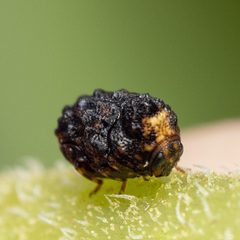
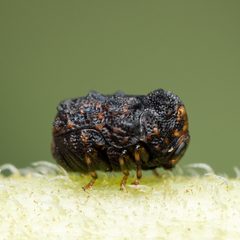
Exema is a of warty leaf beetles in the tribe Fulcidacini, Cryptocephalinae. These small beetles (2–3 mm) are renowned for their remarkable fecal mimicry—when disturbed, they retract their , legs, and into grooves, resembling caterpillar . The genus occurs worldwide with at least 9 in North America. Exema species have been documented on Asteraceae including gray-headed coneflower (Ratibida pinnata) and sweet coneflower (Rudbeckia subtomentosa). Larvae are case-bearing, constructing protective cases from their own .
Pronunciation
How to pronounce Exema: /ɛkˈsɛ.ma/
These audio files are automatically generated. While they are not always 100% accurate, they are a good starting point.
Identification
Distinguished from other leaf beetles by the combination of extremely small size (2–3 mm), compact body form, and the distinctive defensive of complete appendage retraction into body grooves. Resembles caterpillar so closely that it is easily overlooked. Distinguished from the related Neochlamisus (slightly larger at 3–4 mm) by size and associations—Exema is typically found on Asteraceae while Neochlamisus occurs on oaks. When appendages are extended, the shape becomes apparent, but when retracted the mimicry is nearly perfect.
Images
Appearance
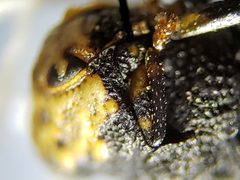
Small beetles measuring 2–3 mm in length. Body compact with a -like appearance in coloration, shape, and texture. When disturbed, the retracts and legs and fold into precisely matched grooves, eliminating any indication of being a . Some show variable coloration including an almost metallic sheen that resembles certain caterpillar frass. The overall form mimics lepidopteran larval in size, shape, and texture.
Habitat
Found in association with herbaceous vegetation, particularly in prairie and woodland edge . Documented in xeric dolomite prairie remnants, dry post oak woodland, and oak-pine woodland. Occurs on plants in open, sunny conditions.
Distribution
Worldwide distribution with documented occurrence in North America (at least 9 ), South America, and other regions. Specific records from Missouri, USA including Perry County and various prairie remnants in the White River Hills region.
Seasonality
have been observed during summer months, with records from mid-July through August in Missouri. Activity likely corresponds with plant .
Diet
Phytophagous; feed on Asteraceae including gray-headed coneflower (Ratibida pinnata) and sweet coneflower (Rudbeckia subtomentosa). Specific larval plants are presumed to match adult hosts but detailed documentation is limited.
Host Associations
- Ratibida pinnata - ADULT_FEEDINGgray-headed coneflower
- Rudbeckia subtomentosa - ADULT_FEEDINGsweet coneflower
Life Cycle
are equipped with a cap of that serves as starting material for the larval case. Larvae are case-bearing, constructing protective cases from their own feces (exuvial-fecal debris). The fecal case provides protection from . occurs within the case. emerge and feed on plant foliage.
Behavior
Exhibits remarkable defensive : when disturbed, the completely retracts its , legs, and into body grooves, becoming indistinguishable from caterpillar . If disturbance is sufficient to cause complete retraction, the beetle will likely roll off the leaf and fall to safety. This mimicry is so convincing that the beetles are frequently overlooked by collectors and naturalists. are active on plant foliage during daylight hours.
Ecological Role
Herbivore feeding on Asteraceae vegetation. The fecal mimicry and case-bearing larval habit represent unique defensive adaptations against . Likely serves as prey for when mimicry fails, though specific predator records are lacking.
Human Relevance
No documented economic importance. Occasionally encountered by entomologists and naturalists in prairie . The remarkable mimicry makes this a noteworthy example of defensive in insects, though the small size and cryptic appearance mean it often goes unnoticed.
Similar Taxa
- NeochlamisusAlso in tribe Chlamisini with similar -mimicry , but larger (3–4 mm vs. 2–3 mm) and typically associated with oaks (Quercus) rather than Asteraceae
- Other CryptocephalinaeShare case-bearing larval habit but generally lack the extreme -mimicry and compact body form of Exema
More Details
Taxonomic Note
Exema is classified in the tribe Fulcidacini (formerly Chlamisini in some treatments), Cryptocephalinae. The was described by Lacordaire in 1848. The tribe Chlamisini was synonymized with Fulcidacini in recent treatments, though older literature may use Chlamisini.
Collection Notes
Due to their small size and exceptional mimicry, Exema are easily overlooked in the field. Sweeping herbaceous vegetation in prairie , particularly on Asteraceae in flower, is the most effective collection method. Specimens may be mistaken for debris or and discarded by inexperienced collectors.