
Exema dispar
Lacordaire, 1848
warty leaf beetle
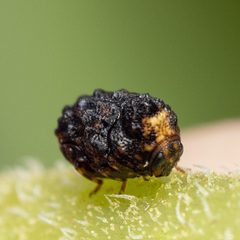
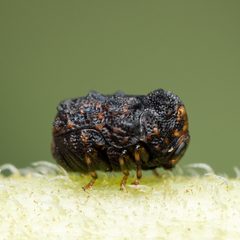
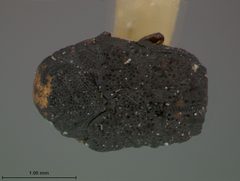
Exema dispar is a of warty in the tribe Chlamisini, known for remarkable mimicry of caterpillar . are small (2–3 mm), compact beetles with a rough, warty that closely resembles the size, shape, texture, and coloration of lepidopteran larval droppings. When disturbed, the retracts its and folds legs and into precisely matched grooves, eliminating any visible beetle-like features. This species has been observed on Asteraceae plants including gray-headed coneflower (Ratibida pinnata) and sweet coneflower (Rudbeckia subtomentosa).
Pronunciation
How to pronounce Exema dispar: /ˈɛk.sɛ.mə dɪsˈpɑr/
These audio files are automatically generated. While they are not always 100% accurate, they are a good starting point.
Identification
Distinguished from other leaf beetles by its uncanny resemblance to caterpillar —small, dark, irregular pellets. When disturbed, legs and fold flush into body grooves, unlike any other group. Distinguished from the related Neochlamisus by smaller size (Neochlamisus is 3–4 mm) and association with Asteraceae rather than oaks. Active beetles may be detected by subtle symmetry or slight metallic reflection not present in actual frass.
Images
Habitat
Associated with Asteraceae plants in open and edge . Documented on gray-headed coneflower (Ratibida pinnata) and sweet coneflower (Rudbeckia subtomentosa). Likely occurs in prairies, meadows, and woodland edges where plants grow.
Distribution
North America; confirmed present in Ontario, Canada and Missouri, USA. Expected range includes eastern and central North America where suitable Asteraceae occur.
Seasonality
active during spring and summer; observations peak during growing season of plants.
Diet
feed on foliage of Asteraceae. Larvae are case-bearing, constructing protective cases from their own .
Host Associations
- Ratibida pinnata - food plantgray-headed coneflower
- Rudbeckia subtomentosa - food plantsweet coneflower
Life Cycle
Females lay equipped with a fecal cap that serves as starting material for the larval case. Larvae are case-bearing, constructing and living within a portable case made from their own excrement. The case likely provides protection from . and occur within or after the case stage.
Behavior
When disturbed, retract the and fold legs and into body grooves, becoming visually indistinguishable from caterpillar . If disturbance is sufficient, beetles may roll off leaves to escape. This cryptic is complemented by motionless resting posture.
Ecological Role
Herbivore feeding on native Asteraceae. The remarkable -mimicry represents a defensive against visually hunting such as birds and . Larval fecal cases may contribute to nutrient cycling through mechanical processing of plant material.
Human Relevance
No documented economic importance. Occasionally encountered by entomologists and naturalists; serves as an excellent example of and in educational contexts. Not a pest of cultivated plants.
Similar Taxa
- Neochlamisus spp.Larger warty leaf beetles (3–4 mm) with similar -mimicry but associated with oaks (Quercus) rather than Asteraceae.
- Other ChlamisiniShare the tribe's characteristic -mimicry and retractile appendages, but differ in size, association, and geographic distribution.
More Details
Mimicry specificity
The mimicry extends beyond static appearance: the variable coloration, including metallic sheen in some individuals, matches the variable appearance of caterpillar from different herbivore and plant diets.
Taxonomic history
The tribe Chlamisini was revised by Karren (1966), who provided the definitive treatment of Exema in North America north of Mexico.