
Fulcidacini
Jakobson, 1924
Warty Leaf Beetles
Genus Guides
5- Chlamisus(Cloaked Warty Leaf Beetles)
- Diplacaspis
- Exema(warty leaf beetles)
- Neochlamisus(warty leaf beetles)
- Pseudochlamys
Fulcidacini is a tribe of leaf beetles (Chrysomelidae) within the Cryptocephalinae, historically treated as the distinct subfamily Chlamisinae. The tribe comprises 11 and approximately 400 , with roughly 80% of species occurring in the Neotropics. Members are commonly known as warty leaf beetles due to their distinctive appearance and are characterized by case-bearing larvae that construct protective cases from fecal material.
Pronunciation
How to pronounce Fulcidacini: /fʊl.kɪˈdæ.sɪ.naɪ/
These audio files are automatically generated. While they are not always 100% accurate, they are a good starting point.
Identification
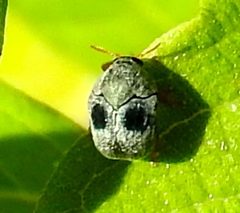
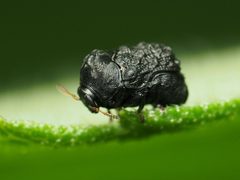
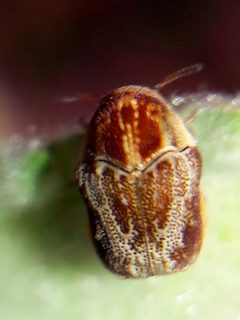
Fulcidacini can be distinguished from other Cryptocephalinae by the tuberculate texture of the and pronotum combined with the distinctive defensive of retracting all appendages. The tribe differs from the superficially similar Cassidinae (tortoise beetles) in body shape and larval —Cassidinae larvae carry exuvial-fecal shields on caudal appendages rather than constructing complete portable cases. Within Fulcidacini, are distinguished by subtle morphological characters: Neochlamisus are generally larger (3–4 mm) and associated with woody , particularly oaks; Exema species are smaller (2–3 mm) and typically found on Asteraceae.
Images
Appearance
are small beetles, typically 2–4 mm in length, with a compact, rounded body form. The and pronotum are often tuberculate or warty in texture, contributing to the . Coloration is generally cryptic, ranging from brown to black, often with a slight metallic sheen. When disturbed, adults retract the and fold legs and into precisely matched grooves, rendering the body outline smooth and compact. Larvae are case-bearing, enclosed in portable cases constructed from fecal material and .
Habitat
Members occur in diverse terrestrial including deciduous forests, woodlands, and prairie-woodland interfaces. Specific microhabitats include foliage of plants, where feed and larvae develop. Neochlamisus are frequently found on oak foliage in mesic to dry-mesic deciduous forests. Exema species inhabit herbaceous vegetation, particularly composite flowers and associated foliage.
Distribution
The tribe has a worldwide distribution except Antarctica, with the highest diversity in the Neotropics where approximately 320 of the 400 occur. Remaining species are distributed across North America, Eurasia, Africa, and Australasia. In North America, the tribe is represented by six including Chlamisus, Diplacaspis, Exema, Neochlamisus, and Pseudochlamys.
Seasonality
are active primarily during the growing season, with peak activity in late spring through fall. In temperate regions, observations extend from May through October, with specific timing varying by latitude and elevation. Larval development occurs during summer months.
Diet
and larvae are phytophagous, feeding on foliage of plants. Neochlamisus feed on woody plants, particularly oaks (Quercus spp.), with specific host associations including Quercus velutina (black oak) and Quercus imbricaria (shingle oak). Exema species feed on herbaceous plants, particularly members of Asteraceae including Ratibida pinnata (gray-headed coneflower) and Rudbeckia subtomentosa (sweet coneflower).
Host Associations
- Quercus velutina - and larval food plantBlack oak; Neochlamisus observed feeding on foliage
- Quercus imbricaria - and larval food plantShingle oak; Neochlamisus associated with this
- Ratibida pinnata - and larval food plantGray-headed coneflower; Exema observed on this
- Rudbeckia subtomentosa - and larval food plantSweet coneflower; Exema associated with this
Life Cycle
Females deposit equipped with a fecal cap that serves as starting material for the larval case and likely deters . Larvae are case-bearing, constructing portable protective cases from their own and . The case is carried throughout larval development. occurs within the case. The case-bearing habit is shared with other Cryptocephalinae but distinguished by the specific use of fecal material.
Behavior
exhibit remarkable defensive : when disturbed, the is retracted and legs and are folded into precisely matched grooves on the body, leaving no indication of appendages. This behavior, combined with cryptic coloration and compact shape, results in effective mimicry of caterpillar (). The mimicry is enhanced by variable coloration including metallic sheen that resembles certain caterpillar frass. Upon sufficient disturbance causing complete appendage retraction, beetles often roll off leaves to escape.
Ecological Role
As primary consumers, Fulcidacini contribute to nutrient cycling through herbivory on foliage. Their specialized associations, particularly with oaks and composite plants, represent evolved plant-insect relationships. The case-bearing larval habit and associated maternal investment in protection represent significant reproductive energy allocation. The -mimicry of represents a notable example of defensive mimicry in beetles.
Human Relevance
No significant direct economic impact. Some in related groups have been investigated for potential. The group is of interest to entomologists studying defensive mimicry, case-bearing , and plant-insect . The tribe's distinctive appearance and behavior make it a subject of natural history observation and photography.
Similar Taxa
- CassidinaeBoth groups have larvae that use fecal material defensively, but Cassidinae larvae carry exuvial-fecal shields on caudal appendages rather than constructing complete portable cases; have more flattened, tortoise-like body form with expanded elytral margins
- Other Cryptocephalinae tribesNon-Fulcidacini Cryptocephalinae lack the pronounced tuberculate texture of the and pronotum; they also lack the distinctive -mimicry defensive of retracting all appendages into body grooves
More Details
Taxonomic History
The group was historically treated as the distinct Chlamisinae but is now classified as the tribe Fulcidacini within Cryptocephalinae. This reclassification reflects phylogenetic relationships based on morphological and molecular data.
Larval Case Construction
The case-bearing habit is a defining feature of the Cryptocephalinae. In Fulcidacini, the case is constructed primarily from larval , with incorporated. This differs from some other case-bearing beetles that use plant material or silk.
Mimicry Effectiveness
The -mimicry of Fulcidacini is sufficiently convincing that observers frequently mistake disturbed beetles for inanimate debris; the mimicry includes not only visual but textural and behavioral components (remaining motionless when appendages are retracted).