
Exema elliptica
Karren, 1966
warty leaf beetle
Exema elliptica is a of warty leaf beetle in the Chrysomelidae, described by Karren in 1966. It belongs to the tribe Chlamisini, commonly known as warty leaf beetles, which are characterized by their remarkable -mimicry defense. The species is found in North America, though specific details about its and associations remain poorly documented.

Pronunciation
How to pronounce Exema elliptica: /ɛkˈsɛmə ɪˈlɪptɪkə/
These audio files are automatically generated. While they are not always 100% accurate, they are a good starting point.
Identification
Exema elliptica can be distinguished from other Exema by its elliptical body shape, as referenced in the species epithet. Within the tribe Chlamisini, Exema species are generally smaller (2–3 mm) than Neochlamisus species (3–4 mm). The Exema is associated with Asteraceae plants, whereas Neochlamisus species are typically found on oaks (Quercus). However, specific diagnostic features separating E. elliptica from are not well documented in available sources.
Images
Appearance
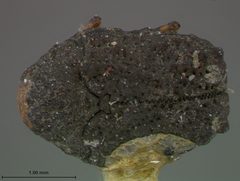
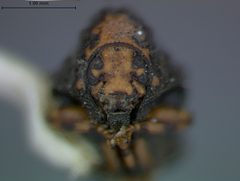
are small, measuring approximately 2–3 mm in length. Like other members of the Exema, they have an elliptical, compact body form with a rough, warty texture to the . The coloration is typically dull brown or black, contributing to their resemblance to caterpillar . The , legs, and can be retracted into grooves on the surface, rendering the nearly indistinguishable from lepidopteran when disturbed.
Habitat
Associated with herbaceous vegetation in open , particularly areas supporting Asteraceae. Specific microhabitat preferences are poorly documented.
Distribution
Recorded from North America. Precise range boundaries within North America are not established in available literature.
Diet
feed on foliage of Asteraceae, including gray-headed coneflower (Ratibida pinnata) and sweet coneflower (Rudbeckia subtomentosa). Larval feeding habits are presumed similar to other Chlamisini, but specific records for E. elliptica are not documented.
Host Associations
- Ratibida pinnata - food plantgray-headed coneflower
- Rudbeckia subtomentosa - food plantsweet coneflower
Life Cycle
Case-bearing larvae construct protective cases from fecal material and , a characteristic of the Cryptocephalinae. Females deposit with a fecal cap that serves as the foundation for the larval case. Specific developmental details for E. elliptica are not documented.
Behavior
When disturbed, retract the and fold legs and into precisely matched grooves, leaving no indication of appendages. This complete retraction, combined with the body texture and coloration, produces highly effective mimicry of caterpillar . If disturbance is sufficient, the may roll off the leaf and fall to the ground.
Ecological Role
Herbivore on Asteraceae foliage. The -mimicry defense likely reduces pressure from visual . Larval case-bearing habit may provide additional protection from predators and desiccation.
Human Relevance
No documented economic or medical significance. The is not known to be a pest of cultivated plants.
Similar Taxa
- NeochlamisusLarger size (3–4 mm vs. 2–3 mm), associated with Quercus rather than Asteraceae
- Other Exema speciesBody shape differences; E. elliptica specifically distinguished by elliptical form, though detailed comparative are lacking
More Details
Feces-mimicry defense
The tribe Chlamisini represents an exceptional case of defensive mimicry, with closely resembling lepidopteran in size, shape, texture, and coloration. This mimicry extends to behavioral components: the retraction of appendages eliminates all visual cues of animacy.
Taxonomic history
Described by J.B. Karren in 1966. The Exema was revised by Schultz in 1976 for North American .