
Synanthedon rileyana
(Edwards, 1881)
horsenettle borer, Riley's clearwing moth
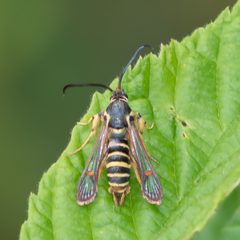
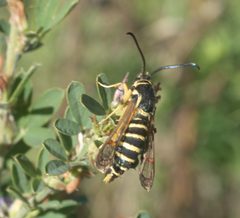
Synanthedon rileyana is a clearwing moth in the Sesiidae, notable for its effective mimicry. are and active from late spring through early autumn. The is distinguished from similar clearwing moths by complete yellow banding on all abdominal segments and a red on the forewing. Larvae are borers in horsenettle (Solanum carolinense), a weedy plant common to sandy agricultural areas.
Pronunciation
How to pronounce Synanthedon rileyana: /sɪnænˈθiːdɒn raɪliˈænə/
These audio files are automatically generated. While they are not always 100% accurate, they are a good starting point.
Identification
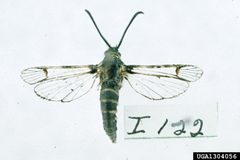
Distinguished from other Synanthedon by yellow banding on every abdominal segment (not partial banding) and the presence of a red on the forewing. Similar to S. decipiens and other clearwing moths but differs in abdominal pattern and association. The combination of complete abdominal banding, red forewing discal cell, and association with horsenettle provides reliable identification.
Images
Appearance
are -mimicking clearwing moths with transparent, narrow wings due to reduced scaling. The body is elongate with yellow banding on every abdominal segment. The forewing possesses a distinctive red . Wingspan measures 20–23 mm. Males have bipectinate (feathery) used to detect female .
Habitat
Sandy areas in agricultural landscapes, particularly fence rows, drainage ditches, and fields where horsenettle (Solanum carolinense) grows. Associated with disturbed, open in the central and eastern United States.
Distribution
United States: recorded from Arkansas, Arizona, Missouri, Oklahoma, North Carolina, Pennsylvania, and Vermont. Distribution centered in the central and eastern United States.
Seasonality
active from May to September. Multiple per year occur, with peak activity in late summer. In Missouri, adults have been observed in September, suggesting a bimodal or extended period.
Diet
Larvae feed internally as borers in stems of Solanum carolinense (horsenettle, Carolina horsenettle). feeding habits not documented.
Host Associations
- Solanum carolinense - larval plantlarvae bore into stems
Life Cycle
Larval stage occurs within stems of horsenettle. Multiple per year suggested by extended period from May through September. site not documented. stage unknown.
Behavior
are and active during daylight hours. Males use to locate females, detecting -specific blends at extremely low concentrations. Adults are not attracted to light traps. Effective mimicry in , with elongate body form and color pattern suggesting hymenopteran identity.
Ecological Role
Larval borer in horsenettle, a native weedy plant. May contribute to biological suppression of this plant in agricultural settings. serve as when visiting flowers. Was
Human Relevance
Larvae bore into horsenettle, a problematic agricultural weed, potentially providing incidental . No significant economic damage to crops documented. occasionally mistaken for stinging due to mimicry.
Similar Taxa
- Synanthedon decipiensOak gall borer with different (oak galls) and abdominal banding pattern; lacks complete yellow banding on all segments and red forewing
- Synanthedon acerniMaple borer with different (Acer) and abdominal pattern; has been recorded at blacklights unlike S. rileyana
- Synanthedon scitulaDogwood borer with different (Cornus) and coloration; also recorded at blacklights
Misconceptions
are frequently mistaken for due to effective mimicry, including body shape, coloration, and . This mimicry is protective against but leads to human misidentification.
More Details
Pheromone biology
Males detect female-emitted at concentrations of only a few molecules, enabling location of mates across distances. Synthetic pheromone blends are used in agricultural survey and detection programs for related sesiid pests.
Taxonomic history
Originally described as Albuna rileyana by Edwards in 1881, later transferred to Synanthedon. The specific epithet honors someone, likely an entomologist of the period.