
Synanthedon decipiens
(Edwards, 1881)
oakgall clearwing, oak gall borer, Oak Gall Borer Moth
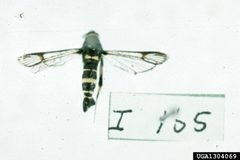
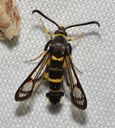
Synanthedon decipiens is a clearwing moth in the Sesiidae, found in eastern North America. The develops as a borer within woody oak galls formed by cynipid . are active primarily in June, with a possible second in September in some regions. The exhibits effective wasp mimicry, with a slender body, narrow transparent wings, and yellow abdominal banding.
Pronunciation
How to pronounce Synanthedon decipiens: /sɪˈnænθɪdɒn dɪˈsɪpiɛnz/
These audio files are automatically generated. While they are not always 100% accurate, they are a good starting point.
Identification
Distinguished from similar clearwing moths by its association with oak galls and specific wing pattern. Most similar to other Synanthedon , but S. decipiens specifically targets cynipid galls on oaks. The combination of small size (12 mm wingspan), eastern North American distribution, and from oak galls is diagnostic. may be separated from wasps by the presence of on wing margins and body, and by resting posture with wings folded along body.
Images
Habitat
Associated with oak forests and woodlands where galls occur. observed nectaring on flowers including goldenrod (Solidago ). Larval confined to woody galls on oak trees formed by cynipid .
Distribution
Eastern North America, ranging west to the Rocky Mountains. Records from throughout the eastern United States. Distribution tied to presence of oak and their associated cynipid gall-formers.
Seasonality
active primarily in June. Evidence from Georgia suggests a bimodal seasonal pattern with possible second in September. September records from Missouri support this potential two-generation cycle in at least part of the range.
Host Associations
- cynipid wasp galls on oaks - larval developmentLarvae bore within woody oak galls induced by cynipid ( Cynipidae). Specific gall-forming wasp not definitively documented in sources.
Life Cycle
Larva bores within woody oak gall, feeding on gall tissue. occurs within the gall. emerges from gall, leaving an exit hole. Adult stage brief, focused on mating and . Number of per year possibly two in southern portions of range, one in northern areas.
Behavior
are and engage in mimicry, including wasp-like . Males use to locate females; males have been observed approaching pheromone lures. Adults visit flowers for nectar. Generally not attracted to light traps, though some related Synanthedon occasionally appear at blacklights.
Ecological Role
Larva acts as a secondary inhabitant of oak galls, utilizing structures created by gall-forming cynipid . serves as when nectaring. Was mimicry provides protection from .
Human Relevance
No significant economic impact documented. Occasionally encountered by entomologists and naturalists. -based survey methods developed for related clearwing have been applied to this group for detection and monitoring.
Similar Taxa
- Synanthedon acerniAnother eastern North American Synanthedon ; distinguished by association with maple rather than oak galls, and different .
- Synanthedon scitulaRelated clearwing occasionally found at blacklights; differs in plant associations and geographic distribution patterns.
- Euhagena nebraskaeClearwing moth with similar mimicry but much larger size, strongly bipectinate male , white thoracic tufts, and western distribution.
More Details
Pheromone Biology
Males detect -specific female blends at extremely low concentrations, with behavioral responses elicited by only a few molecules. Synthetic pheromone components have been developed for survey and detection of clearwing moth pests, and these lures attract S. decipiens males.
Wasp Mimicry Effectiveness
The mimicry is sufficiently effective that observers frequently mistake for , even at close range. The combination of body shape, coloration, transparent wings, and creates a compelling hymenopteran illusion.