
Synanthedon scitula
(Harris, 1839)
dogwood borer, pecan borer, Dogwood Borer Moth
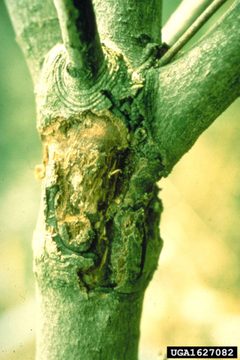
Synanthedon scitula is a clearwing moth in the Sesiidae and a significant pest of woody plants. Larvae tunnel into burrknot tissue and cambium of trees, causing damage ranging from localized feeding to tree death. The has one per year, with active from June through September. It is widely distributed across North America and has been recorded from numerous host species including dogwood, pecan, apple, and many other hardwoods.
Pronunciation
How to pronounce Synanthedon scitula: //sɪˈnænθədɒn ˈsɪtjʊlə//
These audio files are automatically generated. While they are not always 100% accurate, they are a good starting point.
Identification
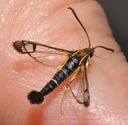
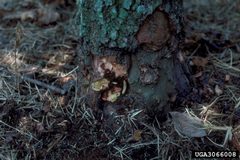
distinguished from other clearwing moths by combination of mostly clear wings, navy blue/black body with yellow markings, and specific abdominal pattern (yellow fourth segment in females, black with yellow ring in males). Larvae identified by cream body with red and association with burrknot tissue or bark scales on trees. Red pushed to surface and held by silk is diagnostic for larval presence.
Images
Habitat
Orchards, nurseries, and natural or ornamental stands of trees; specifically associated with burrknot tissue on above-ground portions of rootstocks and trunks. Larvae require burrknots, bark scales, or injured bark for initial establishment.
Distribution
Nearctic region; recorded across North America from southern Canada to Mexico. Specific records include western New York, northeastern United States ( June–September, peaking mid-July), with earlier emergence further south.
Seasonality
One per year. emerge from mid-June through early September, with peak in mid-July in the Northeast; emergence begins earlier in southern portions of range. Larvae overwinter in feeding tunnels and resume activity when temperatures exceed 7–10°C (45–50°F).
Diet
Larvae feed on woody tissue of plants, primarily in burrknots but also in cambium and main trunk. Three feeding types recognized: Type I (confined to burrknot, least harmful), Type II (extends to cambium adjacent to burrknot), and Type III (bark and main trunk, most damaging).
Host Associations
- Cornus florida - flowering dogwood - primary
- Carya illinoinensis - pecan - primary
- Malus - apple - clonal rootstocksmajor pest in orchards; larvae feed in burrknots on above-ground rootstock portions
- Acer - mapleattracted to lights; status confirmed
- Fagus - beech
- Betula - birch
- Castanea - chestnut
- Ulmus - elm
- Corylus - hazel
- Carya - hickory
- Sorbus - mountain-ash
- Quercus - oak
- Pinus - pine
- Salix - willow
- Myrica - bayberry
- Prunus serotina - black cherry
- Vaccinium - blueberry
Life Cycle
One annually. laid singly, hatch in 8–9 days. Larvae pass through six instars, initially burrowing into burrknot tissue or areas around bark scales. Larvae overwinter in feeding tunnels (2nd to 6th instar), resuming feeding when temperatures exceed 45–50°F. occurs in feeding tunnel within tough silken cocoon covered with ; pupal stage lasts 8–20 days depending on temperature. Pupa pushes out of cocoon before ; amber pupal case often remains on burrknot.
Behavior
Larvae push red to surface, held together by silk, creating visible sign of . are and have been observed coming to lights. Females have been observed with raised, tufted abdominal tips with spread, apparently releasing . Adults are effective mimics in .
Ecological Role
Pest ; no known beneficial ecological role. rates in apple orchards averaged 30% (range 0–100%). Several fungi and reported to attack the species but not yet used effectively for .
Human Relevance
Major economic pest of apple rootstocks, dogwood, pecan, and other woody plants in orchards and ornamental landscapes. Damage ranges from reduced yield to tree death. Management approaches include chlorpyrifos application timed to hatch, latex paint trunk barriers, and berming soil to graft union to prevent access to burrknots. Synthetic used for monitoring. Chemical destruction of burrknots with naphthaleneacetic acid ineffective and may worsen other borer problems.
Similar Taxa
- Synanthedon acerniMaple borer; also in Synanthedon, attracted to lights, but associated with maple rather than dogwood/pecan; abdominal markings differ
- Euhagena nebraskaeAnother sesiid clearwing moth with -mimic appearance, but has more extensive white markings, bipectinate male , and develops in roots of Onagraceae rather than woody tree trunks
- Other Synanthedon speciesMany are clearwing borers of woody plants; identification requires examination of abdominal pattern and association
Sources and further reading
- BugGuide
- Wikipedia
- GBIF taxonomy match
- iNaturalist taxon
- NCBI Taxonomy
- Catalogue of Life
- Euhagena nebraskae in Kansas | Beetles In The Bush
- Dogwood Borer, Synanthedon scitula (Harris) (Insecta: Lepidoptera: Sesiidae)
- SEASONAL BIOLOGY AND CONTROL OF THE DOGWOOD BORER, SYNANTHEDON SCITULA (LEPIDOPTERA: SESIIDAE) ON CLONAL APPLE ROOTSTOCKS IN NEW YORK