
Synanthedon myopaeformis
(Borkhausen, 1789)
Red-belted Clearwing, Apple Clearwing Moth
Synanthedon myopaeformis is a clearwing moth in the Sesiidae, native to Europe, North Africa, and western Asia, and introduced to North America (first detected in Canada in 2005). are and mimic in appearance, with transparent wings, dark coloration, and a distinctive red-orange band across the . Larvae are borers that tunnel under the bark of fruit trees, particularly apple, causing significant economic damage in orchards. The has become a major pest in North American apple production, prompting extensive research into monitoring and control methods.
Pronunciation
How to pronounce Synanthedon myopaeformis: /sɪˈnænθədɒn maɪəˈpiːfɔːrmɪs/
These audio files are automatically generated. While they are not always 100% accurate, they are a good starting point.
Identification
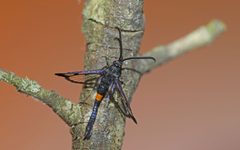
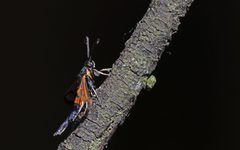
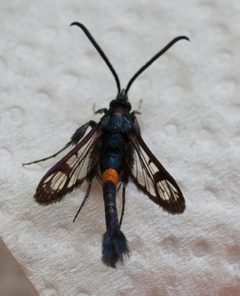
Distinguished from other clearwing moths by the combination of transparent wings with dark margins, blue-black body coloration, and the prominent red-orange abdominal band. In North America, distinguished from native Synanthedon by this red belt and association with apple orchards. Pupae with protruding golden-brown cases visible on bark are diagnostic. are and -mimicking in , unlike most .
Images
Appearance
have blue-black bodies with a dark orange-red transverse stripe across the segmented . Wings are largely transparent with dark margins and short fringe; forewings are 1.8–2.8 cm in wingspan, narrower and longer than hindwings. Adults possess short, bushy terminal abdominal tufts. Caterpillars are 2.5 cm long, off-white with reddish-brown . Pupae are approximately 1.5 cm long, golden brown, with two protruding from the head; pupal cases often visible protruding from bark.
Habitat
Found in and around apple orchards, gardens, woodlands, and hedgerows where trees occur. Larval development is strictly dependent on host trees with suitable bark conditions; larvae favor old, cankerous, or damaged trees where bark integrity is compromised. have been observed feeding on flowers of showy milkweed (Asclepias speciosa) in North America.
Distribution
Native to Europe, the Near East, and North Africa. Introduced to North America: first detected in southwestern Canada in 2005, subsequently found in the United States. Within its native range, widespread across western, central, and southern Europe.
Seasonality
emerge in early summer and are active from May through August. activity is temperature-dependent, ceasing when average temperatures drop to 15–16°C. Larval development spans approximately two years with two periods under bark.
Diet
Larvae feed on phloem and young plant tissues under the bark of trees, including apple (Malus), crab apple, pear (Pyrus), quince, plum, cherry, apricot, hawthorn (Crataegus), and mountain ash (Sorbus). feed on floral nectar; in British Columbia, specifically observed feeding on showy milkweed (Asclepias speciosa).
Host Associations
- Malus domestica - larval primary ; major economic impact
- Malus - larval apple including crab apple
- Pyrus - larval pear
- Prunus domestica - larval plum
- Prunus avium - larval cherry
- Prunus armeniaca - larval apricot
- Crataegus - larval hawthorn
- Sorbus - larval mountain ash
- Cydonia oblonga - larval quince
- Asclepias speciosa - nectar sourceobserved feeding in British Columbia; attracted by phenylacetaldehyde
Life Cycle
Approximately two-year with one . Females lay up to 250 singly on bark, typically in cracks or damaged areas. Larvae bore into phloem, creating visible trails; they feed during warm periods and overwinter under bark twice. After the second , larvae pupate in golden-brown cocoons that protrude from bark. Pupal stage lasts approximately two weeks. emerge in early summer.
Behavior
activity with strong temperature dependence; are significantly less active on cold days. Adults exhibit -mimicking appearance and flight . Males respond to female (3,13-octadecadienyl acetate). Both sexes are attracted to phenylacetaldehyde from flowers and to pear ester (ethyl-(E,Z)-2,4-decadienoate) combined with acetic acid. possess dichromatic vision based on UV and green photoreceptors, with peak sensitivity at 335–370 nm and 495–560 nm.
Ecological Role
Larval boring activity damages trees, reducing tree vigor and fruit production. In native range, part of natural forest and orchard ; in introduced range, pest disrupting commercial apple production. Serves as host for Liotryphon crassiseta and susceptible to (Steinernema), fungi ( bassiana, Metarhizium brunneum), and bacteria (Bacillus thuringiensis).
Human Relevance
Major economic pest of apple orchards in Europe and introduced North American range. Larval tunneling under bark girdles branches and trunks, reducing tree health and yield. Subject to extensive research including -based , mass trapping with color-selective traps, using natural enemies, and trunk coatings with oils or lime. Monitoring programs use pheromone traps for detection and timing of interventions.
Similar Taxa
- Synanthedon acerniNorth American native clearwing moth; lacks red abdominal band, associated with maple rather than apple
- Synanthedon scitulaNorth American native clearwing moth; different associations and abdominal coloration pattern
- Synanthedon fatiferaNorth American native ; bores into Viburnum crowns rather than fruit trees, different abdominal markings
- Melittia speciesOther clearwing moths with mimicry; typically larger, different wing patterns, and squash vine borer
More Details
Vision and Trap Color
Research demonstrates that trap color affects capture rates differentially depending on type. For -baited traps, yellow and green are most effective; for food baits (phenylacetaldehyde, grape juice), black and blue traps are superior. Fluorescent yellow traps reflecting both green and UV wavelengths catch fewer than standard yellow, suggesting antagonistic interactions between visual channels.
Female-Targeted Monitoring
Unlike most traps that capture primarily males, a combination of pear ester and acetic acid attracts both sexes with 40–80% female capture, enabling female-targeted monitoring.
Subspecies
Five recognized: S. m. myopaeformis, S. m. cruentata (Mann, 1859), S. m. graeca (Staudinger, 1871), S. m. luctuosa (Lederer, 1853), and S. m. typhiaeformis (Borkhausen, 1789).
Sources and further reading
- BugGuide
- Wikipedia
- GBIF taxonomy match
- iNaturalist taxon
- NCBI Taxonomy
- Catalogue of Life
- Euhagena nebraskae… again | Beetles In The Bush
- Female‐targeted attractant containing pear ester for Synanthedon myopaeformis
- Spectral efficiency and microstructure of the compound eyes ofSynanthedon myopaeformis(Lepidoptera: Sesiidae)
- REARING FRUIT TREE BORERS ON NATURAL HOSTS AND ARTIFICIAL MEDIUM DIET: 2. SYNANTHEDON MYOPAEFORMIS BORKH. (LEPIDOPTERA : AEGRIIDAE)
- Spectral discrimination by Synanthedon myopaeformis (Lepidoptera: Sesiidae) when orienting to traps baited with sex pheromone or feeding attractants
- Research on Performance of Synthetical Pheromonal Traps Properties in Studying Biology of Synanthedon Myopaeformis (Borkhausen, 1789) Specie
- Candidate Pheromone Receptors of the Red-Belted Clearwing Moth Synanthedon myopaeformis Bind Pear Ester and Other Semiochemicals
- Monitoring of the Red-Belted Clearwing Moth,Synanthedon myopaeformis, and its ParasitoidLiotryphon crassisetain Apple Orchards in Yellow Moericke Traps