
Eichlinia cucurbitae
(Harris, 1828)
Squash Vine Borer
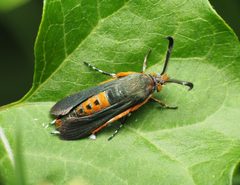
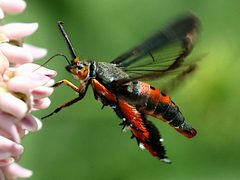
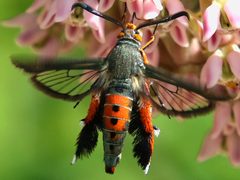
Eichlinia cucurbitae, commonly known as the squash vine borer, is a sesiid whose larvae are a major pest of cucurbit crops. The moth is a clearwing that mimics in appearance and . Larvae tunnel into the stems of plants, disrupting vascular tissues and causing vine wilt and death. The has a broad distribution in the Nearctic and Neotropical regions and typically produces two per year in temperate climates.
Pronunciation
How to pronounce Eichlinia cucurbitae: /ˈaɪklɪniə ˌkjuːkɜːrˈbaɪtiː/
These audio files are automatically generated. While they are not always 100% accurate, they are a good starting point.
Identification
distinguished from actual by the presence of on the body (visible upon close inspection) and the characteristic clear wings with dark borders. The bright orange hind leg patches are a key field mark. Larvae identified by their location inside cucurbit stems accompanied by (yellow-green excrement) at entry holes. Distinguished from other clearwing moths by association and the specific pattern of wing venation and body coloration.
Images
Habitat
Agricultural and garden settings where cucurbit crops are cultivated. Also found in wild where native cucurbits (Cucurbitaceae) occur. are active in open, sunny areas near plants.
Distribution
Nearctic and Neotropical regions. Documented throughout eastern and central North America, from southern Canada to northern South America. GBIF records confirm presence in both regions.
Seasonality
active from late spring through summer, with peak activity varying by latitude. Two per year typical in temperate zones: first generation emerges in late May to June, second generation in July to August. Overwinters as larvae or pupae in cocoons in soil.
Diet
Larvae feed internally on the vascular tissues of cucurbit stems and vines. plants include cultivated and wild in Cucurbitaceae, with strong preference for Cucurbita pepo (pumpkins, squash, zucchini), Cucurbita maxima, and Cucumis melo. Blue Hubbard squash is particularly attractive. do not feed; they rely on larval reserves.
Host Associations
- Cucurbita pepo - larval Highly preferred; includes pumpkins, summer squash, zucchini
- Cucurbita maxima - larval Includes Hubbard squash, a favored
- Cucumis melo - larval Melons
- Cucurbita moschata - larval Butternut squash; less frequently attacked
- Cucurbita argyrosperma - larval Cushaw squash; relatively
Life Cycle
Complete . hatch in approximately one week. Larvae bore into stems near the soil line or at leaf axils, feeding for 4-6 weeks. Mature larvae exit the plant and spin cocoons in soil, where they pupate. First emerge in 2-4 weeks; second generation larvae overwinter as or pupae in cocoons, with adult the following spring. Some may have a partial third generation in southern regions.
Behavior
are and exhibit -mimicry , including rapid, erratic and hovering near vegetation. Females deposit singly on leaf undersides and stems, typically near the base of plants. Larvae tunnel upward and downward in stems, pushing out of entry holes. When disturbed, larvae may wriggle vigorously within the stem.
Ecological Role
Primary consumer of cucurbit plants; significant agricultural pest. Larval tunneling disrupts water and nutrient transport, leading to plant death. Serves as prey for various including birds (which learn to avoid -mimicking ), wasps, and . Adults may contribute to pollination incidentally while visiting flowers.
Human Relevance
Major economic pest of cucurbit crops in North America. Damage can result in total crop loss in untreated gardens and small farms. Management strategies include floating (removed at flowering to allow pollination), trap cropping with Blue Hubbard squash, manual removal of and larvae, stem injection of , and applications. Subject of ongoing research in and .
Similar Taxa
- Melittia satyriniformisAnother clearwing moth with similar appearance, but associated with different plants (primarily wild cucurbits and rarely cultivated ); wing venation and body coloration differ slightly
- Synanthedon spp.Clearwing borers in Sesiidae, but typically attack woody plants (trees and shrubs) rather than herbaceous vines; often have different color patterns and periods
- Vespula spp.Yellowjacket which mimic; distinguished by two pairs of wings (wasps have one pair plus ), scaled body, and different antennal structure
Misconceptions
Often mistaken for a or due to ; this confusion can lead to unnecessary fear of the harmless . The 'squash vine borer' is sometimes applied loosely to other stem-boring pests, but properly refers only to this .
More Details
Taxonomic Note
Formerly classified as Melittia cucurbitae; transferred to Eichlinia based on phylogenetic revision of the tribe Melittiini. Some older literature and databases may still use the former combination.
Management Research
Recent studies indicate that injecting (Steinernema carpocapsae, Heterorhabditis bacteriophora) into infested stems can achieve larval mortality comparable to conventional , offering a alternative.
Sources and further reading
- BugGuide
- GBIF taxonomy match
- iNaturalist taxon
- Catalogue of Life
- Cucurbit catastrophe: Squash vine borer, Melittia cucurbitae — Bug of the Week
- Pumpkin vines on the menu: Squash vine borer, Melittia cucurbitae — Bug of the Week
- White-Eyed Fruit Flies: How Improvements in Gene Editing Could Aid in Pest Management