
Chamaesphecia
Spuler, 1910
Species Guides
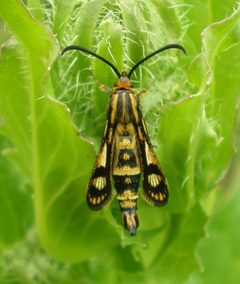
1- Chamaesphecia empiformis(cypress spurge clearwing)
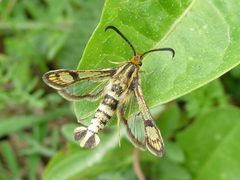
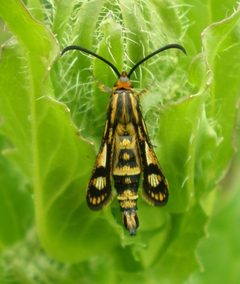
Chamaesphecia is a of clearwing moths (Sesiidae) established by Spuler in 1910, containing over 80 distributed primarily across the Palearctic region. Species are characterized by their -mimicking appearance and specialized larval associations with plants, particularly in the Euphorbiaceae and Lamiaceae. Several species have been investigated for of weeds, including leafy spurge (Euphorbia esula) and horehound (Marrubium vulgare). The genus is divided into two subgenera: Chamaesphecia and Scopulosphecia.
Pronunciation
How to pronounce Chamaesphecia: /ˌkæməˈsfɛʃiə/
These audio files are automatically generated. While they are not always 100% accurate, they are a good starting point.
Images
Distribution
Palearctic region, with highest diversity in Europe, Russia (including Crimea, Volgograd Region, Stavropol Territory, Northern Caucasus), Central Asia, and extending into Turkey and the Balkans. Individual show restricted distributions; for example, Chamaesphecia efetovi is documented from Crimea, Romania, Bulgaria, Serbia, and Turkey, while Chamaesphecia schmidtiiformis occurs on the Crimean Peninsula.
Human Relevance
Several Chamaesphecia have been evaluated as agents for plants. Chamaesphecia crassicornis was identified as the best candidate for controlling leafy spurge (Euphorbia esula) in North America due to larval survival rates on both the target weed and its European Euphorbia virgata. Chamaesphecia mysiniformis has been investigated for control of horehound (Marrubium vulgare) in Australia. Males of some species are attracted to synthetic , which has been used for detection and monitoring, though artificial were ineffective for Chamaesphecia schmidtiiformis.
Sources and further reading
- BugGuide
- Wikipedia
- GBIF taxonomy match
- iNaturalist taxon
- NCBI Taxonomy
- Catalogue of Life
- First records of Chamaesphecia efetovi O. Gorbunov, 2019 (Lepidoptera: Sesiidae) in Türkiye (Turkey)
- To the distribution of Chamaesphecia (Scopulosphecia) schmidtiiformis (Freyer, 1836) (Lepidoptera: Sesiidae) on the Crimean Peninsula (Russia)
- New data on distribution of Chamaesphecia efetovi O. Gorbunov, 2019, in the Crimea (Lepidoptera: Sesiidae)
- Biology and Host Specificity of Chamaesphecia mysiniformis (Lepidoptera: Sesiidae), a Potential Biological Control Agent of Marrubium vulgare (Lamiaceae) in Australia
- Description of EuropeanChamaespheciaspp. (Lepidoptera: Sesiidae) feeding onEuphorbia(Euphorbiaceae), and their potential for biological control of leafy spurge (Euphorbia esula) in North America