
Synanthedon albicornis
(Edwards, 1881)
Western Willow Clearwing Moth
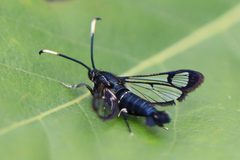
Synanthedon albicornis is a clearwing moth in the Sesiidae, commonly known as the Western Willow Clearwing Moth. The exhibits , with males possessing highly bipectinate (feathery) and distinctive white thoracic tufts composed of hair-like . Like other sesiids, it is a mimic with reduced wing scaling that creates a transparent appearance. The species is and generally not attracted to light traps.
Pronunciation
How to pronounce Synanthedon albicornis: //sɪˌnænˈθiːdɒn ˌælbɪˈkɔːrnɪs//
These audio files are automatically generated. While they are not always 100% accurate, they are a good starting point.
Identification
Males are distinguished by highly bipectinate and prominent white thoracic tufts formed by elongated, hair-like ; wing margins bear flattened scales that create a distinctive fringe. Females lack the feathery antennae and prominent thoracic tufts. The transparent wings with dark scaling along and margins create a -like appearance typical of the . Specific identification from similar Synanthedon requires examination of genitalia or reference to regional distribution and associations.
Images
Habitat
Associated with willow (Salix) ; occurs in open areas where plants grow, including prairie regions and riparian zones.
Distribution
Nearctic region: recorded from Alberta, Manitoba, and Saskatchewan in Canada; range extends through western North American prairie and parkland regions.
Seasonality
active in fall; observations include early October in Kansas and September-October in Nebraska.
Diet
Larvae bore into willow (Salix) stems and crowns; specific plant associations require Salix .
Host Associations
- Salix - larval willow
Life Cycle
Complete with larval boring stage in living willow stems; emerge in autumn. Specific details of and larval instars not documented in available sources.
Behavior
activity pattern; males have been observed perching on dried flower . Generally unresponsive to light traps, though some Synanthedon are occasionally collected at blacklights.
Ecological Role
Stem-borer in willow; contributes to nutrient cycling through wood decomposition. -mimicry likely provides protection from .
Human Relevance
Minor economic significance; larval boring may weaken or kill ornamental willow plantings, though less frequently reported than some like S. fatifera on Viburnum.
Similar Taxa
- Euhagena nebraskaeSimilar size, clearwing appearance, and prairie ; distinguished by male structure and thoracic tuft coloration (E. nebraskae males have different antennal and lack the prominent white thoracic tufts of S. albicornis)
- Synanthedon fatiferaCongeneric clearwing with similar ; distinguished by association (Viburnum versus Salix) and distribution pattern
- Synanthedon acerniCongeneric eastern occasionally attracted to lights; distinguished by geographic range and association with maple