
Synanthedon bibionipennis
(Boisduval, 1869)
Strawberry Crown Moth
Synanthedon bibionipennis is a clearwing moth in the Sesiidae, commonly known as the strawberry crown . are active from April to August and are . The has one per year. Larvae are borers that feed internally on the crowns and roots of various rosaceous plants.
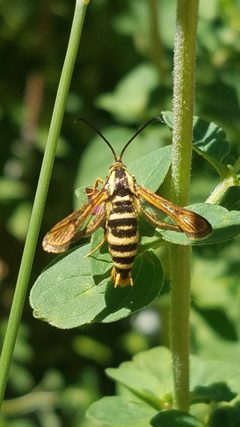
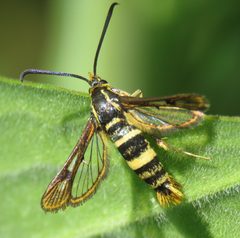
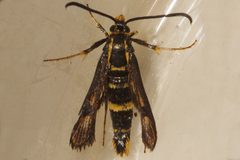
Pronunciation
How to pronounce Synanthedon bibionipennis: /sɪːˈnænθɪˌdɒn ˌbɪbiˌoʊnɪˈpɛnɪs/
These audio files are automatically generated. While they are not always 100% accurate, they are a good starting point.
Identification
The small size (20 mm wingspan) and western North American distribution help distinguish this from other Synanthedon. Clearwing moths in this require close examination of genitalia or specific wing venation patterns for definitive identification. The combination of transparent wings, -mimicking , and association with rosaceous plants provides field clues.
Images
Appearance
have a wingspan of approximately 20 mm. As a sesiid , the wings are largely transparent with reduced scaling along the margins, giving a -like appearance in . The body is slender with coloration typical of the .
Habitat
Associated with supporting its rosaceous plants, including agricultural settings, gardens, and wildlands where Fragaria, Rosa, Rubus, and Potentilla occur.
Distribution
Native to western North America: from Montana south to Texas, westward to the Pacific coast, and from British Columbia to California. Introduced and established in Hawaii.
Seasonality
are active from April to August. One per year.
Diet
Larvae feed internally on crowns and roots of various Rosaceae , including strawberry (Fragaria), rose (Rosa), raspberry/blackberry (Rubus), and cinquefoil (Potentilla).
Host Associations
- Fragaria - larval strawberry
- Rosa - larval
- Rubus - larval raspberry, blackberry
- Potentilla - larval cinquefoil
Life Cycle
One per year. Larvae are internal borers in plant crowns and roots. occurs within the host tissue or soil. emerge in spring and summer.
Behavior
are and active during daylight hours. Like most sesiids, they are generally not attracted to light traps. They exhibit -mimicking .
Ecological Role
As a borer in rosaceous plants, larvae can weaken or kill plants by damaging crowns and root systems. This is considered a pest in agricultural contexts.
Human Relevance
Economic pest of strawberry and other rosaceous crops. Larval boring damage reduces plant vigor and yield. Management may involve cultural controls or targeted applications.
Similar Taxa
- Synanthedon acerniAnother North American Synanthedon ; may overlap in range but associated with different (maple).
- Synanthedon scitulaAnother North American Synanthedon that has been observed at blacklights, unlike most sesiids.
- Synanthedon fatiferaSimilar member that bores into Viburnum crowns rather than Rosaceae.
More Details
Light Trap Avoidance
Most sesiid , including this , are not attracted to standard blacklight traps. lures are more effective for detection and monitoring.
Introduced Range
Established in Hawaii as an introduced , likely transported with plant material.