
Syntomeida epilais
Walker, 1854
Polka-Dot Wasp Moth, Oleander Moth, Uncle Sam Moth
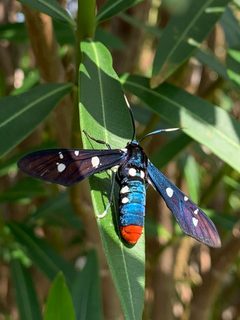
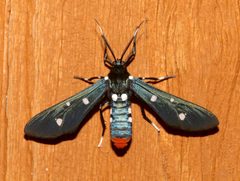
Syntomeida epilais, commonly known as the polka-dot or oleander moth, is a day-flying moth native to the Caribbean that has become established in the southeastern United States. The is notable for its striking aposematic coloration—iridescent blue wings with white polka-dots and a red-tipped —that mimics the appearance of stinging wasps. Both and larvae sequester cardiac glycosides from their plants, making them toxic to . The species possesses the most elaborate system known in the Erebidae, with females producing ultrasonic signals to attract mates and defend against bats.
Pronunciation
How to pronounce Syntomeida epilais: //sɪn.toʊˈmaɪ.də ˈɛ.pɪ.laɪs//
These audio files are automatically generated. While they are not always 100% accurate, they are a good starting point.
Identification
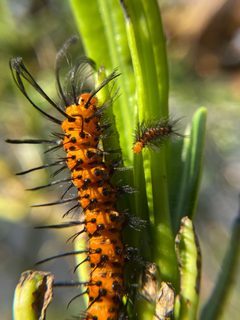
Distinguished from other wasp moths by the specific pattern of white polka-dots on metallic blue wings combined with the red abdominal tip. The spotted oleander caterpillar moth (Empyreuma pugione) is similar but has orange and black coloration rather than blue and white. Larvae are distinguished from the spotted oleander caterpillar by dark spots and black hair tufts (versus light-colored spots and reddish-brown hair tufts in E. pugione).
Images
Habitat
Associated with cultivated and ornamental plantings of oleander (Nerium oleander) in urban and suburban environments. In its native range, found in Neotropical areas with native Apocynaceae such as devil's-potato (Echites umbellata). are frequently observed flying around oleander hedges and bushes during daylight hours.
Distribution
Native to the Caribbean. Established in the southeastern United States: locally common throughout Florida, with records extending north to South Carolina and west to Mississippi and Texas. The North American S. e. jucundissima occurs in Florida and Georgia.
Seasonality
are active year-round in southern Florida, with peak activity during warmer months. In more northern parts of the range, adults are active primarily from spring through fall. Mating typically develops by the third night post-.
Diet
Larvae feed almost exclusively on oleander (Nerium oleander), an introduced plant in the Americas. They may also feed on desert rose (Adenium obesum) and, in their native range, on devil's-potato (Echites umbellata), which is believed to have been the ancestral plant. do not feed; they rely on energy reserves accumulated during the larval stage.
Host Associations
- Nerium oleander - larval food plantPrimary ; introduced to Americas in 17th century
- Echites umbellata - larval food plantNative in Florida and Caribbean, devil's-potato
- Adenium obesum - larval food plantDesert rose; secondary
Life Cycle
Females deposit groups of 12–75 spherical (pale cream to light yellow, <1 mm diameter) on the undersides of oleander leaves. Larvae hatch and feed gregariously when young, becoming solitary as they mature. They pass through several instars, consuming leaf tissue between (window-paning) when small, skeletonizing leaves when larger. occurs in silken cocoons in protected locations. emerge and do not feed. time varies with temperature; multiple generations occur annually in Florida.
Behavior
activity, unusual among . Females produce ultrasonic acoustic signals by vibrating thoracic tymbals to attract males; males respond with their own signals, creating an antiphonal duet essential for successful mating. Females modulate their acoustic responses based on context: during the first two nights post-, they respond strongly to bat attack sequences for defense; by the third night, they respond preferentially to male signals for courtship. Post-mated females cease responding to male signals while maintaining defensive responses to bats. Larvae are gregarious when young, solitary when older.
Ecological Role
As a herbivore, larvae can cause significant defoliation of oleander, particularly in ornamental plantings. The serves as to a diverse of and in Florida, including 12 documented parasitoid species (7 Hymenoptera, 5 Diptera) and 3 predator species. The most abundant parasitoid is the tachinid fly Lespesia archippivora. represents a documented case of Müllerian mimicry in the context of bat defense.
Human Relevance
Considered a pest of ornamental oleander in Florida and southern Georgia, where larval feeding can cause aesthetic damage and, in severe , plant death. using has been investigated. The striking appearance makes it a subject of interest for nature photographers and entomological education. No economic value as a food source or .
Similar Taxa
- Empyreuma pugioneSpotted oleander caterpillar moth; similar -mimic appearance and shared plant, but distinguished by orange and black coloration versus blue and white in S. epilais. Larvae have light-colored spots and reddish-brown hair tufts versus dark spots and black hairs.
- Amata spp.Related wasp moths in the same tribe (Syntomini); share general -mimic body plan but differ in color pattern, typically with black and yellow or black and white banding rather than polka-dots.
Misconceptions
Despite suggesting danger, the is entirely harmless and lacks a stinger. The larval setae, while visually intimidating, are non-urticating and do not cause skin irritation. The is not native to North America despite its establishment there.
More Details
Acoustic Communication
Possesses the most elaborate system documented in the Erebidae. Communication occurs via ultrasonic frequencies beyond human hearing range, with signals detectable at distances exceeding 5 cm.
Chemical Defense
Both life stages sequester cardiac glycosides (including oleandrin) from plants, rendering them toxic to vertebrate . This is the basis for the bright aposematic coloration.
Sources and further reading
- BugGuide
- Wikipedia
- GBIF taxonomy match
- iNaturalist taxon
- NCBI Taxonomy
- Catalogue of Life
- Doubling down on defense: The polka-dot wasp moth, Syntomeida epilais — Bug of the Week
- Two beauties doubling down on defense: The polka-dot wasp moth, Syntomeida epilais, and spotted oleander caterpillar moth, Empyreuma pugione — Bug of the Week
- Noctuidae | Beetles In The Bush | Page 3
- Notodontidae | Beetles In The Bush
- Bugs in Orange and Black III – Argus tortoise beetle, Chelymorpha cassidea; oleander caterpillar, Syntomeida epilais; and wheel bug, Arilus cristatus (MISSING LINKS) — Bug of the Week
- Oleander Caterpillar, Syntomeida epilais Walker (Insecta: Lepidoptera: Arctiidae)
- Parasitoids and Predators Associated with Syntomeida epilais (Lepidoptera: Arctiidae) on Oleander
- Is it a bat or a male? A female moth (Syntomeida epilais, Lepidoptera: Erebidae: Arctiinae) adapts its acoustic signals for defense or courtship