
Malacosoma constricta
Edwards, 1874
Pacific tent caterpillar
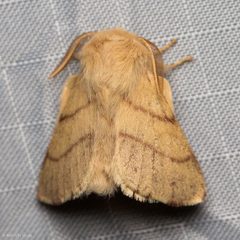
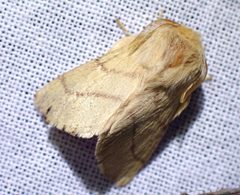
Malacosoma constricta, the Pacific , is a to western North America, recorded from California, Oregon, and Washington. The species is specialized on oaks (Quercus spp.) as larval . Two are recognized in California: M. c. austrinum occurs from Santa Barbara County southward, while M. c. constrictum occurs from Los Angeles County northward. The larvae construct small silken tents for group living and , feeding gregariously on oak foliage.
Pronunciation
How to pronounce Malacosoma constricta: /mæləkɔːˈsoʊmə kənˈstrɪktə/
These audio files are automatically generated. While they are not always 100% accurate, they are a good starting point.
Identification
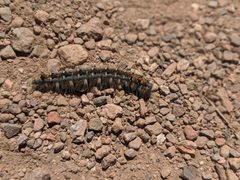
Larvae distinguished from other western tent caterpillars by the combination of: orange hairs with grayish/cream lateral hairs, dark blue , and speckled sides. The restriction to oak in California, Oregon, and Washington provides geographic and ecological separation from M. californicum (western tent caterpillar), which occurs on diverse hosts including desert almond, cherry, apple, alder, poplar, and willow. M. americanum (eastern tent caterpillar) occurs east of the Rocky Mountains. The small tent size (up to 10 cm) and structure contrasts with the larger, more elaborate tents of M. americanum.
Images
Appearance
Larvae have orange hairs on the surface, grayish or cream-colored hairs on the sides, and speckles along the lateral margins. The is dark blue. Larvae spin silken tents up to 10 cm wide. are laid in golden yellow clumps along sticks. are not described in available sources.
Habitat
California oak woodlands and associated oak-dominated . Larvae reported only on oaks (Quercus spp.).
Distribution
to western North America: California, Oregon, and Washington. In California, M. c. austrinum ranges from Santa Barbara County southward; M. c. constrictum occurs from Los Angeles County northward.
Seasonality
Larval activity coincides with spring leaf flush of oaks. Specific period not documented in available sources.
Diet
Larvae feed on oak (Quercus spp.) leaves. Gregarious feeding results in localized defoliation of branches.
Host Associations
- Quercus - primary Only reported ; larvae feed on leaves
Life Cycle
overwinter in golden yellow clumps laid along sticks. Larvae hatch in spring and construct silken tents. Larvae feed in groups outside the tent, entering only to . details not documented; likely occurs in silken cocoons away from tree based on congeneric patterns. emerge as ; specific timing unknown.
Behavior
Larvae exhibit communal living in silken tents. Group foraging outside the tent; tent used primarily for molting and . Trail- likely used for recruitment to food sources, as documented in , but not explicitly confirmed for this .
Ecological Role
Defoliator of oaks; localized branch defoliation occurs but typically does not cause major damage to healthy trees. Serves as food source for and . May contribute to nutrient cycling through deposition.
Human Relevance
Occasional nuisance when present in high numbers. Aesthetic impacts from visible tents and defoliation. Control rarely necessary; manual removal of masses or tents effective. Not associated with Mare Reproductive Loss (unlike M. americanum).
Similar Taxa
- Malacosoma californicumWestern tent caterpillar; broader range (desert almond, cherry, apple, alder, poplar, willow), not restricted to oaks; occurs in desert and montane beyond oak woodlands
- Malacosoma americanumEastern tent caterpillar; geographically separated (eastern North America), on Rosaceae (cherry, apple, crab apple), constructs larger and more elaborate tents in branch crotches
- Malacosoma disstriaForest ; lacks true tent, makes silken mats on branches, broader range including maple, birch, aspen
Sources and further reading
- BugGuide
- Wikipedia
- GBIF taxonomy match
- iNaturalist taxon
- Catalogue of Life
- Get them when they're little - Eastern tent caterpillar, Malacosoma americanum — Bug of the Week
- Hairy wanderers - Eastern tent caterpillars, Malacosoma americanum — Bug of the Week
- Time for tents - Eastern tent caterpillar, Malacosoma americanum — Bug of the Week
- Return of the tent makers - Eastern tent caterpillar, Malacosoma americanum — Bug of the Week
- Tents in the Mojave: Western tent caterpillar, Malacosoma californicum — Bug of the Week
- The silk trail - Eastern tent caterpillar, Malacosoma americanum — Bug of the Week