
Malacosoma incurva
(Edwards, 1882)
Southwestern Tent Caterpillar Moth
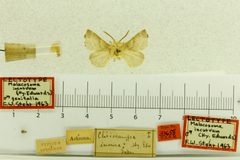
Malacosoma incurva is a native to the southwestern United States. have a wingspan of approximately 27 mm. The larvae construct silken tents and feed on specific plants including Fremont cottonwood, willows, and Prunus . The species was first described by Henry Edwards in 1882 and is distinguished from related eastern and western tent caterpillars by its restricted geographic range.
Pronunciation
How to pronounce Malacosoma incurva: /ˌmæləkəˈsoʊmə ɪnˈkɜrvə/
These audio files are automatically generated. While they are not always 100% accurate, they are a good starting point.
Identification
Distinguished from the eastern tent caterpillar (Malacosoma americanum) and western tent caterpillar (Malacosoma californicum) by its occurrence in the southwestern United States rather than eastern or western North America. are small with a wingspan of about 27 mm. Larvae likely share the hairy body and tent-building characteristic of the , though specific coloration patterns for M. incurva are not documented in available sources.
Images
Habitat
Associated with riparian and woodland supporting its plants, including areas with Populus fremontii, Salix , and Prunus species.
Distribution
Southwestern North America, specifically documented from Arizona, New Mexico, Nevada, and Utah.
Diet
Larvae feed on Populus fremontii (Fremont cottonwood), Salix (willow) , and Prunus species.
Host Associations
- Populus fremontii - larval food plantFremont cottonwood
- Salix - larval food plantwillow
- Prunus - larval food plantcherry and related
Similar Taxa
- Malacosoma americanumEastern tent caterpillar, occurs in eastern North America rather than the Southwest; larvae have distinctive blue stripes and white stripe
- Malacosoma californicumWestern tent caterpillar, occurs in western North America from Alberta to California; larvae feed on desert almond and other rosaceous plants in addition to willows and poplars
More Details
Subspecies
Two are recognized: Malacosoma incurva incurva and Malacosoma incurva discoloratum (Neumoegen, 1893).
Sources and further reading
- BugGuide
- Wikipedia
- GBIF taxonomy match
- iNaturalist taxon
- Catalogue of Life
- Get them when they're little - Eastern tent caterpillar, Malacosoma americanum — Bug of the Week
- Hairy wanderers - Eastern tent caterpillars, Malacosoma americanum — Bug of the Week
- Time for tents - Eastern tent caterpillar, Malacosoma americanum — Bug of the Week
- Return of the tent makers - Eastern tent caterpillar, Malacosoma americanum — Bug of the Week
- Tents in the Mojave: Western tent caterpillar, Malacosoma californicum — Bug of the Week
- The silk trail - Eastern tent caterpillar, Malacosoma americanum — Bug of the Week