
Malacosoma tigris
Dyar, 1902
Sonoran Tent Caterpillar
Malacosoma tigris, the Sonoran , is a tent caterpillar in the Lasiocampidae. It is one of several North American Malacosoma species that construct silken tents on plants. The species is distinguished by its distribution in the southwestern United States and Mexico. Like related tent caterpillars, it exhibits social larval and undergoes complete with , larva, pupa, and stages.
Pronunciation
How to pronounce Malacosoma tigris: /ˌmæ.lə.kəˈsoʊ.mə ˈtaɪ.ɡrɪs/
These audio files are automatically generated. While they are not always 100% accurate, they are a good starting point.
Identification
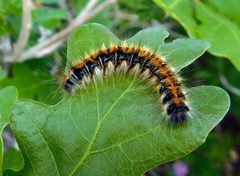
Distinguished from the eastern tent caterpillar (Malacosoma americanum) and western tent caterpillar (Malacosoma californicum) by geographic range; M. tigris occurs in the Sonoran Desert region and southwestern North America rather than eastern or western regions of the continent. Specific larval coloration and pattern distinguishing M. tigris from is not documented in available sources.
Images
Habitat
Associated with arid and semi-arid regions of the southwestern United States and northwestern Mexico, including Sonoran Desert .
Distribution
Southwestern United States (Arizona, New Mexico, southern California) and northwestern Mexico (Sonora, Baja California).
Seasonality
Larval activity in spring coinciding with plant leaf ; active in late spring to summer.
Life Cycle
are deposited in dark, Styrofoam-like masses encircling small branches. Larvae hatch in spring and construct silken tents on branches. As larvae grow, tents are enlarged and relocated to branch crotches. occurs in silken cocoons, often away from host plants in protected locations. emerge to mate and lay eggs for the following .
Behavior
Larvae are social, engaging in communal foraging and cooperative tent construction and maintenance. Trail- are used to recruit nestmates to food sources. Tents serve thermoregulatory functions, elevating body temperature for faster growth, and provide protection from and .
Ecological Role
Herbivore that can defoliate plants during years; serves as food source for , , and that regulate cycles.
Human Relevance
Can be a pest of ornamental and fruit trees in the Sonoran Desert region; manual removal of masses and tents is an effective management strategy. Burning tents is not recommended due to tree damage.
Similar Taxa
- Malacosoma americanumEastern tent caterpillar; occurs in eastern North America, distinguished by range and larval coloration (blue lateral stripes, white stripe).
- Malacosoma californicumWestern tent caterpillar; occurs in western North America from Alberta to California and Arizona, overlapping partially with M. tigris but distinguished by specific distribution and associations.
More Details
Hodges Number
MONA or Hodges number 7700.
Sources and further reading
- BugGuide
- Wikipedia
- GBIF taxonomy match
- iNaturalist taxon
- Catalogue of Life
- Get them when they're little - Eastern tent caterpillar, Malacosoma americanum — Bug of the Week
- Hairy wanderers - Eastern tent caterpillars, Malacosoma americanum — Bug of the Week
- Time for tents - Eastern tent caterpillar, Malacosoma americanum — Bug of the Week
- Return of the tent makers - Eastern tent caterpillar, Malacosoma americanum — Bug of the Week
- Tents in the Mojave: Western tent caterpillar, Malacosoma californicum — Bug of the Week
- The silk trail - Eastern tent caterpillar, Malacosoma americanum — Bug of the Week