
Orgyia vetusta
Boisduval, 1852
Western Tussock Moth
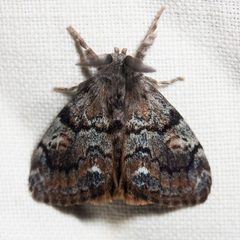
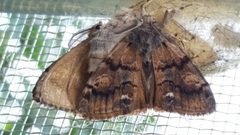
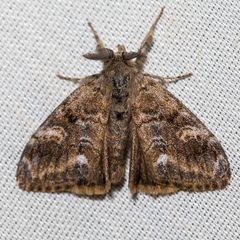
Orgyia vetusta, the Western Tussock , is a of tussock moth in the Erebidae. It is native to western North America, ranging from British Columbia through the Pacific States to New Mexico, with an isolated in Idaho. The species is known to undergo periodic , and females are wingless while males possess functional wings. Larvae are notable for their distinctive hair tufts and tussocks.
Pronunciation
How to pronounce Orgyia vetusta: /ɔːrˈdʒaɪə vəˈtʊstə/
These audio files are automatically generated. While they are not always 100% accurate, they are a good starting point.
Identification
Distinguished from Orgyia antiqua (Vapourer ) by geographic range—O. vetusta is western North American while O. antiqua is Palearctic. Distinguished from Orgyia pseudotsugata (Douglas-fir Tussock Moth) by larval coloration: O. pseudotsugata larvae have two prominent white hair tufts and lack the red lateral dots present in O. vetusta. males of Orgyia require genitalia examination or geographic context for reliable identification. The wingless female form is diagnostic for the Orgyia but not for species-level ID.
Images
Appearance
males have grayish-brown forewings with darker markings and feathery . Females are wingless, with a robust, grayish body covered in dense hair. Larvae display prominent hair tufts: four cream-colored tussocks on the back, paired red dots on the sides, and a distinctive black with white markings. The body is covered with long, irritating hairs.
Habitat
Found in mixed conifer and hardwood forests, particularly those containing oak, Douglas-fir, and other trees. Occupies elevations from sea level to montane zones. During , larvae may defoliate extensive areas of suitable forest.
Distribution
Pacific States of the United States (Washington, Oregon, California), British Columbia in Canada, and an isolated in Boise County, Idaho. Ranges eastward to New Mexico.
Seasonality
are active from late spring through summer, with timing varying by latitude and elevation. Larvae feed through summer and early autumn. occurs in cocoons attached to trees or debris, with adults emerging the following season.
Diet
Larvae feed on foliage of various woody plants including oaks (Quercus spp.), Douglas-fir (Pseudotsuga menziesii), manzanita (Arctostaphylos spp.), and other broadleaf and coniferous trees.
Host Associations
- Quercus - larval food plantoaks
- Pseudotsuga menziesii - larval food plantDouglas-fir
- Arctostaphylos - larval food plantmanzanita
Life Cycle
are laid in a mass on or near the female's cocoon. Larvae hatch and feed gregariously in early instars, becoming solitary later. They develop through five instars, pupating in silken cocoons incorporating body hairs. emerge after as pupae; females call males with and lay eggs on their cocoon without dispersing.
Behavior
Larvae are gregarious in early instars, dispersing as they mature. Females are sedentary, remaining at their cocoon and emitting to attract flying males. Males are strongly attracted to light. During years, larvae may descend from trees on silk threads to find new .
Ecological Role
Larvae function as herbivores that can substantially reduce leaf area of trees during , potentially affecting forest productivity. The serves as host for including Pimpla sanguinipes (Ichneumonidae), which contributes to . Larval hairs may irritate vertebrate , providing defensive protection.
Human Relevance
Periodic cause defoliation of forest and shade trees, occasionally reaching levels of economic or aesthetic concern. Larval hairs can cause skin irritation in sensitive individuals. The is monitored by forestry services as part of programs.
Similar Taxa
- Orgyia pseudotsugataDouglas-fir Tussock overlaps in range and use; distinguished by larval pattern (two white tufts vs. four cream tussocks and red dots in O. vetusta) and preference for fir over oak.
- Orgyia antiquaVapourer is Palearctic in distribution; O. vetusta is strictly Nearctic. Larvae of O. antiqua have different color pattern with yellow and black tussocks.
More Details
Outbreak dynamics
have been documented, with larvae capable of extensive defoliation. Natural enemies including and contribute to population collapse.
Taxonomic history
Formerly placed in Hemerocampa; transferred to Orgyia based on morphological and phylogenetic studies. The Orgyia is characterized by wingless females across all .