
Megacopta cribraria
(Fabricius, 1798)
kudzu bug, bean plataspid, globular stink bug, lablab bug
Megacopta cribraria is a plataspid shield bug native to South and East Asia that has become a significant pest in the southeastern United States since its discovery in Georgia in 2009. The exhibits a specialized symbiotic relationship with gut bacteria, particularly Candidatus Ishikawella capsulata, which enables it to feed on leguminous plants. North American descend from Japanese lineages and possess microbiomes that facilitate soybean , distinguishing them from some Asian populations. The is notable for its strong , attraction to white surfaces, and defensive secretion that causes odor, skin irritation, and staining.
Pronunciation
How to pronounce Megacopta cribraria: /ˌmɛɡəˈkɒptə krɪˈbrɛərɪə/
These audio files are automatically generated. While they are not always 100% accurate, they are a good starting point.
Identification
Distinguished from other stink bugs (Pentatomidae) by its globular, almost circular body shape and the greatly enlarged scutellum that covers most of the wings and . Differs from native plataspids in North America by its larger size and association with leguminous crops. Can be separated from the brown marmorated stink bug (Halyomorpha halys) by its more rounded, less angular body outline and uniform coloration without contrasting light and dark markings. on white surfaces is a behavioral cue for identification.
Images
Appearance
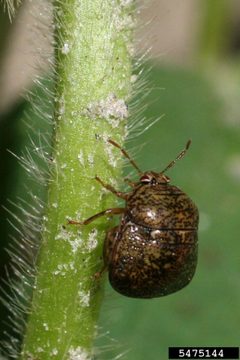
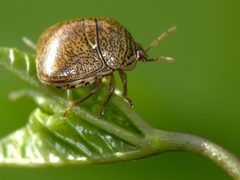
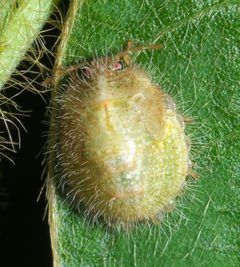
are approximately 4–6 mm in length with a distinctive square-ish, globular body shape resembling a squat armor breastplate. The surface is shiny olive-green to brown with punctate markings. Nymphs are football-shaped, lime-green, and conspicuously hairy. The body is strongly dorsoventrally flattened with the scutellum covering most of the , typical of Plataspidae.
Habitat
In its native range, found in agricultural and semi-natural associated with leguminous plants, particularly lablab beans, pigeon pea, cowpea, and kudzu. In the North American range, strongly associated with kudzu-infested areas, soybean fields, and at field edges. Overwinters in protected locations including leaf litter, beneath tree bark, and in human-made structures.
Distribution
Native to South and East Asia including India, China, Japan, Korea, Taiwan, Thailand, Vietnam, Indonesia, Malaysia, Myanmar, Nepal, Pakistan, Sri Lanka, and New Caledonia. Introduced to the United States, first detected in Gwinnett County, Georgia in October 2009. As of 2017, established in Alabama, Arkansas, Delaware, Florida, Georgia, Kentucky, Louisiana, Maryland, Mississippi, North Carolina, South Carolina, Tennessee, Virginia, Texas, and the District of Columbia.
Seasonality
emerge from sites in spring when temperatures warm, typically April–May in the southeastern United States. Multiple occur per year with peak in late summer and early autumn. Adults seek overwintering in autumn, often aggregating on building exteriors in September–November. activity occurs primarily between 07:30 and 19:30 with peak activity during midday.
Diet
Phloem sap obtained through ; feeds preferentially on tender new growth and stems over older foliage.
Host Associations
- Pueraria montana var. lobata - primary ( range)Major food source and in North America
- Glycine max - crop pestSoybean; causes yield reduction through feeding on stems, petioles, and nodes
- Lablab purpureus - crop pestLablab beans; primary in native range
- Cajanus cajan - Pigeon pea
- Vigna unguiculata - Cowpea
- Cyamopsis tetragonoloba - Guar
- Sesbania bispinosa - Danchi
- Ficus carica - occasional Fig; reported as unexpected in Maryland
Life Cycle
Females deposit barrel-shaped in rows on undersides of leaves. Nymphs hatch and undergo five instars before reaching adulthood. Nymphs are gregarious and found in with . Development rate and survival depend on access to maternal gut ; nymphs deprived of symbiont-containing pellets exhibit slower growth, smaller body size, and higher mortality. Multiple per year in the range.
Behavior
Exhibits strong , forming dense clusters on plants and sites. Attracted to high-reflectance white surfaces, including building walls and vehicles, due to visual cues from simple . Defensive secretion released when disturbed, crushed, or poked; secretion functions as both and congregation . behavior observed when contacting deterrent substances. activity temperature-dependent, with females flying faster than males due to larger body size. Aggregates at field edges rather than field interiors.
Ecological Role
Herbivore that reduces growth of kudzu, potentially providing incidental of this weed. However, spillover feeding on native and crop legumes creates negative economic impacts. Serves as for including Paratelenomus saccharalis and Ooencyrtus nezarae, which may regulate . Gut Candidatus Ishikawella capsulata has co-evolved with host populations across their geographic range.
Human Relevance
Significant agricultural pest of soybean, with potential to cause up to 60% yield loss in untreated fields. Nuisance pest in residential areas due to autumn on buildings, defensive odor, skin irritation, and staining of fabrics and surfaces. Subject to research including , breeding, and threshold-based application.
Similar Taxa
- Halyomorpha halysBrown marmorated stink bug; similar pest with defensive odor and building , but has more angular body shape, contrasting color pattern, and different range
- Nezara viridulaSouthern green stink bug; similar legume pest but belongs to Pentatomidae with triangular scutellum and different body proportions
- Megacopta punctatissimaFormerly treated as distinct ; phylogenetic analysis confirms conspecificity with M. cribraria, with Japanese previously assigned to this name
Sources and further reading
- BugGuide
- Wikipedia
- GBIF taxonomy match
- iNaturalist taxon
- NCBI Taxonomy
- From the mailbag: Fig-eating Kudzu bugs come to college, Megacopta cribraria — Bug of the Week
- For Kudzu Bugs, a Single Pesticide Application Targeting Nymphs is Most Cost-Effective
- Free Online Resource for Soybean Growers to Manage Kudzu Bugs
- Another Natural Enemy of Invasive Kudzu Bug Arrives in North America
- Dominic Reisig's Recap of the Entomology 2013 Meeting in Austin
- Invasive Species: Entomology's Role in a Multisector Mission
- Megacopta cribraria . [Distribution map].
- Mechanisms of Soybean Host-Plant Resistance Against Megacopta cribraria (Hemiptera: Plataspidae)
- Discovery and Distribution of Megacopta cribraria (Hemiptera: Heteroptera: Plataspidae) in Northeast Georgia
- Efficacy of aqueous Aegle marmelos leaf extract for the control of Megacopta cribraria
- Host plant resistance in soybean for pest management ofMegacopta cribraria(Hemiptera: Plataspidae)
- Stylet probing behaviors of the invasive kudzu bug,Megacopta cribraria,using electropenetrography
- Spatial distribution ofMegacopta cribrariaegg masses and parasitism byParatelenomus saccharalisin soybean
- Cold tolerance and overwintering behavior of kudzu bugs (Megacopta cribraria) at its northern limit
- Efficacy of aqueous Aegle marmelos leaf extract for the control of Megacopta cribraria
- Seasonal Occurrence and Interspecific Interactions of Egg Parasitoids of Megacopta cribraria (Heteroptera: Plataspidae) in Japan
- The effects of the juvenile hormone analogues on diapausingHalyomorpha halys, Megacopta cribraria andNezara viridula and associated hymenopteran egg parasitoids
- Diel flight pattern and size‐dependent flight speed of kudzu bug, Megacopta cribraria (Fabricius)
- First Record of Ooencyrtus nezarae (Hymenoptera: Encyrtidae), a Parasitoid of Megacopta cribraria (Hemiptera: Plataspidae) in Florida
- Host Preference of Megacopta cribraria (Hemiptera: Plataspidae) on Selected Edible Beans and Soybean
- Efficacy of Aqueous Aegle marmelos Leaf Extract for the Control of Megacopta cribraria (F.) (Hemiptera: Plataspidae)
- Diversity of the Obligate Gut Bacteria Indicates Host-Symbiont Coevolution at the Population Level in the Plataspid Stinkbug Megacopta cribraria.