
Megacopta
Hsiao & Jen, 1977
Species Guides
1- Megacopta cribraria(kudzu bug)
Megacopta is a of true bugs in the Plataspidae, containing at least 25 described distributed across Asia. The genus is best known for Megacopta cribraria, the kudzu bug, which became an pest in North America after its accidental introduction to Georgia in 2009. Members of this genus are phytophagous, with many species associated with leguminous plants. Several Megacopta species possess obligate bacterial gut that are essential for normal development and are transmitted via symbiont capsules deposited on masses.
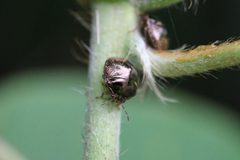
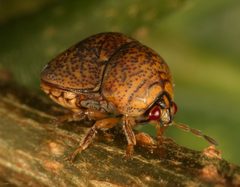
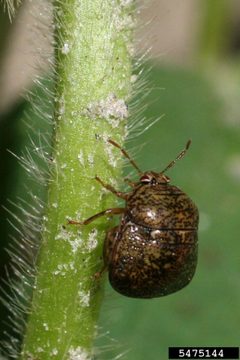
Pronunciation
How to pronounce Megacopta: /ˌmɛɡəˈkɒptə/
These audio files are automatically generated. While they are not always 100% accurate, they are a good starting point.
Images
Distribution
Native to Asia, with recorded from China, India, Indonesia, Japan, Korea, Malaysia, Myanmar, Nepal, Pakistan, Sri Lanka, Taiwan, Thailand, and Vietnam. Megacopta cribraria has been introduced to North America, where it is established in the southeastern and mid-Atlantic United States, and to New Caledonia in Oceania.
Human Relevance
Megacopta cribraria is a significant agricultural pest of soybean in the southeastern United States, capable of causing yield losses through phloem feeding. The also aggregates on human structures in autumn to seek , becoming a nuisance pest that releases foul defensive secretions when disturbed. These secretions can stain fabrics, walls, and skin, and may cause skin irritation or blisters in sensitive individuals. Other species in the have not been reported as economically important pests.
Similar Taxa
- Halyomorpha halys (brown marmorated stink bug)Both are Asian stink bugs that aggregate on buildings for and release defensive odors; however, Megacopta is in Plataspidae while Halyomorpha is in Pentatomidae, and Megacopta have a more rounded, globular body shape compared to the shield-shaped pentatomids.
- Nezara viridula (southern green stink bug)Both are phytophagous stink bugs that feed on legumes including soybean; Nezara is larger, green, and shield-shaped (Pentatomidae), while Megacopta is smaller, olive-brown, and more rounded (Plataspidae).
Sources and further reading
- BugGuide
- Wikipedia
- GBIF taxonomy match
- iNaturalist taxon
- NCBI Taxonomy
- From the mailbag: Fig-eating Kudzu bugs come to college, Megacopta cribraria — Bug of the Week
- Move over stink bugs, here comes the kudzu bug, Megacopta cribraria — Bug of the Week
- For Kudzu Bugs, a Single Pesticide Application Targeting Nymphs is Most Cost-Effective
- Another Natural Enemy of Invasive Kudzu Bug Arrives in North America
- Free Online Resource for Soybean Growers to Manage Kudzu Bugs
- Dominic Reisig's Recap of the Entomology 2013 Meeting in Austin
- Megacopta cribraria . [Distribution map].
- Mechanisms of Soybean Host-Plant Resistance Against Megacopta cribraria (Hemiptera: Plataspidae)
- Discovery and Distribution of Megacopta cribraria (Hemiptera: Heteroptera: Plataspidae) in Northeast Georgia
- Host plant resistance in soybean for pest management ofMegacopta cribraria(Hemiptera: Plataspidae)
- Efficacy of aqueous Aegle marmelos leaf extract for the control of Megacopta cribraria
- Stylet probing behaviors of the invasive kudzu bug,Megacopta cribraria,using electropenetrography
- Spatial distribution ofMegacopta cribrariaegg masses and parasitism byParatelenomus saccharalisin soybean
- Cold tolerance and overwintering behavior of kudzu bugs (Megacopta cribraria) at its northern limit
- Efficacy of aqueous Aegle marmelos leaf extract for the control of Megacopta cribraria
- The effects of the juvenile hormone analogues on diapausingHalyomorpha halys, Megacopta cribraria andNezara viridula and associated hymenopteran egg parasitoids
- Seasonal Occurrence and Interspecific Interactions of Egg Parasitoids of Megacopta cribraria (Heteroptera: Plataspidae) in Japan
- Diel flight pattern and size‐dependent flight speed of kudzu bug, Megacopta cribraria (Fabricius)
- First Record of Ooencyrtus nezarae (Hymenoptera: Encyrtidae), a Parasitoid of Megacopta cribraria (Hemiptera: Plataspidae) in Florida
- Capsule-Transmitted Gut Symbiotic Bacterium of the Japanese Common Plataspid Stinkbug, Megacopta punctatissima
- Biopesticide and Parasitoid Effects on Megacopta cribraria (Hemiptera: Plataspidae) Life Stage Density and Egg Parasitism in Soybean