
Plataspidae
shield bugs, kudzu bugs, plataspid bugs
Genus Guides
2- Brachyplatys(black bean bug)
- Megacopta
is a of shield bugs in the suborder Heteroptera, native to the Old World and primarily found in tropical and subtropical regions. Members are characterized by a greatly enlarged scutellum that covers most or all of the and wings. The family includes the economically significant pest Megacopta cribraria (kudzu bug), which was introduced to North America in 2009 and has become a major pest of soybean in the southeastern United States. Most feed on plants, particularly legumes, though some exhibit broader ranges.
Pronunciation
How to pronounce Plataspidae: /pləˈtæspəˌdaɪ/
These audio files are automatically generated. While they are not always 100% accurate, they are a good starting point.
Identification
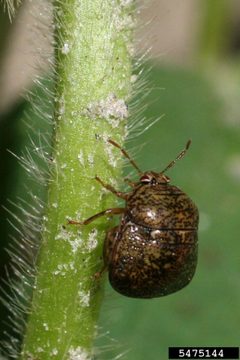
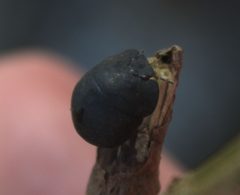
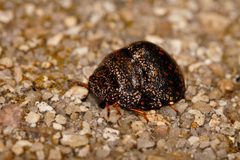
are distinguished from other shield bugs by their greatly enlarged, shield-like scutellum that typically covers the entire and wings, leaving only the and part of the exposed. The body is broadly oval to subcircular, often appearing flattened and shield-shaped. This extensive scutellar coverage separates them from Pentatomidae (stink bugs), where the scutellum is triangular and does not cover the wings. The mandibular plates are often broadly laminate and may overlap medially in some . Body size ranges from approximately 4–8 mm in most .
Images
Distribution
Native to the Old World, with primary distribution in tropical and subtropical regions of Asia, Africa, and Australia. Some of Coptosoma occur in temperate areas. The has been introduced to the Americas and Pacific islands through human activity: Megacopta cribraria was introduced to Georgia, USA in 2009 and has spread throughout the southeastern United States; Brachyplatys subaeneus has been introduced to Panama and Colombia; Coptosoma xanthogramma was introduced to Hawaii in 1965. In Europe, only the Coptosoma occurs, with C. scutellatum widely distributed and three Mediterranean species (C. sandahli, C. costale, C. mucronatum) having restricted ranges.
Diet
Phytophagous; feeding habits range from oligophagous to . Primary associations are with Fabaceae (legumes), including soybean and kudzu. Some feed on plants in multiple , and fungi feeding has been reported in some members. Megacopta cribraria feeds on kudzu (Pueraria montana), soybean (Glycine max), and other legumes, but has been observed on at least eight other plant families including Moraceae (fig, mulberry).
Behavior
Gregarious; often found in large . In Libyaspis, group at branch bases where larvae develop, using their protective pronotum and scutellum to block access by predatory ladybug larvae. Megacopta cribraria adults seek in autumn, aggregating on human-made structures and beneath loose bark or in plant debris. Defensive secretions are released when disturbed or crushed, producing a strong odor and potentially causing skin irritation or staining.
Ecological Role
Herbivores that impact plant through feeding on vascular plants. In their native range, they serve as for specialized including Paratelenomus saccharalis, Ooencyrtus nezarae, and Dirphys boswelli. Megacopta cribraria has become prey for in its introduced North American range, including the Florida predatory stink bug (Euthyrhynchus floridanus). Some members harbor symbiotic microorganisms in their digestive tract, with specific bacterial associations for each host .
Human Relevance
Megacopta cribraria is a significant agricultural pest of soybean in the southeastern United States, capable of causing up to 60% yield loss through piercing-sucking feeding that reduces seed number and weight. The is also a nuisance pest due to autumn on buildings and defensive secretions that stain surfaces and irritate skin. Brachyplatys subaeneus is a crop pest in southern China. Some species have been investigated for of kudzu, though effectiveness is limited by their mobility between plants.
Similar Taxa
- PentatomidaeBoth are shield-shaped Heteroptera, but have a greatly enlarged scutellum covering the entire and wings, versus the triangular scutellum exposing most of the abdomen in Pentatomidae.
- ScutelleridaeBoth have enlarged scutella covering the , but Scutelleridae (jewel bugs) typically have a more rounded, convex, often metallic body, while are flatter and less convex with different body proportions.
Sources and further reading
- BugGuide
- Wikipedia
- GBIF taxonomy match
- iNaturalist taxon
- NCBI Taxonomy
- Another Natural Enemy of Invasive Kudzu Bug Arrives in North America
- For Kudzu Bugs, a Single Pesticide Application Targeting Nymphs is Most Cost-Effective
- From the mailbag: Fig-eating Kudzu bugs come to college, Megacopta cribraria — Bug of the Week
- Free Online Resource for Soybean Growers to Manage Kudzu Bugs
- Bugs in Orange and Black, Part II: A spooky southern predator heads north in a warming world – Florida predatory stink bug, Euthyrhynchus floridanus — Bug of the Week
- A revision of the genus Hemitrochostoma (Hemiptera, Heteroptera, Plataspidae)
- Host plant resistance in soybean for pest management ofMegacopta cribraria(Hemiptera: Plataspidae)
- The identity of the Brachyplatys species recently introduced to Panama, with a review of bionomics (Hemiptera: Heteroptera: Plataspidae)
- Two newly introduced Heteroptera (Insecta: Hemiptera) species in Colombia: Brachyplatys subaenus (Plataspidae) and Thaumastocoris peregrinus (Thaumastocoridae)
- Seasonal Occurrence and Interspecific Interactions of Egg Parasitoids of Megacopta cribraria (Heteroptera: Plataspidae) in Japan
- Ecology and Management of Kudzu Bug (Hemiptera: Plataspidae) in Southeastern Soybeans
- Dirphys boswelli(Hymenoptera: Aphelinidae) an egg-parasitoid of Plataspidae (Heteroptera)
- Host Preference of Megacopta cribraria (Hemiptera: Plataspidae) on Selected Edible Beans and Soybean
- Biopesticide and Parasitoid Effects on Megacopta cribraria (Hemiptera: Plataspidae) Life Stage Density and Egg Parasitism in Soybean
- Efficacy of Aqueous Aegle marmelos Leaf Extract for the Control of Megacopta cribraria (F.) (Hemiptera: Plataspidae)
- Attraction ofParatelenomus saccharalis(Hymenoptera: Platygastridae), an Egg Parasitoid ofMegacopta cribraria(Hemiptera: Plataspidae), to Host-Associated Olfactory Cues
- Electronic Monitoring of the Feeding Behavior of Blissidae, Coreidae, Miridae, and Plataspidae
- First Record of Ooencyrtus nezarae (Hymenoptera: Encyrtidae), a Parasitoid of Megacopta cribraria (Hemiptera: Plataspidae) in Florida