
Brachyplatys subaeneus
(Westwood, 1837)
black bean bug
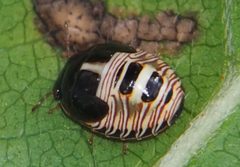
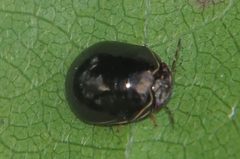
Brachyplatys subaeneus, commonly known as the black bean bug, is a shield bug in the Plataspidae native to Asia. It has established in the Western Hemisphere, first detected in Panama in 2012 and subsequently reported from Rica, the Dominican Republic, Ecuador, Mexico, and Florida (USA). The is a significant agricultural pest with a strong preference for legume crops, though it feeds on multiple plant families. Genetic studies have identified three distinct lineages within its native range and traced invasive populations to specific source regions.
Pronunciation
How to pronounce Brachyplatys subaeneus: //ˌbrækɪˈpleɪtɪs səˈbiːniəs//
These audio files are automatically generated. While they are not always 100% accurate, they are a good starting point.
Identification
Diagnostic characters of B. subaeneus include features of the syntype specimens as illustrated in taxonomic revisions. The was historically misidentified as B. vahlii in early reports from Panama, requiring careful examination of syntype material for correct identification. Distinctive traits separating it from involve specific morphological features of the shield-shaped body typical of Plataspidae.
Images
Habitat
Tropical and subtropical regions; associated with agricultural and natural environments supporting plants. Aggregates on stems and petioles under leaves of host plants.
Distribution
Native range extends across Asia from India eastward to Japan and throughout Southeast Asia. established in Panama (2012), Rica, Dominican Republic, Ecuador, Mexico, and Florida, USA (2020). modeling indicates potential for further expansion into northern and central South America.
Diet
Feeds on plant fluids extracted from vascular tissues of plants. Shows clear preference for Fabaceae (legumes) including common beans (Phaseolus spp.), cowpeas (Vigna spp.), soybean (Glycine max), and pigeon pea (Cajanus cajan). Also reported to damage crop plants in other including corn, hemp, sweet potato, potato, sugarcane, and rice.
Host Associations
- Phaseolus spp. - pestcommon beans
- Vigna spp. - pestcowpeas
- Glycine max - pestsoybean
- Cajanus cajan - pestpigeon pea
- Zea mays - pestcorn
- Cannabis sativa - pesthemp
- Ipomoea batatas - pestsweet potato
- Solanum tuberosum - pestpotato
- Saccharum officinarum - pestsugarcane
- Oryza sativa - pestrice
Life Cycle
Females produce 300–400 laid over several months. Eggs are deposited in hidden locations on or near plants. Development includes nymphal stages prior to adulthood.
Behavior
Nymphs and aggregate on stems or petioles under leaves. Adults and nymphs feed together in groups on plant tissues.
Human Relevance
Significant agricultural pest threatening legume crops of major economic importance. Potential economic consequences of spread considered substantial due to wide range and value of affected crops. in the Americas pose serious threat to local legume production. Subject of genetic monitoring and pest management research.
Similar Taxa
- Brachyplatys vahliiHistorically misidentified as B. vahlii in early reports from Panama; requires examination of syntype material and diagnostic characters for correct separation
More Details
Genetic structure
Native comprise three geographic lineages (NO, PH, SO) with strong genetic differentiation. Panama populations derived from NO lineage.
Invasion history
First Western Hemisphere record in 2012 (Panama), initially misidentified as B. vahlii. Subsequent verified reports from multiple countries indicate ongoing range expansion.
Sources and further reading
- BugGuide
- Wikipedia
- GBIF taxonomy match
- iNaturalist taxon
- NCBI Taxonomy
- The current distribution of Brachyplatys subaeneus 1 in Mexico
- Native genetic structure of black bean bug Brachyplatys subaeneus: Implications for pest management
- The identity of the Brachyplatys species recently introduced to Panama, with a review of bionomics (Hemiptera: Heteroptera: Plataspidae)